The United States men’s national soccer team, globally and culturally recognized as the Stars and Stripes or the Yanks, represents the foundational economic and organizational locomotive of the CONCACAF region. Blessed with state-of-the-art sports science infrastructure, immense athletic scouting depth, and a generation of technical talent fully embedded across Europe’s premier domestic leagues, the United States has successfully evolved past its historical tag as a developing soccer nation.
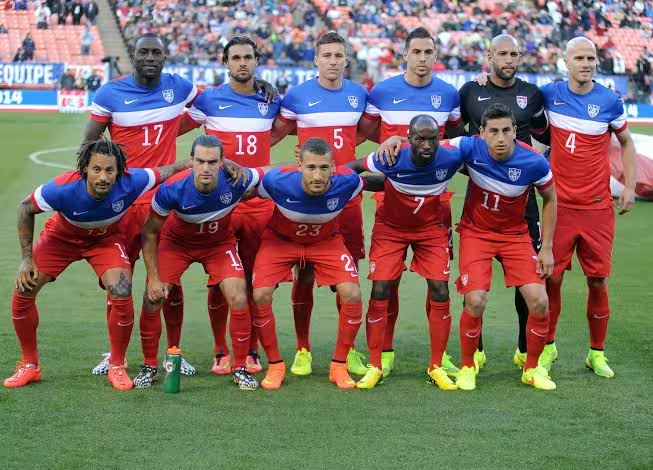
Following their entry into the 2026 FIFA World Cup, the United States operates under monumental, unprecedented sporting pressure. Sharing co-hosting responsibilities alongside their regional neighbors Mexico and Canada, the Stars and Stripes enjoy massive home-field advantages at high-profile venues like Los Angeles’s SoFi Stadium and New York’s MetLife Stadium. This comprehensive, professional review breaks down the structural design of the active 2026 roster, historical milestones, individual records, and up-to-date tournament data.
Brief History and Core Continental Achievements
While soccer spent decades navigating a crowded domestic sports landscape, the United States holds a fascinating position as a global pioneer, having finished in third place at the inaugural 1930 FIFA World Cup in Uruguay—which stands as the highest tournament placement ever achieved by an active CONCACAF nation.
Modern Continental Supremacy
Following their qualification breakthrough for the 1990 tournament, the United States established an era of fierce regional dominance. The nation has captured 7 CONCACAF Gold Cup titles alongside a historic, unbroken three-peat in the CONCACAF Nations League Finals (2021, 2023, and 2024). Their historic modern standard was set during the 2002 FIFA World Cup, where an explosive young team famously defeated arch-rivals Mexico in the Round of 16 to march into the Quarter-finals, establishing an elite benchmark for the modern soccer landscape.
Technical Roster Breakdown (2026 Campaign)
Under disciplined, high-intensity tactical management, the modern American squad functions inside a fluid 4-3-3 or a highly structured 4-2-3-1 archetype. The system places a supreme premium on extreme physical stamina, intense counter-pressing traps in the middle third, and explosive vertical wide counters triggered by elite inverted wingers.
1. Goalkeepers
The American goalmouth continues its historic tradition of relying on exceptional physical length, elite cross-claiming metrics, and commanding penalty box communication.
- Matt Turner (#1): The active first-choice starting goalkeeper. Turner brings world-class close-range reflexes, exceptional penalty-saving instincts, and extensive tournament experience.
- Patrick Schulte (#12): A highly talented, modern ball-playing goalkeeper who provides elite starting-caliber backup depth from the bench.
- Ethan Horvath (#22): A vastly experienced, cold-blooded shot-stopper finalizing an exceptionally deep goalkeeping department.
2. Defenders
The defensive line balances ball-carrying center-backs who possess the composure to distribute out of heavy pressure with rapid fullbacks who push high up the pitch to dictate attacking width.
- Antonee Robinson (#3): The undisputed first-choice left-back. Known as “Jedi,” Robinson provides world-class acceleration, elite vertical crossing lines, and relentless recovery tracking.
- Chris Richards (#4) & Tim Ream (#13): The preferred central defensive pairing, offering an exceptional mixture of physical height, high-volume clearance metrics, and left-right footed passing symmetry.
- Joe Scally (#2) & Sergiño Dest (#18): Incredibly dynamic, attack-minded right-backs responsible for executing overlapping combinations and cutting inside to generate overloads.
- Miles Robinson (#15) & Cameron Carter-Vickers (#5): Physically robust, high-speed central defenders deployed to track elite opposition forwards across open space.
- Kristoffer Lund (#14): A highly disciplined wide defensive piece utilized to maintain strict structural containment on the lateral flanks.
3. Midfielders
The midfield functions as the absolute tactical engine room, meticulously balancing intense defensive shielding with creative, line-breaking passing sequences.
- Weston McKennie (#8): The tireless box-to-box engine and emotional heartbeat of the team. McKennie provides world-class aerial threat on offensive set-pieces, robust ball-winning metrics, and late-arriving box entries.
- Tyler Adams (#4): The primary defensive shield and structural hub. When fully fit, Adams excels at aggressively choking out opposition central counter-attacks and directing lateral coverage.
- Yunus Musah (#6): A world-class progressive ball-carrier possessing exceptional press-resistance, close-control dribbling, and physical driving lines out of high-pressure zones.
- Malik Tillman (#10) & Giovanni Reyna (#7): Elite creative playmakers tasked with operating in the half-spaces between opposition lines to unlock deep blocks.
- Johnny Cardoso (#17) & Luca de la Torre (#14): High-work-rate central assets deployed to plug passing lanes and sustain pressing densities in the middle third.
4. Forwards
The frontline provides a devastating combination of clinical final-third finishing, intricate inside-cutting movements, and world-class 1v1 wing isolation dominance.
- Christian Pulisic (#10): The captain, undisputed superstar icon, and talismanic leader. Operating from the left flank, Pulisic utilizes explosive acceleration, world-class dribbling flair, and clinical final-third execution to completely dismantle opposition backlines.
- Folarin Balogun (#9): The premier central striker leading the attack. Balogun offers elite off-the-ball movement, exceptional situational IQ, and highly clinical finishing with both feet inside the box.
- Timothy Weah (#21) & Haji Wright (#11): Exceptionally fast, direct wide options deployed to stretch opposing fullbacks and exploit vertical space behind high lines.
- Ricardo Pepi (#19) & Josh Sargent (#20): Physically imposing central target strikers chosen to lead the front-line press and convert aerial crosses.
- Brenden Aaronson (#11): A high-intensity pressing forward utilized to inject relentless defensive work rates into the final third late in matches.
FIFA World Cup Performance Statistics
The statistical resume of the United States highlights an international program that stands as one of the most regular global tournament competitors outside of Europe and South America, amassing 12 total appearances.
World Cup Tournament History Dashboard
The table below logs the absolute statistical metrics of the United States across their complete historical FIFA World Cup final appearances:
| World Cup Era | Tournaments | Overall Record (W-D-L) | Goals (GF-GA) | Final Tournament Milestone / Result |
|---|---|---|---|---|
| 1930 | 1 | 2-0-1 | 7-6 | Third-Place Finish (Highest CONCACAF Mark) |
| 1934–1950 | 2 | 1-0-3 | 6-19 | Group Stage Exit (Defeated England 1-0 in 1950) |
| 1990–1998 | 3 | 1-1-7 | 7-19 | Round of 16 (1994 as Hosts), 2x Group Exits |
| 2002 | 1 | 2-1-2 | 7-7 | Quarter-finals (5th Place Overall) |
| 2006–2014 | 3 | 2-4-5 | 13-18 | 2x Round of 16 Exits (2010, 2014), 1x Group Exit |
| 2022 | 1 | 1-2-1 | 3-4 | Round of 16 Exit |
| 2026 | 1 (Active) | 1-1-0 | 3-1 | Group Stage Performance (Tournament Active) |
| Historical Totals | 12 Tournaments | 17-19-23 | 66-90 | Highest Placement: 3rd Place (1930) |
The Active 2026 World Cup Campaign
As co-hosts, the United States bypassed the grueling CONCACAF qualification cycles, utilizing elite international friendlies and high-stakes continental tournaments to hone their structural discipline. Competing on home soil before ecstatic home crowds, the Stars and Stripes have enjoyed a highly competitive opening sequence.
- The Group Opener: The United States kicked off their tournament campaign in spectacular fashion, grinding out a high-intensity 2-1 victory to secure an ideal three points.
- The Second Matchday: In their second group stage fixture, the squad displayed intense physical resilience, battling through a highly tactical 1-1 draw to position themselves in prime position to comfortably secure safe passage into the expanded Round of 32 knockout stages.
Legendary Individual Records and Milestones
The history of American soccer is written by pioneering global legends and dedicated tournament veterans who established the absolute highest standards for North American international sports.
All-Time Cap and Scoring Leaderboards
The tables below document the historical all-time record holders for senior international appearances and goals scored for the United States men’s national team:
| Rank | Most Capped Players | Total International Caps | Career Era | Goals Scored |
|---|---|---|---|---|
| 1 | Cobi Jones | 164 | 1992–2004 | 15 |
| 2 | Landon Donovan | 157 | 2000–2014 | 57 |
| 3 | Michael Bradley | 151 | 2006–2019 | 17 |
| 4 | Clint Dempsey | 141 | 2004–2017 | 57 |
| 5 | Jeff Agoos | 134 | 1988–2003 | 4 |
| Rank | All-Time Top Goalscorers | Goals Scored | Matches Played | World Cup Goals |
|---|---|---|---|---|
| 1 | Landon Donovan | 57 | 157 | 5 (National Record) |
| 2 | Clint Dempsey | 57 | 141 | 4 |
| 3 | Jozy Altidore | 42 | 115 | 0 |
| 4 | Christian Pulisic | 31 | 76 | 2 |
| 5 | Eric Wynalda | 34 | 106 | 1 |
Elite Individual Benchmarks
- The Shared Scoring Crown: Attacking legends Landon Donovan and Clint Dempsey remain locked in an absolute tie at the apex of the all-time scoring charts with 57 international goals each, with Donovan holding the record for the most World Cup finals goals (5).
- The Active Ascency: Captain Christian Pulisic enters the 2026 matches as the leading active goalscorer with 31 international goals in just 76 caps, maintaining a world-class scoring ratio that positions him to eventually challenge the long-standing benchmarks at the top of the chart.
Tactical Identity: High-Intensity Press and Transverse Width
The contemporary tactical blueprint of the Stars and Stripes operates primarily out of a highly flexible, explosive 4-3-3 matrix. The core philosophy centers on absolute mid-block compression. Out of possession, Weston McKennie and Tyler Adams lead synchronized trapping triggers to choke out central progressive lanes, aggressively forcing opposition distributions outward toward the touchlines.
Once a turnover is secured, the United States transitions with terrifying vertical speed. Deep pivots immediately skip midfield lines, looking to feed quick vertical balls into wide channels. This movement unleashes Christian Pulisic to manipulate isolated defenders in 1v1 situations, while rapid fullbacks like Antonee Robinson make high-speed overlapping runs to deliver high-volume horizontal crosses into the box, transforming deep defensive containment into surgical final-third execution inside a matter of single-digit seconds.
Conclusion
The United States men’s national soccer team stands as a magnificent testament to long-term structural organization, elite athletic pace, and tactical maturity. Their highly disciplined performances at the 2026 World Cup showcase an international program fully prepared to leverage home-soil energy to challenge the traditional hierarchies of the global game. As Christian Pulisic orchestrates transitions and a modern midfield engine room dictates pressing densities under intense national expectation, the Stars and Stripes possess every structural asset necessary to write a historic chapter on the global stage.