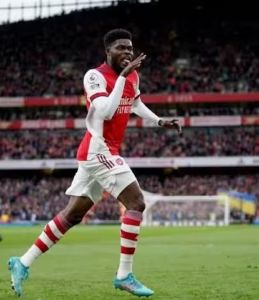
The Ghana national football team, globally celebrated as the Black Stars, represents one of the most culturally iconic and historically successful football programs on the African continent. Managed by the experienced tactician Carlos Queiroz, Ghana is renowned for a footballing identity built on explosive athleticism, a rich pool of technical flair, and a relentless, fearless team spirit when matching up against global superpowers.
As a multiple-time continental champion and a highly respected competitor on the global stage, Ghana enters the 2026 FIFA World Cup as a dangerous dark-horse contender. Bolstered by an elite mix of European league veterans and a fresh wave of rapid young forwards, the Black Stars remain an unpredictable and formidable challenge. This comprehensive, professional profile examines the structural configuration of Ghana’s active 2026 roster, their foundational history, individual records, and their active campaign in North America.
Brief History and Core Continental Achievements
While the Ghana Football Association was founded in 1950, the country truly established its golden footprint during the 1963–1982 eras. The Black Stars rapidly grew into a continental superpower, capturing four Africa Cup of Nations (AFCON) titles (1963, 1965, 1978, and 1982). They also finished as continental runners-up five times, building a legacy that commands immense institutional respect across the global football community.
The World Cup Breakthrough
Ghana made their long-awaited debut on the global stage at the 2006 FIFA World Cup in Germany, instantly turning heads by advancing from a brutal group stage over the Czech Republic and United States. Four years later, at the 2010 FIFA World Cup in South Africa, the Black Stars captured global hearts. They marched dramatically to the Quarter-finals, coming within a penalty kick of becoming the first African nation to reach a World Cup Semi-final, establishing a modern standard of excellence for African sports.
Technical Roster Breakdown (2026 Campaign)
Under the rigid, highly organized defensive philosophy of head coach Carlos Queiroz, Ghana sets up inside a compact, ultra-disciplined 5-4-1 or 4-3-3 shape. The system relies heavily on a deeply entrenched low block that chokes passing lanes before hitting opponents on rapid counter-attacks.
1. Goalkeepers
The Ghanaian goal area relies on exceptional positional awareness, elite reflex-stopping, and vocal coordination from deep in the penalty box.
- Benjamin Asare (#16): The active starting goalkeeper at the 2026 finals. Asare has earned widespread international praise for his exceptional handling and positional calmness under intense tournament pressure.
- Lawrence Ati Zigi (#1): A vastly experienced, highly energetic keeper who provides elite starting-caliber depth from the bench.
- Joseph Anang (#12): A sharp, high-reflex backup shot-stopper finalizing the team’s strong goalkeeping department.
2. Defenders
Queiroz’s backline is engineered for ultimate defensive containment, combining extreme physical resilience with sharp positional anticipation.
- Jerome Opoku (#18) & Jonas Adjetey (#4): The foundational center-back pairing, offering imposing height, superb clearance numbers, and clean tackle execution.
- Gideon Mensah (#14) & Marvin Senaya (#26): Highly disciplined, tireless wide fullbacks responsible for shutting down wing isolation attempts and executing recovery tracking.
- Abdul Mumin (#6) & Abdul Rahman Baba (#17): Experienced, tactically sound defenders providing elite depth across both central and lateral spaces.
- Derrick Luckassen (#23) & Kojo Peprah Oppong (#21): Heavy-tackling, physical defensive utility options deployed to lock down games late in the second half.
3. Midfielders
The midfield functions as a hard-pressing unit, meticulously designed to absorb central overloads and recycle possession efficiently.
- Thomas Partey (#5): The vice-captain, primary deep shield, and tactical heartbeat of the team. Partey acts as the vital line-breaking links between low-block sequences and forward triggers.
- Kwasi Sibo (#8) & Caleb Yirenkyi (#3): Energetic, ball-winning engine rooms who provide relentless lateral coverage to plug central passing lines.
- Antoine Semenyo (#11): A highly dynamic, powerful modern player who transitions seamlessly between midfield ball-retention and direct forward positions.
- Elisha Owusu (#15) & Augustine Boakye (#20): High-work-rate tactical options utilized to sustain defensive pressing intensities.
4. Forwards
The frontline balances elite veteran experience with blistering transitional speed to exploit high opposition backlines.
- Jordan Ayew (#9): The captain, most-experienced talisman, and an essential leader who controls the attacking tempo.
- Iñaki Williams (#19): A lethal inside-forward providing elite physical hold-up capabilities and continuous off-the-ball vertical threat.
- Abdul Fatawu (#7) & Ernest Nuamah (#24): Exceptionally fast, creative wingers deployed to isolate fullbacks in wide spaces.
- Prince Kwabena Adu (#25) & Kamaldeen Sulemana (#22): Blistering transitional wildcards used to stretch fatigued opposing backlines on the counter-attack.
- Brandon Thomas-Asante (#10) & Christopher Bonsu Baah (#13): Versatile, high-intensity forward variants completing a dynamic attacking unit.
FIFA World Cup Performance Statistics
Ghana's statistical resume at the FIFA World Cup places them among the most consistent African representatives in tournament history.
World Cup Tournament History Dashboard
The table below logs Ghana’s absolute performance metrics across their completed and active FIFA World Cup final appearances:
| World Cup Edition | Overall Record (W-D-L) | Goals (GF-GA) | Final Tournament Milestone / Result |
|---|---|---|---|
| 2006 | 2-0-2 | 4-6 | Round of 16 (World Cup Debut) |
| 2010 | 2-2-1 | 5-4 | Quarter-finals (5th Place Overall) |
| 2014 | 0-1-2 | 4-6 | Group Stage Exit |
| 2022 | 1-0-2 | 5-7 | Group Stage Exit |
| 2026 | 1-1-0 (Active) | 1-0 | Group Stage Performance |
| Historical Totals | 6-4-7 | 23-23 | Highest Placement: Quarter-finals (2010) |
The Active 2026 World Cup Campaign
Ghana dominated a highly competitive CAF qualification group to secure their fifth ticket to the World Cup finals. Competing in a deeply tactical Group L in North America, the Black Stars have delivered a defensive masterclass.
- The Panama Opener: Ghana kicked off their campaign on June 17, 2026, in Toronto, grinding down a stubborn Panama side to secure a vital 1-0 victory, establishing an ideal start to the tournament.
- The England Stalemate: On June 23, 2026, in Boston, Carlos Queiroz implemented a masterful defensive low block against tournament favorites England. Despite conceding 78% possession and enduring 19 shots, Ghana’s bravery, fighting spirit, and tactical discipline completely frustrated the English attack. Backed by three crucial saves from Benjamin Asare, Ghana held on for a historic 0-0 draw.
With 4 points accumulated and zero goals conceded, Ghana sits comfortably in prime position to advance to the Round of 32 knockout stages ahead of their final group stage showdown against Croatia.
Legendary Individual Records and Milestones
The history of the Black Stars is built upon iconic goalscorers and dedicated veterans who established elite individual benchmarks.
All-Time Cap and Scoring Leaderboards
The tables below document the historical all-time record holders for senior international appearances and goals scored for the Ghanaian men’s national team:
| Rank | Most Capped Players | Total Caps / Appearances | Career Era | Goals Scored |
|---|---|---|---|---|
| 1 | André Ayew | 120 | 2007–2024 | 24 |
| 2 | Jordan Ayew | 119 | 2010–Present | 28 |
| 3 | Asamoah Gyan | 109 | 2003–2019 | 51 |
| 4 | Richard Kingson | 93 | 1996–2011 | 1 |
| 5 | John Paintsil | 89 | 2001–2013 | 0 |
| Rank | All-Time Top Goalscorers | Goals Scored | Matches Played | World Cup Goals |
|---|---|---|---|---|
| 1 | Asamoah Gyan | 51 | 109 | 6 (African Record) |
| 2 | Edward Acquah | 45 | 41 | 0 |
| 3 | Kwasi Owusu | 36 | 45 | 0 |
| 4 | Karim Abdul Razak | 25 | 70 | 0 |
| 5 | Jordan Ayew | 28 | 119 | 2 |
Elite Individual Records
- The Absolute African Record: Striker Asamoah Gyan remains the all-time leading African goalscorer in FIFA World Cup history, having scored 6 goals across the 2006, 2010, and 2014 editions.
- The Ayew Longevity: Captain Jordan Ayew enters the June 2026 matches with 119 international caps, placing him just one appearance away from tying his brother André Ayew as the most-capped player in the history of Ghanaian football.
Tactical Identity: The Queiroz Blueprint
Under Carlos Queiroz, Ghana has developed an incredibly disciplined and structured defensive identity. They drop into a deep, compact 5-4-1 mid-to-low block designed to squeeze out space between the defensive lines, rendering central progression almost impossible for opponents.
Out of possession, Thomas Partey screens the central defenders, directing teammates to compress the shape and force opposition attacks wide. Once a turnover is forced, Ghana transitions with lethal vertical speed. The team bypasses midfield lines entirely, hitting the flanks to utilize the blistering speed of Antoine Semenyo and wingers like Abdul Fatawu, transforming defensive containment into dangerous attacking counter-sequences inside a matter of seconds.
Conclusion
The Ghana national football team represents a magnificent blend of historic continental prestige and modern tactical transformation. Their flawless defensive statistics at the 2026 World Cup highlight a team perfectly engineered to navigate the extreme requirements of knockout tournament football. As Jordan Ayew approaches legendary appearance milestones under the elite guidance of Carlos Queiroz, the Black Stars continue to prove that their defensive organization, brave team ethics, and rapid transitions belong among the very best in international football.