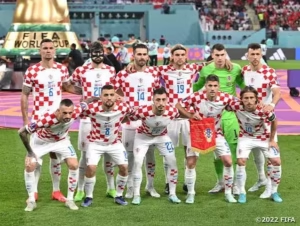
The Canada men’s national soccer team, distinctively known on the international sporting landscape as Les Rouges (The Reds), represents one of the most explosive, rapidly ascending programs in modern global football. Historically viewed as a minor player in a sports market dominated by traditional North American disciplines, Canada has systematically engineered a massive revolution over the past decade to shatter regional glass ceilings.
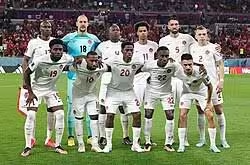
Following a highly competitive preliminary cycle, Canada enters the 2026 FIFA World Cup as a focal point of global sporting attention. Sharing co-hosting responsibilities alongside the United States and Mexico, Les Rouges enjoy unprecedented home-field advantages at high-profile venues like Toronto’s BMO Field and Vancouver’s BC Place. This comprehensive profile breaks down the structural design of the active senior roster, foundational history, individual records, and up-to-date tournament data.
Brief History and Core Continental Achievements
While the Canadian Soccer Association was founded in 1912, the country spent decades attempting to translate its vast grassroots participation metrics into international consistency. Their foundational breakthrough arrived when they captured the 1985 CONCACAF Championship, earning their historic, maiden voyage to the global stage the following summer.
The Modern Golden Era
Canada proved their elite regional pedigree by winning the 2000 CONCACAF Gold Cup, executing a legendary knockout run to stun the regional establishment. Following a subsequent period of structural rebuilding, Canada initiated a spectacular modern golden era in the early 2020s. Under tactical systems designed to unlock world-class technical pace, Les Rouges shocked the hemisphere by finishing in first place in the final round of CONCACAF qualification for the 2022 World Cup, outranking both Mexico and the United States to firmly cement their position as a modern powerhouse in North American soccer.
Technical Roster Breakdown (2026 Campaign)
Under highly structured tactical management, the modern Canadian squad functions inside a fluid 3-4-2-1 or an aggressive, high-pressing 4-3-3 formation. The system places a supreme premium on extreme physical pace, vertical width from wing-backs, and a high-intensity counter-press designed to trap opponents in their own defensive third.
1. Goalkeepers
The Canadian goal area focuses on reliable shot-stopping consistency, vocal box organization, and highly accurate long-range distribution out of the back.
- Maxime Crépeau (#1): The active first-choice starting goalkeeper. Crépeau brings exceptional short-range reflexes, immense mental composure under heavy tournament pressure, and superior distribution metrics.
- Dayne St. Clair (#16): An incredibly agile, athletic shot-stopper who provides elite, starting-caliber backup depth from the bench.
- Tom McGill (#22): A highly capable young goalkeeper providing secure depth to the senior goalkeeping department.
2. Defenders
The defensive line balances physically imposing central markers with rapid fullbacks who possess the recovery speed to operate in aggressive high-line structures.
- Alistair Johnston (#2): A robust, tactically disciplined defender who operates seamlessly as a right-sided center-back in a back three or an orthodox right-back.
- Kamal Miller (#3) & Derek Cornelius (#13): The preferred central defensive pairing, providing exceptional physical aerial presence, clean tackling metrics, and strong left-footed passing balance.
- Moïse Bombito (#15) & Joel Waterman (#4): High-speed modern central defenders capable of tracking elite opposition forwards across open spaces.
- Richie Laryea (#22): A highly energetic fullback providing relentless two-way work rates, aggressive wide dribbling, and versatile defensive cover on both flanks.
- Sam Adekugbe (#5) & Luc de Fougerolles (#6): Tactically sound wide defensive pieces utilized to maintain strict structural containment against explosive opposing wingers.
3. Midfielders
The midfield functions as a high-work-rate engine room, meticulously balancing intense possession recycling with rapid, direct progressive entries into the final third.
- Alphonso Davies (#19): The captain, undisputed world-class talisman, and structural heartbeat of the team. Davies operates anywhere from a left wing-back to a dynamic free-roaming forward, utilizing world-class acceleration and elite dribbling to completely unbalance opposing systems.
- Stephen Eustáquio (#7): The midfield maestro and active vice-captain. Eustáquio acts as the primary deep-lying pivot, orchestrating team tempos, dictating possession lines, and executing precise dead-ball set-pieces.
- Ismaël Koné (#8): A highly dynamic, technical box-to-box midfielder possessing exceptional press-resistance, close-control dribbling, and progressive physical driving lines.
- Jonathan Osorio (#21) & Samuel Piette (#6): Vastly experienced, highly disciplined central midfielders deployed to plug passing lanes and stabilize structural transitions.
- Jacob Shaffelburg (#14) & Ali Ahmed (#20): High-energy, explosive wide assets utilized to inject direct vertical running lines against fatigued opposition blocks.
4. Forwards
The frontline provides a devastating combination of clinical, world-class final-third finishing, intricate link play, and intense front-line pressing metrics.
- Jonathan David (#9): The premier central striker leading the attack. David offers elite off-the-ball movement, exceptional footballing IQ, and clinical, two-footed finishing inside the penalty area.
- Cyle Larin (#17): A physically dominant forward who provides excellent hold-up play, aerial box presence, and a proven history of clutch international goals.
- Tajon Buchanan (#11): An exceptionally fast inside-forward who thrives when aggressively isolating fullbacks in 1v1 situations in the final third.
- Theo Bair (#10) & Jacen Russell-Rowe (#18): Physically robust central attacking variants utilized to wear down opposition center-backs late in matches.
FIFA World Cup Performance Statistics
Canada's statistical resume highlights a program rapidly translating its modern continental dominance into competitive execution on the absolute grandest global stage.
World Cup Tournament History Dashboard
The table below logs Canada’s absolute performance metrics across their historical FIFA World Cup final appearances:
| World Cup Edition [1] | Host Country / Nations | Overall Record (W-D-L) | Goals (GF-GA) | Final Tournament Milestone / Result |
|---|---|---|---|---|
| 1986 | Mexico | 0-0-3 | 0-5 | Group Stage Exit (World Cup Debut) |
| 2022 | Qatar | 0-0-3 | 2-7 | Group Stage Exit (First-Ever Goals Scored) |
| 2026 | Canada, USA, Mexico | 1-1-0 (Active) | 3-1 | Group Stage Performance |
| Historical Totals | 3 Tournaments Entered | 1-1-6 | 5-13 | First Points and Wins Secured in 2026 |
The Active 2026 World Cup Campaign
As co-hosts, Canada bypassed the grueling CONCACAF qualification cycles, utilizing elite international friendlies and competitive continental tournaments to hone their structural discipline. Competing on home soil before ecstatic home crowds, Les Rouges have written historic pages for the sport within the country.
- The Historic Group Opener: Canada kicked off their tournament campaign in spectacular fashion, grinding out a high-intensity 1-0 victory to secure the nation’s first-ever win and clean sheet in World Cup history.
- The Second Matchday: In their second group fixture, Canada displayed intense physical resilience, playing out a highly tactical 2-1 victory to put themselves in prime position to safely secure safe passage into the expanded Round of 32 knockout stages.
Legendary Individual Records and Milestones
The history of Canadian soccer is built upon modern trailblazers and dedicated international veterans who set the standard for future generations.
All-Time Cap and Scoring Leaderboards
The tables below document the historical all-time record holders for senior international appearances and goals scored for the Canadian men’s national team:
| Rank | Most Capped Players | Total International Caps | Career Era | Goals Scored |
|---|---|---|---|---|
| 1 | Atiba Hutchinson | 104 | 2003–2023 | 9 |
| 2 | Julian de Guzman | 89 | 2002–2016 | 4 |
| 3 | Paul Stalteri | 84 | 1997–2010 | 7 |
| 4 | Randy Samuel | 82 | 1983–1997 | 0 |
| 5 | Jonathan Osorio | 81 | 2013–Present | 9 |
| Rank | All-Time Top Goalscorers | Goals Scored | Matches Played | World Cup Goals |
|---|---|---|---|---|
| 1 | Jonathan David | 31 | 58 | 1 |
| 2 | Cyle Larin | 30 | 71 | 0 |
| 3 | Dwayne De Rosario | 22 | 81 | 0 |
| 4 | Alphonso Davies | 16 | 56 | 1 (First-Ever World Cup Goal) |
| 5 | John Catliff | 15 | 44 | 0 |
Elite Individual Records
- The First Historical Goal: Talismanic winger Alphonso Davies holds an immortal position in national sports folklore, scoring Canada’s first-ever FIFA World Cup goal via a powerful header against Croatia during the 2022 tournament in Qatar.
- The Scoring Chart Race: Forward Jonathan David and strike partner Cyle Larin remain locked in an elite, head-to-head race at the apex of Canada’s all-time scoring leaderboards, continuously extending their historic benchmarks well past previous records.
Tactical Identity: High-Intensity Transition
The modern tactical blueprint of Les Rouges operates primarily out of a highly flexible, asymmetric 3-4-2-1 formation. The core philosophy centers on absolute verticality. Rather than indulging in prolonged, static possession sequences in the middle third, Canada seeks to create central overloads via Stephen Eustáquio before releasing their rapid wide weapons.
Out of possession, Canada implements an aggressive, coordinated front-line press. Jonathan David and Tajon Buchanan lead the tracking to cut off central passing lanes, forcing opposition distributions outward toward the touchlines. Once a turnover is forced, Canada transitions with terrifying speed. Alphonso Davies uses his world-class acceleration to stretch backlines, allowing inside playmakers to feed vertical balls directly into the box, transforming defensive containment into lethal final-third execution inside a matter of single-digit seconds.
Conclusion
The Canada men’s national soccer team represents a magnificent blend of historic breakthrough energy, elite athletic pace, and tactical maturity. Their historic performances at the 2026 World Cup showcase a program fully prepared to leverage home-soil advantage to challenge the traditional hierarchies of the global game. As Alphonso Davies orchestrates transitions and Jonathan David provides clinical final-third execution, Les Rouges possess all the technical parameters, structural cohesion, and competitive drive necessary to cement their status among the rising elite of international soccer.