The Croatia national football team, fiercely known worldwide as the Vatreni (The Blazers), represents one of the most remarkable stories of sustained excellence in international football. Despite representing a nation with a population of under four million people, Croatia has established itself as an undeniable global superpower since gaining independence in 1991.
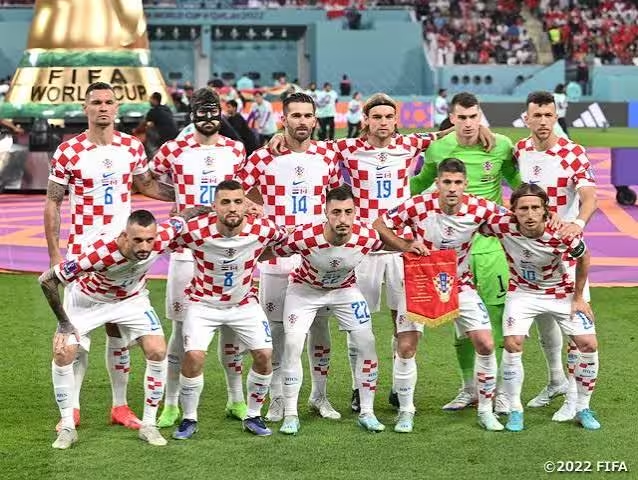
Characterized by a footballing identity centered on world-class midfield orchestration, extreme mental toughness, and a legendary record in extra-time and penalty shootouts, the Vatreni are a permanent fixture at the business end of major tournaments. Led by their timeless captain Luka Modrić and manager Zlatko Dalić, Croatia continues to defy generational transitions. This comprehensive review breaks down the structural components of the squad competing at the 2026 FIFA World Cup, their historic milestones, and their complete analytical profile.
Brief History and Extraordinary Golden Eras
Croatian football history is brief in years but exceptionally dense in historic achievements. Upon entering FIFA competition as an independent nation, Croatia stunned the sports world at their first-ever tournament during the 1998 FIFA World Cup in France, where a golden generation led by tournament top-scorer Davor Šuker marched to a historic third-place finish.
Twenty years later, the Vatreni surpassed that benchmark. At the 2018 FIFA World Cup in Russia, Croatia displayed unmatched resilience, winning three consecutive knockout matches via extra-time or penalty shootouts to reach their first-ever World Cup Final, ultimately earning the silver medal. They proved this was no fluke four years later, navigating a highly technical transition to secure another bronze medal at the 2022 FIFA World Cup in Qatar, solidifying their reputation as the ultimate tournament team.
Technical Roster Breakdown (2026 Campaign)
Under the long-serving management of Zlatko Dalić, the modern Croatian team strikes a calculated balance. The squad integrates a legendary, highly experienced midfield core with an incredibly talented generation of physically imposing, modern European defenders.
1. Goalkeepers
The Croatian goal is anchored by shot-stoppers, all renowned for their historic penalty-saving exploits, both internationally and locally. Here are the names of the team’s celebrated goalkeepers:
- Dominik Livaković (#1): The undisputed starting goalkeeper. His world-class reflexes and elite penalty-saving legacy remain the foundation of Croatia’s defensive stability.
- Dominik Kotarski (#12): A highly capable, modern distributor who provides elite backup security.
- Ivor Pandur (#23): A talented shot-stopper filling out the squad’s deep goalkeeping reserves.
2. Defenders
Croatia’s defensive line is characterized by modern physical archetypes, most who possess both elite tackling power and elite technical passing out of the back.
- Joško Gvardiol (#4): One of the world’s premier elite defenders. Combining blistering recovery speed with world-class ball-carrying skills, he anchors the left flank or central defense.
- Josip Šutalo (#6) & Marin Pongračić (#3): The preferred starting center-back pairing, providing physical aerial dominance and structural discipline.
- Josip Stanišić (#2): A tactically intelligent, reliable right-back who excels in standard defensive containment and crossing phases.
- Duje Ćaleta-Car (#5) & Martin Erlić (#25): Highly experienced, robust central backup options built for physical tournament battles.
- Luka Vušković (#22): The prodigiously talented teenage defender representing the absolute future of the Croatian backline.
3. Midfielders
The midfield is the crown jewel and absolute tactical engine room of Croatian football, combining unparalleled game-reading IQ with press-resistant ball retention.
- Luka Modrić (#10): The captain, greatest Croatian icon, and timeless talisman. Even at 40 years old, his vision, spatial management, and external-foot passing dictate the entire tempo of matches.
- Mateo Kovačić (#8): A world-class box-to-box engine, renowned as one of the most press-resistant ball-carriers in global football.
- Mario Pašalić (#15): A highly dangerous hybrid midfielder known for making clinical, late attacking runs into the opposition penalty area.
- Nikola Vlašić (#13) & Luka Sučić (#21): Creative, dynamic progressive links who operate expertly in pockets of space between opposition lines.
- Martin Baturina (#16) & Petar Sučić (#17): The highly energetic new wave of technical midfielders injected to sustain the team’s pressing intensity.
4. Forwards
The frontline functions on high-volume tactical pressing, direct vertical crossing targets, and aggressive aerial presence.
- Ivan Perišić (#14): The legendary wide forward, providing tireless two-way work rates, elite wing crosses, and a history of clutch international goals.
- Andrej Kramarić (#9): A highly intelligent, fluid forward who drifts across the front line to link midfield buildup with direct shooting actions.
- Ante Budimir (#11): A physically imposing, old-school target man chosen for his elite aerial hold-up play and clinical back-post positioning.
- Petar Musa (#26) & Igor Matanović (#20): High-energy central forward options utilized to wear down opposition central defenders.
FIFA World Cup Performance Statistics
Croatia’s statistics at the FIFA World Cup represent one of the most efficient medal-to-appearance ratios in modern football history, yielding three medals across their first six tournament appearances.
World Cup Tournament History Dashboard
The table below documents Croatia’s historical statistics across their completed and active FIFA World Cup final campaigns:
| World Cup Edition | Overall Record (W-D-L) | Goals (GF-GA) | Final Tournament Milestone / Result |
|---|---|---|---|
| 1998 | 5-0-2 | 11-5 | Third-Place Finish (Bronze Medal) |
| 2002 | 1-0-2 | 2-3 | Group Stage Exit |
| 2006 | 0-2-1 | 2-3 | Group Stage Exit |
| 2018 | 4-2-1 | 14-9 | Runners-up (Silver Medal) |
| 2022 | 2-4-1 | 8-7 | Third-Place Finish (Bronze Medal) |
| 2026 | 1-0-1 (Active) | 3-4 | Group Stage Performance |
| Historical Totals | 13-8-8 | 40-31 | 3x World Cup Medals in 6 Finished Tournaments |
The Active 2026 World Cup Campaign
Croatia dominated their European qualification group to earn their seventh ticket to the finals. At the active 2026 tournament in North America, competing in a highly structural Group L, the Vatreni have displayed typical tournament resilience.
After dropping their opening fixture to a heavily disciplined England side, Croatia rebounded completely on June 23, 2026, in Toronto. Facing a stubborn Panama defense, Zlatko Dalić executed a decisive double-substitution at half-time, bringing on striker Ante Budimir. The tactical move paid off instantly in the 54th minute, as Budimir bundled home a low cross from Josip Stanišić to secure a vital 1-0 victory. The win earned Croatia their first 3 points of the campaign, setting up a high-stakes final group match against Ghana to determine qualification for the Round of 32.
Legendary Individual Records
The story of the Vatreni is defined by iconic record-breakers, some whose durability has redrawn the boundaries of international football longevity.
All-Time Cap and Scoring Leaderboards
The tables below document the historical record holders for senior international appearances and goals scored for the Croatian men’s national team:
| Rank | Most Capped Players | Matches / Caps | Career Era | Active Status |
|---|---|---|---|---|
| 1 | Luka Modrić | 200 | 2006–Present | Active |
| 2 | Ivan Perišić | 142 | 2011–Present | Active |
| 3 | Darijo Srna | 134 | 2002–2016 | Retired |
| 4 | Stipe Pletikosa | 114 | 1999–2014 | Retired |
| 5 | Ivan Rakitić | 106 | 2007–2019 | Retired |
| Rank | All-Time Top Goalscorers | Goals Scored | Matches Played | Career Era |
|---|---|---|---|---|
| 1 | Davor Šuker | 45 | 69 | 1991–2002 |
| 2 | Mario Mandžukić | 33 | 89 | 2007–2018 |
| 3 | Ivan Perišić | 33 | 142 | 2011–Present |
| 4 | Andrej Kramarić | 30 | 101 | 2014–Present |
| 5 | Eduardo da Silva | 29 | 64 | 2004–2014 |
Historic Milestones reached in June 2026
- The 200th Cap Milestone: During the 1-0 victory over Panama on June 23, 2026, Luka Modrić became the first Croatian player in history to reach 200 international caps, solidifying his position as one of international football’s ultimate icons.
- The Penalty Shootout Record: Goalkeeper Dominik Livaković holds the joint-record for the most saves in a single FIFA World Cup penalty shootout, stopping 3 penalties against Japan in 2022.
- The 1998 Golden Boot: Davor Šuker remains the only Croatian player to win the FIFA World Cup Golden Boot, netting 6 goals during their historic 1998 French campaign.
Tactical Identity: The Modern Style
Under Zlatko Dalić, Croatia’s tactical system revolves around structured control, low defensive blocks, and calculated tempo modulation via a 4-3-3 or a fluid 4-2-3-1 formation.
Because Modrić and Kovačić possess elite press-resistance, Croatia completely dictates the rhythm of the game, suffocating opposition high-press lines by recycling possession safely. Out of possession, Croatia shifts into an incredibly disciplined defensive shape, relying on center-backs to handle aerial threats while utilizing fullbacks to block crossing lanes. Once an opposition attack stalls, the team triggers quick vertical distributions out wide to technical targets like Ivan Perišić or introduces physical target men like Ante Budimir to change the depth of the attack, making them an incredibly difficult team to break down over 90 minutes.
Conclusion
The Croatia national football team stands as a supreme blueprint for maximizing athletic talent, structural discipline, and national pride. Their statistics highlight an international side that consistently bats well above its weight class, turning major international tournaments into their personal proving grounds. As Luka Modrić celebrates his historic 200th cap while guiding the team through another high-stakes World Cup campaign, the Vatreni continue to demonstrate that their unique brand of tactical resilience belongs among the absolute upper echelon of football history.