The Australia men’s national football team, culturally and universally heralded across the sporting landscape as the Socceroos, represents one of the most resilient, physically imposing, and structurally disciplined programs in global football. Historically a dominant force in Oceania, Australia executed a monumental geopolitical and sporting shift in 2006 by migrating to the Asian Football Confederation (AFC) to expose its player pool to elite, high-stakes qualification cycles.
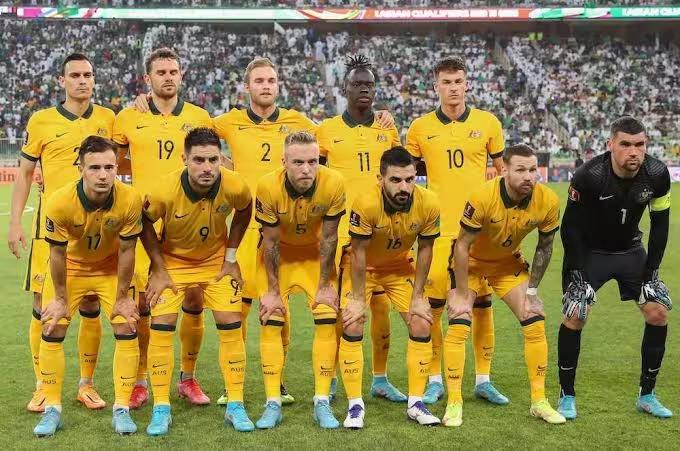
Following their entry into the 2026 FIFA World Cup, the Socceroos operate under intense tactical focus. Navigating the expanded global tournament in North America, Australia combines a robust, highly physical defensive foundation with a fast, dynamic wave of attacking talent competing across Europe’s top-flight domestic leagues. This comprehensive profile breaks down the structural design of the active 2026 roster, foundational history, individual records, and up-to-date tournament performance data.
Brief History and Core Continental Achievements
The footballing history of Australia is marked by absolute determination and a long-standing pursuit of respect on the global stage. After decades of fighting through complex intercontinental playoff systems as members of the Oceania Football Confederation (OFC)—highlighted by an iconic maiden World Cup appearance in 1974—Australia changed its sporting destiny forever by joining the AFC.
Masters of Two Continents
Australia holds the unique, historic distinction of being the only national team in football history to win continental championships in two different confederations. The Socceroos captured four OFC Nations Cup titles (1980, 1996, 2000, and 2004) before scaling the absolute mountain of Asian football by lifting the AFC Asian Cup in 2015 on home soil in Sydney. On the global stage, their absolute benchmark of modern excellence was achieved during the 2022 FIFA World Cup in Qatar, where an organized, resilient squad matched up against the world’s elite to advance to the Round of 16, matching the nation’s finest historic tournament run from 2006.
Technical Roster Breakdown (2026 Campaign)
Under highly structured tactical management, the modern Australian squad functions inside a fluid 4-2-3-1 or a compact, transition-minded 4-4-2 shape. The system places a supreme premium on extreme physical stamina, defensive synchronization in a mid-block, and utilizing rapid inside forwards to exploit vertical channels.
1. Goalkeepers
The Australian goalmouth continues its rich historical tradition of relying on exceptional physical length, elite cross-claiming metrics, and commanding penalty box communication.
- Mathew Ryan (#1): The veteran captain, talisman, and long-serving protector of the national team. Ryan brings world-class positioning, extensive European top-flight experience, and immense vocal organizational leadership from deep in his box.
- Joe Gauci (#12): A highly talented, modern reflex shot-stopper who provides elite starting-caliber backup depth from the English Premier League level.
- Paul Izzo (#23): A sharp, highly agile backup keeper finalizing a secure and deeply experienced goalkeeping department.
2. Defenders
The defensive line focuses on absolute physical dominance, structural telepathy in central channels, and fullbacks capable of executing intense recovery tracking.
- Harry Souttar (#19): A towering, world-class central defensive anchor. Standing at 6’6″, Souttar offers absolute aerial dominance in both penalty boxes, exceptional clearance numbers, and highly robust tackling power.
- Kye Rowles (#4) & Cameron Burgess (#3): Physically robust central defenders who form a highly cohesive structural partnership alongside Souttar, providing excellent left-footed passing balance out of the backline.
- Gethin Jones (#2) & Nathaniel Atkinson (#5): Highly disciplined, tactically sound right-backs responsible for shutting down wide isolation attempts and executing recovery runs.
- Jordan Bos (#16) & Aziz Behich (#13): Dynamic wide defenders responsible for providing overlapping options on the left flank, with Bos offering explosive transitional driving lines.
- Alessandro Circati (#5): A highly talented young European-based center-back representing the absolute future of the Australian defensive core.
3. Midfielders
The midfield functions as a tireless, hard-pressing engine room designed to choke out opposition central passing lanes and recycle possession cleanly.
- Jackson Irvine (#22): The vice-captain, primary box-to-box engine, and emotional heartbeat of the team. Irvine provides relentless lateral coverage, high-volume aerial dominance, and a knack for late-arriving box entries.
- Keanu Baccus (#8) & Aiden O’Neill (#6): Robust, aggressive central anchors responsible for disrupting opposition counter-attacks and protecting the central defenders.
- Connor Metcalfe (#10) & Riley McGree (#14): Highly technical progressive midfielders possessing excellent press-resistance, close-control dribbling, and final-third vision.
- Ajdin Hrustic (#7): The creative centerpiece. Operating in the advanced playmaker slot, Hrustic utilizes exceptional spatial intelligence and world-class dead-ball execution to unlock deep blocks.
4. Forwards
The frontline provides a devastating combination of clinical transitional speed, direct 1v1 wing isolation, and intense front-line defensive pressing.
- Craig Goodwin (#23): The premier attacking winger. Goodwin offers world-class crossing quality, clinical final-third finishing, and lethal technical ability on dead-ball set-pieces.
- Mitchell Duke (#15): The tireless veteran target forward chosen to lead the front-line press, hold up long balls, and absorb heavy physical contact from center-backs.
- Martin Boyle (#6) & Samuel Silvera (#11): Blistering, exceptionally fast wide forwards deployed to stretch opposing backlines and cut inside to generate shooting angles.
- Kusini Yengi (#9) & Nestory Irankunda (#20): The explosive new wave of Australian attacking depth. Irankunda offers world-class acceleration and unpredictable transitional flair, while Yengi provides direct physical power inside the box.
FIFA World Cup Performance Statistics
Australia’s statistical resume at the FIFA World Cup highlights an international program that has successfully established a permanent, highly competitive baseline on the global stage, amassing seven total appearances.
World Cup Tournament History Dashboard
The table below logs Australia’s absolute performance metrics across their historical FIFA World Cup final appearances:
| World Cup Edition | Confederation Represented | Overall Record (W-D-L) | Goals (GF-GA) | Final Tournament Milestone / Result |
|---|---|---|---|---|
| 1974 | OFC | 0-1-2 | 0-5 | Group Stage Exit (World Cup Debut) |
| 2006 | OFC (Migrated post-cup) | 1-1-2 | 5-6 | Round of 16 Exit (Eliminated by Champions Italy) |
| 2010–2018 | AFC | 2-2-8 | 8-21 | 3x Consecutive Group Stage Exits |
| 2022 | AFC | 2-0-2 | 4-6 | Round of 16 Exit (Defeated Denmark and Tunisia) |
| 2026 | AFC (Active) | 1-1-0 | 2-1 | Group Stage Performance (Active) |
| Historical Totals | 7 Tournaments Entered | 6-5-14 | 19-39 | Highest Placement: Round of 16 (2006, 2022) |
The Active 2026 World Cup Campaign
Australia successfully navigated a grueling, highly technical AFC qualification cycle, finishing top of their third-round group to earn their sixth consecutive ticket to the World Cup finals. Competing in North America, the Socceroos have delivered highly disciplined opening sequence displays.
- The Group Opener: Australia kicked off their tournament campaign in clinical fashion, utilizing their physical aerial presence to secure a high-stakes 1-0 victory, banking an ideal three points.
- The Second Matchday: In their second group stage fixture, the squad displayed intense tactical resilience, grinding through a highly physical 1-1 draw to keep their knockout qualification paths entirely in their own hands.
Legendary Individual Records and Milestones
The history of the Socceroos is built upon pioneering global icons and dedicated tournament veterans who established the absolute highest standards for Australian international sports.
All-Time Cap and Scoring Leaderboards
The tables below document the historical all-time record holders for senior international appearances and goals scored for the Australian men’s national team:
| Rank | Most Capped Players | Total International Caps | Career Era | Goals Scored |
|---|---|---|---|---|
| 1 | Mark Schwarzer | 109 | 1993–2013 | 0 |
| 2 | Tim Cahill | 108 | 2004–2018 | 50 |
| 3 | Lucas Neill | 96 | 1996–2013 | 1 |
| 4 | Brett Emerton | 95 | 1998–2012 | 20 |
| 5 | Alex Tobin | 87 | 1988–1998 | 2 |
| Rank | All-Time Top Goalscorers | Goals Scored | Matches Played | World Cup Goals |
|---|---|---|---|---|
| 1 | Tim Cahill | 50 | 108 | 5 (National Record) |
| 2 | Damian Mori | 29 | 45 | 0 |
| 3 | Archie Thompson | 28 | 54 | 0 (13 Goals in a Single Match) |
| 4 | John Aloisi | 27 | 55 | 1 |
| 5 | Attila Abonyi | 25 | 61 | 0 |
Elite Individual Benchmarks
- The Immortal Cahill Legacy: Attacking icon Tim Cahill stands entirely alone at the apex of Australian sports history, serving as the nation’s all-time top scorer with 50 international goals and holding the absolute record for the most World Cup goals, scoring 5 across three consecutive tournaments (2006, 2010, and 2014).
- The Global Scoring Record: Forward Archie Thompson holds an immortal, official FIFA world record, having scored an extraordinary 13 goals in a single international match during Australia’s historic 31-0 victory over American Samoa in 2001.
Tactical Identity: The Organized Mid-Block and Aerial Overload
The contemporary tactical blueprint of the Socceroos operates primarily out of a highly structured, balanced 4-2-3-1 matrix. The hallmark of the entire system is spatial compression. Out of possession, Jackson Irvine and Keanu Baccus lead a synchronized, highly disciplined mid-block that chokes central progressive lanes, forcing opposition combinations outward toward the touchlines.
Once a turnover is secured, Australia transitions with calculated precision. Deep pivots immediately shift the ball wide to release the technical crossing qualities of Craig Goodwin. This movement triggers a devastating aerial overload strategy inside the opposition penalty area, as towering center-back Harry Souttar and box-creeping midfielders aggressively swarm the back post to convert high-volume horizontal distributions. This balance of rigid defensive containment and absolute set-piece dominance turns Australia into an incredibly direct, dangerous threat over 90 minutes.
Conclusion
The Australia men’s national football team stands as a magnificent testament to long-term structural organization, extreme physical toughness, and tactical maturity. Their highly disciplined, organized performances at the 2026 World Cup showcase an international program masterfully engineered to systematically neutralize and pick apart the progressive systems of global football giants. As Mathew Ryan commands the backline from his box and Harry Souttar enforces defensive containment, the Socceroos possess every structural asset necessary to sustain their position among the absolute elite of international football.