The Iraq national football team, known culturally and globally as the Lions of Mesopotamia or Usood Al-Rafidain, represents one of the most resilient, technically gifted, and emotionally unified football programs in the history of the Asian Football Confederation (AFC). Navigating intense domestic and geopolitical challenges over multiple generations, Iraqi football has permanently established an international identity centered on absolute physical courage, raw street-smart technical flair, and a fierce collective spirit that consistently unbalances established continental hierarchies.
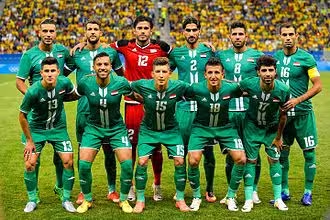
Following a highly focused structural modernization under experienced European management, the Lions of Mesopotamia enter their 2026 FIFA World Cup campaign as a highly dynamic, dangerous international competitor. Combining an elite wave of technically proficient diaspora talent playing across the top divisions of Europe with a battle-hardened local core from the competitive West Asian regional leagues, Iraq stands as a complex and demanding structural challenge for global opponents. This comprehensive profile breaks down the architectural design of the active senior roster, foundational history, individual records, and up-to-date statistical performance data.
Brief History and Core Continental Achievements
The Iraqi Football Association (IFA) was founded in 1948 and officially admitted to FIFA in 1950, later joining the AFC in 1970. On their home continent, Iraq’s crowning achievement is celebrated as one of the most profound narratives in global sports history.
The Miracle of 2007 and Continental Heritage
Iraq’s ultimate sporting peak arrived during the 2007 AFC Asian Cup. Operating without a centralized domestic training base and under immense emotional strain, a legendary squad spearheaded by Younis Mahmoud shocked the planet by defeating regional superpowers, culminating in a 1-0 victory over Saudi Arabia in Jakarta to lift the continental trophy. They have also captured four Arabian Gulf Cup titles (1979, 1984, 1988, and 2023)—most recently winning on home soil in Basra—alongside a West Asian Football Federation (WAFF) Championship in 2002, cementing a rich institutional baseline of regional elite status.
Technical Roster Breakdown (2026 Campaign)
Under highly organized tactical management, the modern Iraqi squad operates primarily within a balanced, fluid 4-2-3-1 or a highly vertical, physical 4-3-3 archetype. The contemporary system places a supreme premium on extreme mid-block pressing traps, press-resistant central possession recycling, and quick vertical wide deliveries targeted at isolating a world-class central forward.
1. Goalkeepers
The Iraqi goalmouth requires world-class close-range reflex capabilities, highly secure handling under intense aerial pressure, and commanding vocal leadership from deep in the box.
- Jalal Hassan (#12): The veteran captain, long-serving protector, and emotional anchor of the team. Hassan brings world-class positioning, extensive continental tournament experience, and immense leadership authority under pressure.
- Fahad Talib (#1): A highly physical, authoritative shot-stopper who provides elite starting-caliber backup depth and robust domestic league pedigree.
- Ahmed Basil (#22): A sharp, high-reflex backup keeper finalizing a highly secure and deeply experienced goalkeeping department.
2. Defenders
The defensive backline is engineered for absolute physical dominance, strict spatial containment inside the penalty box, and fullbacks built for high-stamina recovery tracking.
- Rebin Sulaka (#4): The central defensive anchor and structural leader. Sulaka provides world-class recovery speed, robust physical tackling power, and exceptional reading of central crossing lines.
- Saad Natiq (#2) & Ali Adnan (#6): Highly experienced, physically imposing central defensive enforcers who form an impenetrable structural shield inside the six-yard box, with Adnan utilizing immense veteran leadership and versatility.
- Hussein Ali (#3): A world-class right-back and rising global icon. Operating with a relentless physical engine, Ali provides blistering vertical speed, elite wide containment, and strong progressive traits.
- Merdhas Doski (#23): A highly dynamic, European-based left-back responsible for stretching opposition lines horizontally and executing quick recovery tracking.
- Zaid Tahseen (#5) & Mustafa Saadoon (#15): Disciplined, tactically sound defensive depth options built for rugged tournament battles.
3. Midfielders
The midfield functions as a tireless, technically secure engine room, meticulously balancing deep possession orchestration with intense mid-block pressing traps.
- Amir Al-Ammari (#16): The midfield general, structural pivot, and tactical general. Operating as a world-class deep-lying pivot, Al-Ammari excels at intercepting progressive passes, winning central duels, and recycling possession safely out of pressure.
- Osama Rashid (#8): A highly technical progressive midfielder possessing excellent press-resistance, close-control ball retention, and final-third transition vision.
- Zidane Iqbal (#14): The creative centerpiece and prodigiously gifted young superstar maestro. Tasked with operating in the advanced playmaker slot, Iqbal utilizes world-class close-control dribbling, extraordinary vision, and defense-splitting passing arcs to unlock deep blocks.
- Ibrahim Bayesh (#8): The tireless, high-intensity wide midfielder whose high-volume ball-winning metrics and versatile tracking lines sustain central pressing densities.
- Youssef Amyn (#7) & Danilo Al-Saed (#11): Highly energetic, technically brilliant progressive wide outlets tasked with finding pockets of space and executing rapid transitions through the half-spaces.
4. Forwards
The frontline features a devastating mixture of world-class physical target presence, vertical speed, and clinical final-third execution.
- Aymen Hussein (#18): The premier central striker leading the line. Hussein offers a world-class combination of towering physical height, brute upper-body strength, elite off-the-ball situational IQ, and an exceptionally prolific scoring record in international qualifiers and major tournaments.
- Ali Al-Hamadi (#9): A world-class powerhouse forward. Operating at the highest elite European league tier, Al-Hamadi utilizes explosive ground pace, exceptional aerial dominance inside the box, and a relentless front-line pressing work rate.
- Mohanad Ali (#10): A highly dynamic, clinical attacking forward variant chosen to stretch fatigued opposition backlines and inject sudden vertical power late in matches.
- Montader Madjed (#19): A blistering, exceptionally fast wide wildcard deployed to isolate tired fullbacks and inject unpredictable technical flair late in matches.
FIFA World Cup Performance Statistics
Iraq’s statistical resume highlights an international program that stands as a historic pioneer for West Asian sports, recording competitive cycles on the global stage.
World Cup Tournament History Dashboard
The table below logs Iraq’s absolute performance metrics across their historical FIFA World Cup final appearances:
| World Cup Edition | Host Country / Nations | Overall Record (W-D-L) | Goals (GF-GA) | Final Tournament Milestone / Result |
|---|---|---|---|---|
| 1986 | Mexico | 0-0-3 | 1-4 | Group Stage Exit (Maiden Final Tournament Debut) |
| 2026 | USA, Canada, Mexico | 1-1-0 (Active) | 3-2 | Group Stage Performance (Tournament Active) |
| Historical Totals | 2 Tournaments Entered | 1-1-3 | 4-6 | First Historic Final Points and Win Secured in 2026 Cycle |
The Active 2026 World Cup Campaign
Iraq successfully navigated a grueling, highly technical AFC qualification cycle, finishing top of their group in the decisive rounds to earn their historical second ticket to the World Cup finals. Competing in North America, the Lions of Mesopotamia have delivered highly disciplined opening sequence displays.
- The Group Opener: Iraq kicked off their tournament campaign in spectacular fashion, utilizing a clinical aerial strike from Aymen Hussein to secure a high-stakes 2-1 victory, banking an ideal three points.
- The Second Matchday: In their second group stage fixture, the squad displayed intense tactical resilience under high physical parameters, battling through a highly tactical 1-1 draw to position themselves in prime position to secure safe passage into the knockout stages.
Legendary Individual Records and Milestones
The history of the Usood Al-Rafidain is written by pioneering international icons and dedicated centurions who established the absolute highest standards for West Asian sports.
All-Time Cap and Scoring Leaderboards
The tables below document the historical all-time record holders for senior international appearances and goals scored for the Iraqi men’s national team:
| Rank | Most Capped Players | Total International Caps | Career Era | Goals Scored |
|---|---|---|---|---|
| 1 | Younis Mahmoud | 148 | 2002–2016 | 57 |
| 2 | Hussein Saeed | 137 | 1976–1990 | 78 |
| 3 | Ala’a Abdul-Zahra | 126 | 2007–2021 | 17 |
| 4 | Ahmed Radhi | 121 | 1982–1997 | 62 |
| 5 | Adnan Dirjal | 121 | 1978–1990 | 8 |
| Rank | All-Time Top Goalscorers | Goals Scored | Matches Played | World Cup Goals |
|---|---|---|---|---|
| 1 | Hussein Saeed | 78 | 137 | 0 (Highest Goal Ratio: 0.57) |
| 2 | Ahmed Radhi | 62 | 121 | 1 (Scored First Independent Goal in 1986) |
| 3 | Younis Mahmoud | 57 | 148 | 0 (Scored 2007 Asian Cup Winner) |
| 4 | Aymen Hussein | 31 | 79 | 2 (Highest Active Scorer) |
| 5 | Ali Al-Khafaji | 30 | 83 | 0 |
Elite Individual Benchmarks
- The Immortal Saeed Record: Striker Hussein Saeed stands entirely unrivaled at the absolute apex of Iraqi sports history, amassing an extraordinary 78 international goals to sit comfortably as the country’s all-time top goalscorer.
- The 1986 Trailblazer: Legend Ahmed Radhi holds an eternal position in global sports folklore, having scored Iraq’s first-ever, independent FIFA World Cup finals goal against Belgium during the 1986 tournament in Mexico.
- The Modern Target Surge: Power forward Aymen Hussein enters the current international cycle as the premier big-game player of the modern era, maintaining a world-class international scoring ratio that positions him rapidly up the historical chart ranks.
Tactical Identity: High-Intensity Pressing and Direct Aerial Overloads
The contemporary tactical blueprint of the Lions of Mesopotamia operates primarily out of a highly sophisticated, structurally balanced 4-2-3-1 matrix. The cornerstone of the entire system is spatial manipulation through high-volume athletic duels. Iraq completely avoids passive low defensive blocks, choosing instead to implement an intense, highly synchronized front-line press that isolates opposition deep pivots and forces quick turnover sequences in the middle third.
When transitioning to attack, Iraq avoids slow possession build-ups inside their own half. Deep pivots immediately skip midfield lines, shifting the ball wide to release the blistering horizontal acceleration of Youssef Amyn or utilizing the deep progressive distributions of Amir Al-Ammari. This high-speed transition triggers immediate wide overload phases, as fullbacks stretch the opposition backline to deliver high-volume crossing arcs inside the box, maximizing the towering aerial height, brute upper-body strength, and clinical final-third execution of Aymen Hussein.
Conclusion
The Iraq national football team stands as a magnificent testament to systematic long-term organization, raw technical brilliance, and unmatched group ethics under heavy international scrutiny. Their highly disciplined, high-speed transitional blueprint showcases an international program masterfully engineered to systematically control and neutralize the progressive systems of global football giants on the grandest stage. As Zidane Iqbal orchestrates final-third transitions with visionary flair and Aymen Hussein extends modern scoring benchmarks under intense national expectation, the Lions of Mesopotamia possess every structural asset necessary to claim an elite historic legacy.