The Tunisia national football team, culturally and universally heralded across the sporting landscape as the Carthage Eagles or Les Aigles de Carthage, represents one of the most structurally disciplined, defensively resilient, and historically consistent football programs on the African continent. Operating within the highly competitive landscape of North African football, Tunisia has systematically built a reputation for defensive organization, tactical intelligence, and a unique ability to frustrate and neutralize global football giants.
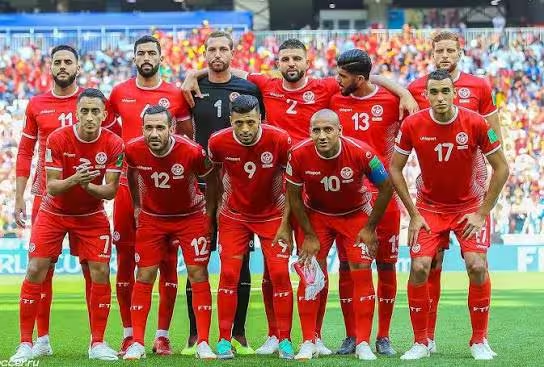
Following a highly focused technical modernization, the Carthage Eagles enter the current international landscape as an incredibly difficult tactical puzzle. Blending an elite wave of technically proficient diaspora players with a battle-hardened core from Africa’s top club competitions, Tunisia stands as a demanding challenge for global opponents. This comprehensive profile breaks down the structural design of the active senior roster, foundational history, individual records, and up-to-date statistical performance data.
Brief History and Core Continental Achievements
The Tunisian Football Federation (FTF) was founded in 1957 and officially admitted to FIFA in 1960, joining the Confederation of African Football (CAF) that same year. On their home continent, Tunisia’s crowning historic milestone arrived when they hosted and won the 2004 Africa Cup of Nations (AFCON), putting on a structural masterclass to defeat rivals Morocco in the final. They have also finished as continental runners-up twice, establishing an institutional legacy of elite regional pedigree.
World Cup Trailblazers and Big-Game Killers
Tunisia occupies an immortal position in global sports folklore as a primary historical trailblazer for African football. At the 1978 FIFA World Cup in Argentina, the Carthage Eagles stunned the international community by defeating Mexico 3-1, recording the first-ever match victory by an African nation in FIFA World Cup history. Across six tournament appearances, Tunisia has built a reputation for defensive bravery, highlighted by a historic 1-0 clean-sheet victory over reigning world champions France at the 2022 World Cup in Qatar.
Technical Roster Breakdown (2026 Campaign)
The modern Tunisian squad operates primarily within a highly disciplined, compact 4-3-3 or a fluid, counter-attacking 3-5-2 structure. The system places a supreme premium on low-block defensive synchronization, heavy spatial compression in the middle third, and utilizing tactical wingers to trigger immediate vertical counter-attacks.
1. Goalkeepers
The Tunisian goalmouth requires exceptional close-range reflex capabilities, highly secure ball handling under heavy physical pressure, and vocal penalty box command.
- Aymen Dahmen (#16): The preferred first-choice starting goalkeeper. Dahmen brings world-class positioning, exceptional shot-stopping reflexes, and immense composure under intense tournament pressure.
- Bechir Ben Saïd (#1): A highly physical, authoritative shot-stopper who provides elite starting-caliber backup depth and robust continental pedigree.
- Amanallah Memmiche (#22): The prodigiously talented young domestic keeper representing the absolute future of the Tunisian goalkeeping department.
2. Defenders
The backline focuses on rigid positional discipline, absolute aerial containment inside the penalty box, and fullbacks built for intense recovery tracking.
- Montassar Talbi (#3): The central defensive anchor and undisputed leader of the backline. Operating at the elite European level, Talbi provides world-class recovery speed, robust tackling power, and impeccable reading of passing lines.
- Yassine Meriah (#4) & Dylan Bronn (#6): Physically robust, heavy-tackling central defenders who partner Talbi to form an impenetrable structural block.
- Ali Abdi (#24): A highly dynamic, attack-minded left-back responsible for providing vertical width in transition and executing quick recovery tracking.
- Yan Valery (#2) & Wajdi Kechrida (#13): Exceptionally disciplined, tactically sound right-backs responsible for shutting down wing isolation attempts and maintaining defensive containment.
- Alaa Ghram (#5): A highly talented young ball-playing center-back deployed to provide robust depth across three-man and four-man backlines.
3. Midfielders
The midfield is the absolute tactical engine room of the Carthage Eagles, combining unparalleled physical stamina with press-resistant ball retention and high-volume ball-winning metrics.
- Ellyes Skhiri (#17): The primary defensive shield, tactical general, and heartbeat of the team. Operating as a world-class deep-lying pivot, Skhiri excels at intercepting opposition progressive passes, covering massive lateral ground, and protecting the backline.
- Aïssa Laïdouni (#14): A tireless, highly aggressive box-to-box engine. Laïdouni utilizes immense physical intensity, ferocious tackling, and explosive driving lines to disrupt opposition midfields.
- Mohamed Ali Ben Romdhane (#8) & Hamza Rafia (#10): Highly technical progressive midfielders possessing excellent press-resistance, close-control ball retention, and transition vision.
- Hannibal Mejbri (#7): The creative centerpiece. Operating as an advanced playmaker between the lines, Mejbri injects sudden vertical power, technical dribbling flair, and intense pressing metrics into the final third.
4. Forwards
The frontline provides a flexible mixture of direct transitional speed, inside-cutting wide movements, and intense front-line defensive pressing.
- Youssef Msakni (#7): The legendary captain, all-time icon, and talismanic leader. Operating from the left flank or as a secondary forward, Msakni utilizes extraordinary close-control dribbling, technical vision, and clinical final-third execution.
- Elias Achouri (#11): An exceptionally fast, technically brilliant young winger. Operating from wide spaces, Achouri thrives when aggressively isolating fullbacks in 1v1 touchline scenarios to cut inside and create shooting angles.
- Sayfallah Ltaief (#20): A blistering, high-intensity wide forward deployed to stretch opposition backlines and inject rapid vertical speed late in matches.
- Haythem Jouini (#9) & Elias Saad (#19): Physically robust central strikers chosen to lead the front-line press, provide penalty box target presence, and convert aerial crosses.
FIFA World Cup Performance Statistics
Tunisia’s statistical resume at the FIFA World Cup highlights an international program that stands as a model of defensive resilience, amassing six total tournament appearances.
World Cup Tournament History Dashboard
The table below logs Tunisia’s absolute performance metrics across their historical FIFA World Cup final appearances:
| World Cup Edition | Host Country / Nations | Overall Record (W-D-L) | Goals (GF-GA) | Final Tournament Milestone / Result |
|---|---|---|---|---|
| 1978 | Argentina | 1-1-1 | 3-2 | Group Stage Exit (First-Ever African World Cup Win) |
| 1998–2006 | France / Korea-Japan / Germany | 0-3-6 | 5-15 | 3x Consecutive Group Stage Exits |
| 2018 | Russia | 1-0-2 | 5-8 | Group Stage Exit (Defeated Panama 2-1) |
| 2022 | Qatar | 1-1-1 | 1-1 | Group Stage Exit (Defeated Champions France 1-0) |
| Historical Totals | 6 Tournaments Entered | 3-5-10 | 14-26 | Highest Achievement: Group Stage |
Legendary Individual Records and Milestones
The history of the Carthage Eagles is written by pioneering icons and dedicated tournament veterans who established elite individual benchmarks for North African football.
All-Time Cap and Scoring Leaderboards
The tables below document the historical all-time record holders for senior international appearances and goals scored for the Tunisian men’s national team:
| Rank | Most Capped Players | Total International Caps | Career Era | Goals Scored |
|---|---|---|---|---|
| 1 | Sadok Sassi | 116 | 1963–1978 | 0 |
| 2 | Tarak Dhiab | 108 | 1974–1990 | 15 |
| 3 | Radhi Jaïdi | 105 | 1996–2009 | 7 |
| 4 | Youssef Msakni | 102 | 2010–Present | 23 |
| 5 | Khaled Badra | 97 | 1995–2006 | 12 |
| Rank | All-Time Top Goalscorers | Goals Scored | Matches Played | Career Goal Ratio |
|---|---|---|---|---|
| 1 | Issam Jemâa | 36 | 84 | 0.43 |
| 2 | Wahbi Khazri | 25 | 74 | 0.34 |
| 3 | Youssef Msakni | 23 | 102 | 0.23 |
| 4 | Francileudo Santos | 21 | 41 | 0.51 |
| 5 | Adel Sellimi | 20 | 80 | 0.25 |
Elite Individual Benchmarks
- The Midfielder Ball of Gold: Playmaker Tarak Dhiab remains the only Tunisian footballer in history to be awarded the prestigious African Footballer of the Year title, capturing the crown in 1977.
- The Modern Centurion Leader: Captain Youssef Msakni enters current international fixtures having officially surpassed the 100-cap milestone, positioning himself to eventually challenge Sadok Sassi’s long-standing national appearance record while sitting as the nation’s highest active goalscorer.
- The World Cup Efficiency: Forward Wahbi Khazri retired from international duty as the nation’s most lethal World Cup performer, scoring 3 total goals across the 2018 and 2022 final tournaments.
Tactical Identity: The Rigid Low Block and Structural Suffocation
The contemporary tactical blueprint of the Carthage Eagles operates primarily out of a highly coordinated, ultra-compact 4-3-3 matrix that seamlessly drops into a low-block 4-5-1 out of possession. The cornerstone of the entire system is spatial denial. Tunisia willingly surrenders high-volume ball possession to elite opponents, choosing to form a synchronized, impenetrable defensive shield that completely chokes out central channels.
Out of possession, Ellyes Skhiri screens the central space with clinical discipline, directing his midfield partners to compress the lines and trap attacking players. Once an opposition sequence stalls, Tunisia completely avoids slow possession build-ups inside their own half. Deep pivots immediately launch vertical, line-breaking passes outward to release the blistering 1v1 acceleration of Elias Achouri on the flank or hit central outlets for quick physical hold-up sequences, transforming deep defensive containment into efficient final-third goals within a matter of seconds.
Conclusion
The Tunisia national football team stands as a magnificent testament to structural organization, tactical discipline, and immense defensive resilience. Their highly synchronized, low-block counter-attacking framework highlights an international program masterfully engineered to systematically control, pick apart, and neutralize the progressive systems of global football giants. As Youssef Msakni commands final-third transitions with veteran intelligence and Ellyes Skhiri locks down the midfield engine room, the Carthage Eagles possess every structural parameter necessary to maintain their historic legacy on the global stage.