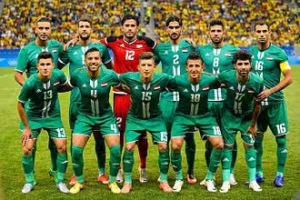
The Egypt national football team, culturally and universally heralded across the sporting landscape as the Pharaohs, represents the absolute historical locomotive, cultural bedrock, and competitive benchmark of footballing excellence on the African continent. Operating as an undisputed institutional giant within the Confederation of African Football (CAF), Egypt has built a legendary international identity centered on unparalleled technical proficiency, immense tactical maturity, and an exceptional tournament winning pedigree.
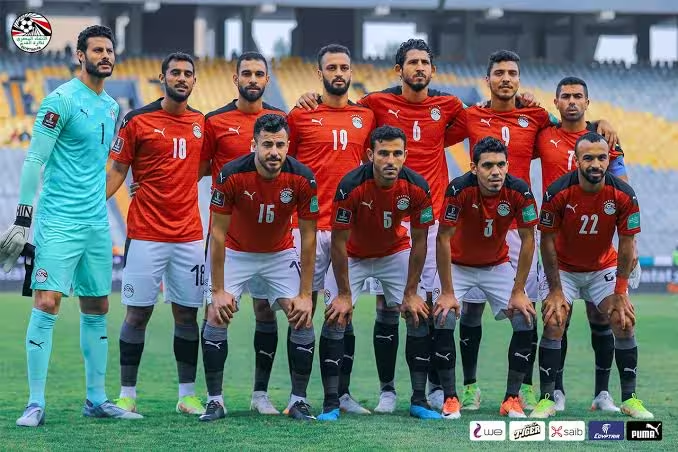
Following an intensely physical qualification cycle, the Pharaohs continue to stand as a formidable global threat. Blending a world-class, elite European forward vanguard with a deeply synchronized, battle-hardened core playing daily inside the upper echelons of competitive African club structures, Egypt represents an incredibly complex tactical puzzle for global opponents. This comprehensive profile breaks down the structural design of the active senior roster, foundational history, individual records, and up-to-date tournament performance data.
Brief History and Core Continental Achievements
The Egyptian Football Association (EFA) holds a prestigious position as a true global pioneer, founded in 1921, admitted to FIFA in 1923, and standing as a primary founding member of CAF in 1957. On their home continent, Egypt’s legacy is entirely unrivaled, sitting as the most successful nation in African history with a record 7 Africa Cup of Nations (AFCON) titles (1957, 1959, 1986, 1998, 2006, 2008, and 2010), highlighted by an iconic, historic continental “three-peat” under manager Hassan Shehata.
Global Pioneers and World Cup Thresholds
Egypt’s historical legacy at the FIFA World Cup is marked by trailblazing breakthroughs across the 20th century. At the 1934 FIFA World Cup in Italy, the Pharaohs broke monumental geographical barriers to become the first-ever African and Arab nation to qualify for and compete in a FIFA World Cup final tournament. Across three historical final tournament appearances (1934, 1990, and 2018), Egypt has consistently delivered highly competitive, intense footballing spectacles, turning their tactical setups into highly respected frameworks worldwide.
Technical Roster Breakdown
The modern Egyptian squad functions inside a highly sophisticated 4-3-3 or a fluid, transition-minded 4-2-3-1 archetype. The tactical blueprint places an absolute premium on low-block defensive synchronization, press-resistant central possession recycling, and explosive vertical distributions into wide channels to unleash world-class inverted inside forwards.
1. Goalkeepers
The Egyptian goalkeeping department remains an elite institution, globally renowned for exceptional close-range reflex capabilities, towering penalty box command, and extreme psychological composure under high-stakes penalty shootout pressure.
- Mohamed El Shenawy (#1): The veteran first-choice starting goalkeeper and long-serving captain. El Shenawy brings world-class positioning, incredible physical frame command, and an elite history of clutch, acrobatic saves in major international tournaments.
- Mostafa Shobeir (#12): A highly talented, modern ball-playing goalkeeper who provides elite starting-caliber depth and exceptional reflex metrics from African club competition.
- Mohamed Awad (#23): A sharp, vastly experienced backup goalkeeper finalizing a highly secure and deeply knowledgeable goalkeeping department.
2. Defenders
The defensive backline is engineered for absolute physical dominance, strict spatial containment inside the penalty box, and fullbacks built for high-stamina recovery tracking.
- Mohamed Abdelmonem (#24): The central defensive anchor and global icon. Operating at the elite European first-division level, Abdelmonem provides world-class recovery speed, robust physical tackling power, and exceptional left-right passing distribution out of the backline.
- Rami Rabia (#5) & Ahmed Hegazi (#6): Towering, physically robust central defensive enforcers who partner Abdelmonem to form an impenetrable structural shield inside the box.
- Mohamed Hamdi (#13): A tactically sophisticated left-back responsible for providing vertical progressive width in transition and executing precise recovery runs.
- Mohamed Hany (#2) & Ahmed Eid (#3): Highly disciplined, tactically sound right-backs responsible for shutting down wing isolation attempts and maintaining rigid defensive blocks.
- Yasser Ibrahim (#4): A heavy-tackling central defensive depth option built for rugged international tournament battles.
3. Midfielders
The midfield functions as a tireless, technically secure engine room, meticulously balancing deep possession orchestration with intense mid-block pressing traps.
- Marwan Attia (#14): The primary defensive shield and tactical anchor. Attia excels at aggressively breaking up opposition transitions, covering extensive lateral ground, and protecting the central defenders.
- Hamdi Fathy (#5) & Emam Ashour (#8): Dynamic, physical box-to-box engine pivots. Ashour provides world-class progressive ball-carrying lines and a dangerous long-range shooting threat, while Fathy executes high-volume ball-winning tackles.
- Ahmed Nabil Koka (#16) & Nasser Maher (#18): Highly energetic, modern progressive midfielders possessing excellent press-resistance and close-control ball retention.
- Zizo (#21): A highly versatile, creative playmaker tasked with operating between opposition lines to deliver precise dead-ball set-pieces and vertical crossing arcs.
4. Forwards
The frontline provides a devastating combination of world-class inside-cutting movements, direct transitional speed, and elite clinical finishing execution.
- Mohamed Salah (#10): The undisputed superstar icon, global phenomenon, and talismanic leader. Operating from the right flank, Salah utilizes world-class explosive acceleration, devastating 1v1 dribbling flair, and world-class final-third execution to completely dismantle opposition backlines.
- Mostafa Mohamed (#11): The premier central striker leading the attack. Mohamed offers world-class physical hold-up capabilities, exceptional aerial dominance inside the box, and a relentless front-line defensive pressing work rate.
- Omar Marmoush (#7): A world-class inside-forward. Operating from the left flank, Marmoush utilizes electric pace, a highly creative technical dribbling threat, and clinical final-third execution to unlock deep blocks.
- Trézéguet (#7): A vastly experienced, high-intensity wide forward renowned for scoring clutch tournament goals and injecting sudden vertical power late in matches.
- Mohamed Sherif (#9) & Osama Faisal (#19): Direct attacking forward variants utilized to alter forward depths and run channels to wear down opposition center-backs.
FIFA World Cup Performance Statistics
Egypt’s statistical resume highlights an international program that stands as a historical pioneer for African and Arab sports, recording highly competitive campaigns on the global stage.
World Cup Tournament History Dashboard
The table below logs Egypt’s absolute performance metrics across their historical FIFA World Cup final appearances:
| World Cup Edition | Host Country / Nations | Overall Record (W-D-L) | Goals (GF-GA) | Final Tournament Milestone / Result |
|---|---|---|---|---|
| 1934 | Italy | 0-0-1 | 2-4 | Round of 16 Exit (World Cup Final Tournament Debut) |
| 1990 | Italy | 0-2-1 | 1-2 | Group Stage Exit (Tied European Champions Netherlands) |
| 2018 | Russia | 0-0-3 | 2-6 | Group Stage Exit |
| Historical Totals | 3 Tournaments Entered | 0-2-5 | 5-12 | First African and Arab Representative in History |
Legendary Individual Records and Milestones
The history of the Pharaohs is written by pioneering global superstars and dedicated international centurions who established the absolute highest standards for African sports.
All-Time Cap and Scoring Leaderboards
The tables below document the historical all-time record holders for senior international appearances and goals scored for the Egyptian men’s national team:
| Rank | Most Capped Players | Total International Caps | Career Era | Goals Scored |
|---|---|---|---|---|
| 1 | Ahmed Hassan | 184 | 1995–2012 | 33 |
| 2 | Hossam Hassan | 176 | 1985–2006 | 68 |
| 3 | Essam El Hadary | 159 | 1996–2018 | 0 |
| 4 | Ahmed Fathi | 134 | 2002–2021 | 3 |
| 5 | Ibrahim Hassan | 131 | 1988–2002 | 14 |
| Rank | All-Time Top Goalscorers | Goals Scored | Matches Played | World Cup Goals |
|---|---|---|---|---|
| 1 | Hossam Hassan | 68 | 176 | 0 |
| 2 | Mohamed Salah | 56 | 100 | 2 (Joint National Record) |
| 3 | Hassan El Shazly | 42 | 62 | 0 (Highest Goal Ratio: 0.68) |
| 4 | Mohamed Aboutrika | 38 | 100 | 0 |
| 5 | Ahmed Hassan | 33 | 184 | 0 |
Elite Individual Benchmarks
- The Immortal Age Record: Legendary goalkeeper Essam El Hadary holds an absolute, immortal FIFA world record as the oldest player to ever compete in a FIFA World Cup final tournament, starting against Saudi Arabia in 2018 at the age of 45 years and 161 days while dramatically saving a first-half penalty.
- The Shared Scoring Crown Target: In reaching the landmark 100-cap milestone, superstar forward Mohamed Salah has amassed an extraordinary 56 international goals, placing him in prime position to eventually challenge the iconic Hossam Hassan’s long-standing national chart record.
- The Midfield Appearance Peak: Midfield general Ahmed Hassan stands in an elite tier of global football history, amassing a staggering 184 international caps across a career that yielded four historical AFCON titles.
Tactical Identity: Low-Block Security and Wide Overloads
The contemporary tactical blueprint of the Pharaohs operates primarily out of a highly flexible, structurally sound 4-3-3 matrix. The cornerstone of the entire system is spatial denial through an impenetrable low-to-mid block shape. Egypt willingly surrenders high-volume possession phases to elite opponents, choosing to form a highly synchronized defensive shield that completely suffocates central lanes.
Out of possession, Marwan Attia screens the central zone with clinical discipline, forcing opposition combinations outward toward the lateral touchlines where physical defenders execute hard tackles. Once a tactical turnover is secured, Egypt transitions with terrifying vertical speed. Deep pivots immediately skip midfield lines, looking to release the world-class explosive acceleration of Mohamed Salah into open wide channels, allowing inverted forwards to slice inside to generate lethal final-third goals within a matter of single-digit seconds.
Conclusion
The Egypt national football team stands as a monumental pillar of global sports history, blending unmatched technical heritage, unparalleled continental dominance, and modern tactical sophistication. Their legendary statistics confirm an international program masterfully engineered to systematically control, pick apart, and neutralize opposition systems on the grandest stage. As Mohamed Salah injects unpredictable creative genius into final-third sequences and a physically dominant midfield axis dictates pressing densities, the Pharaohs possess every structural asset necessary to maintain their historic position among the elite of international football.