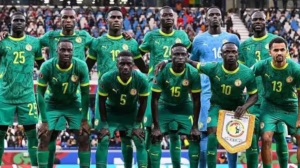
The Saudi Arabia national football team, known culturally and globally as the Green Falcons or Al-Saqour Al-Khodur, represents the historic economic engine, administrative anchor, and a perennially dominant athletic powerhouse of the Asian Football Confederation (AFC). Armed with a fully professionalized domestic ecosystem, state-of-the-art sporting facilities, and an elite baseline of local talent, Saudi Arabia stands as one of the most decorated footballing cultures in modern Asian history.
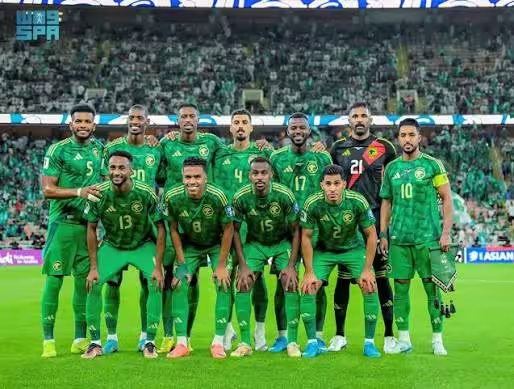
Following a period of extensive technical modernization, the Green Falcons enter their active campaigns under highly disciplined, elite management. Combining immense tactical group synergy developed from playing side-by-side within domestic powerhouses like Al-Hilal and Al-Nassr with an explosive, high-stamina pressing system, Saudi Arabia stands as a complex and demanding structural challenge for global opponents. This comprehensive profile breaks down the architectural design of the active senior roster, foundational tournament milestones, legendary individual records, and up-to-date statistical performance metrics.
Brief History and Core Continental Achievements
The Saudi Arabian Football Federation (SAFF) was officially founded in 1956 and admitted to FIFA in 1956, later joining the AFC in 1972. On their home continent, the Green Falcons established a legendary era of absolute, unrivaled dominance during the late 20th century, capturing three AFC Asian Cup titles (1984, 1988, and 1996) alongside finishing as continental runners-up three times across an extraordinary six-tournament final sequence.
The Global Breakthrough and Giant-Killing Heritage
Saudi Arabia made their monumental final tournament debut at the 1994 FIFA World Cup in the United States, putting on a breathtaking display of technical flair to march straight into the Round of 16, highlighted by Saeed Al-Owairan’s immortal, world-famous individual goal against Belgium. Across six total final tournament appearances (1994, 1998, 2002, 2006, 2018, and 2022), the Green Falcons have permanently etched their name into global sports folklore by producing high-intensity, historic upsets—none more profound than their legendary 2-1 victory over eventual champions Argentina at the 2022 World Cup in Qatar.
Technical Roster Breakdown
Under highly rigid, sophisticated technical direction, the modern Saudi Arabian squad operates primarily within a compact 4-3-3 or a fluid, defensively dense 3-4-2-1 archetype. The tactical template places an absolute premium on high-intensity defensive lines, press-resistant central circulation, and lightning-fast vertical transitions executed through inverted inside forwards.
1. Goalkeepers
The Saudi goal area requires exceptional close-range reflex capabilities, highly secure ball handling under high-stakes tournament pressure, and advanced sweeping attributes to protect a high defensive line.
- Mohammed Al-Owais (#21): The preferred first-choice starting goalkeeper. Al-Owais brings world-class positioning, incredible physical frame command, and an elite history of clutch, big-game saving masterclasses on the grandest international stages.
- Ahmed Al-Kassar (#22): A highly authoritative, athletic shot-stopper providing elite starting-caliber depth, demonstrating exceptional penalty-box collection metrics.
- Raghed Al-Najjar (#23): A sharp, highly agile backup goalkeeper finalizing an exceptionally secure and deeply knowledgeable goalkeeping department.
2. Defenders
The defensive line focuses on rigid positional discipline, rapid recovery tracking across open spaces, and fullbacks built to provide tactical width during progressive buildups.
- Ali Al-Bulaihi (#5): The central defensive enforcer and psychological heartbeat of the backline. Al-Bulaihi provides robust physical tackling power, elite 1v1 defensive isolation traits, and immense tournament authority.
- Ali Lajami (#4) & Hassan Tambakti (#17): The preferred starting central partnership, combining modern ground speed, high-volume clearance metrics, and precise short-passing distribution out of the backline.
- Saud Abdulhamid (#12): A world-class right-back and global icon. Operating with relentless physical engines, Abdulhamid provides blistering vertical recovery speed, elite touchline dribbling, and precise crossing lines.
- Yasser Al-Shahrani (#13): The legendary, vastly experienced veteran left-back responsible for providing structural stability and organizing lateral containment channels.
- Aawn Al-Saluli (#3) & Hassan Kadesh (#14): Physically robust central defensive backups deployed to provide structural depth across both three-man and four-man backlines.
3. Midfielders
The midfield functions as a tireless, technically secure engine room, meticulously balancing deep possession orchestration with intense mid-block pressing traps.
- Mohamed Kanno (#23): The primary midfield general and structural anchor. Standing as a towering physical presence, Kanno combines world-class press-resistance, close-control ball retention, and late progressive box entries.
- Abdullah Al-Khaibari (#6): The primary defensive shield and tactical pivot. Al-Khaibari excels at aggressively breaking up opposition transitions, intercepting passing lanes, and protecting the central defenders.
- Faisal Al-Ghamdi (#16) & Musab Al-Juwayr (#8): The premier young wave of technical midfield playmakers, possessing exceptional positional intelligence, visionary passing range, and press-resistant ball recycling out of tight zones.
- Abdulelah Al-Malki (#7) & Mukhtar Ali (#15): High-work-rate central anchors deployed to plug passing lanes and sustain central pressing densities in the middle third.
4. Forwards
The frontline provides a devastating combination of clinical final-third finishing, direct transitional speed, and intense front-line defensive pressing.
- Salem Al-Dawsari (#10): The captain, undisputed superstar icon, and talismanic leader. Operating from the inverted left flank, Al-Dawsari utilizes world-class explosive acceleration, intricate close-control dribbling, and clinical final-third execution to score legendary, historic goals.
- Firas Al-Buraikan (#9): The premier central striker leading the line. Al-Buraikan offers elite off-the-ball situational movement, exceptional physical hold-up metrics, and highly clinical finishing with both feet inside the box.
- Saleh Al-Shehri (#11): A vastly experienced, high-intensity central forward renowned for scoring clutch tournament goals and executing a relentless front-line press.
- Abdulrahman Ghareeb (#18) & Ayman Yahya (#19): Blistering, exceptionally fast wide forwards deployed to stretch opposition fullbacks and inject rapid vertical speed late in matches.
- Abdullah Radif (#20): A highly energetic young forward wildcard utilized to alter forward depths and run channels to wear down opposition center-backs.
FIFA World Cup Performance Statistics
Saudi Arabia’s statistical resume highlights an international program that stands as one of the most regular and consistently resilient global tournament competitors in Asian history, amassing six final tournament finishes.
World Cup Tournament History Dashboard
The table below logs Saudi Arabia’s absolute performance metrics across their completed FIFA World Cup final appearances:
| World Cup Edition | Host Country / Nations | Overall Record (W-D-L) | Goals (GF-GA) | Final Tournament Milestone / Result |
|---|---|---|---|---|
| 1994 | USA | 2-0-2 | 5-6 | Round of 16 Exit (Maiden Final Tournament Debut) |
| 1998–2006 | France / Korea-Japan / Germany | 0-2-7 | 4-26 | 3x Consecutive Group Stage Exits |
| 2018 | Russia | 1-0-2 | 2-7 | Group Stage Exit (Defeated Egypt 2-1) |
| 2022 | Qatar | 1-0-2 | 3-5 | Group Stage Exit (Famous 2-1 Triumph vs Argentina) |
| Historical Totals | 6 Tournaments Entered | 4-2-13 | 14-44 | 1x Knockout Stage Appearance (Round of 16) |
All-Time Cap and Scoring Leaderboards
The tables below document the historical all-time record holders for senior international appearances and goals scored for the Saudi Arabian men’s national team:
| Rank | Most Capped Players | Total International Caps | Career Era | Goals Scored |
|---|---|---|---|---|
| 1 | Mohamed Al-Deayea | 178 | 1993–2006 | 0 |
| 2 | Mohammed Al-Khilaiwi | 163 | 1992–2001 | 3 |
| 3 | Sami Al-Jaber | 156 | 1992–2006 | 46 |
| 4 | Abdullah Zubromawi | 142 | 1993–2002 | 3 |
| 5 | Hussein Abdulghani | 138 | 1996–2018 | 5 |
| Rank | All-Time Top Goalscorers | Goals Scored | Matches Played | World Cup Goals |
|---|---|---|---|---|
| 1 | Majed Abdullah | 72 | 117 | 0 (Highest Goal Ratio: 0.62) |
| 2 | Sami Al-Jaber | 46 | 156 | 3 (National World Cup Record) |
| 3 | Yasser Al-Qahtani | 42 | 108 | 1 |
| 4 | Obeid Al-Dosari | 41 | 94 | 0 |
| 5 | Talal Al-Meshal | 32 | 60 | 0 |
Elite Individual Benchmarks
- The World Cup Scoring Peak: Iconic forward Sami Al-Jaber holds the absolute national record for the most goals scored at FIFA World Cup finals with 3 goals, famously netting across three distinct World Cup final editions (1994, 1998, and 2006).
- The Legendary Custodian: Goalkeeper Mohamed Al-Deayea stands in an elite tier of global football history, amassing an extraordinary 178 international caps to sit comfortably as one of the most capped male shot-stoppers of all time.
- The Active Legend: Inverted winger Salem Al-Dawsari enters current fixtures as the premier big-game player of the modern era, having matched Al-Jaber’s record of 3 World Cup goals, including his historic game-winners against Egypt in 2018 and Argentina in 2022.
Tactical Identity: Aggressive Offside Traps and High-Line Inversion
The contemporary tactical blueprint of the Green Falcons operates primarily out of a highly sophisticated, structurally bold 4-3-3 matrix. The defining cornerstone of the entire system is the implementation of an aggressive, hyper-synchronized high defensive line. Saudi Arabia completely abandons deep, passive low blocks, choosing instead to compress the pitch by pushing Ali Al-Bulaihi and the central defense up toward the center circle, trapping opposition forwards in meticulous offside grids.
When a tactical turnover is ruthlessly triggered, the Green Falcons transition with vertical speed. Rather than engaging in safe lateral loops, the metronomic engine of Mohamed Kanno immediately projects play into the wide areas. This triggers immediate wide inversion phases; right-back Saud Abdulhamid makes blistering high-speed overlapping transitions, forcing opposing lines to warp horizontally and creating massive pockets inside the half-spaces for Salem Al-Dawsari to cut inside, isolate markers, and unleash surgical final-third combinations.
Conclusion
The Saudi Arabia national football team stands as a magnificent monumental pillar of Asian football history, blending unmatched regional heritage, state-of-the-art infrastructural backing, and exceptional tactical discipline. Their highly coordinated, high-line transitional blueprint showcases an international program masterfully engineered to systematically control and neutralize the progressive systems of global football titans. As Salem Al-Dawsari orchestrates final-third execution with masterclass flair and Saud Abdulhamid commands the flank, the Green Falcons possess every structural asset necessary to maintain their prestigious standing at the absolute apex of international football.