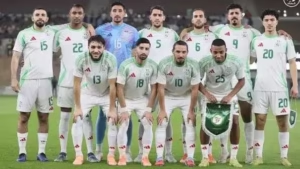
The Ivory Coast national football team, culturally and universally heralded across the sporting landscape as Les Éléphants (The Elephants), represents one of the most physically dominant, technically gifted, and historically prestigious football programs on the African continent. Operating within the intense competitive landscape of West African football, the Ivory Coast has built a global reputation for producing world-class powerhouse athletes who combine explosive speed, brute physical strength, and immense tactical resilience.
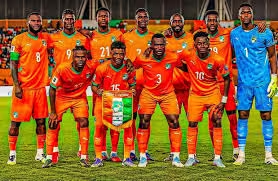
Following their historic continental triumph at the 2023 Africa Cup of Nations (AFCON) on home soil and structural stabilization under modern tactical management, Les Éléphants enter the current international landscape as an elite regional giant. Blending a robust, multi-champion European club core with a devastatingly fast wave of young forward talent, the Ivory Coast stands as a monumental structural obstacle for international opponents. This comprehensive profile breaks down the structural design of the active senior roster, foundational history, individual records, and up-to-date statistical performance data.
Brief History and Core Continental Achievements
The Ivorian Football Federation was founded in 1960 and officially admitted to FIFA in 1964, later joining the Confederation of African Football (CAF) in 1965. On their home continent, the Ivory Coast stands as an undisputed heavyweight, capturing three Africa Cup of Nations titles (1992, 2015, and 2023) alongside finishing as continental runners-up twice, establishing a rich institutional legacy that commands immense sporting respect.
The Golden Generation and Global Breakthrough
The turn of the 21st century sparked a monumental golden era for Ivorian football. Spearheaded by the legendary Didier Drogba and the Touré brothers, the Ivory Coast secured their historic, maiden qualification for the 2006 FIFA World Cup in Germany. The Elephants established an elite benchmark of global competitiveness by qualifying for three consecutive World Cup final tournaments (2006, 2010, and 2014). Though placed in consecutive competitive groups alongside global superpowers like Brazil, Argentina, and Portugal, they consistently delivered high-intensity, fearless performances that captured global sports adoration.
Technical Roster Breakdown (2026 Campaign)
Under highly disciplined tactical management, the modern Ivorian squad functions primarily inside a robust, physically dominant 4-3-3 or a fluid 4-2-3-1 formation. The system places an absolute premium on high-intensity physical duels, structural security through powerful deep pivots, and rapid vertical wide distributions to isolate direct, explosive wingers.
1. Goalkeepers
The Ivorian goal area requires exceptional reflex shot-stopping, commanding aerial dominance during set-piece phases, and physical robustness.
- Yahia Fofana (#1): The preferred first-choice starting goalkeeper. Fofana brings world-class positioning, superb penalty box collection metrics, and immense tactical composure forged in the French Ligue 1.
- Badra Ali Sangaré (#16): A vastly experienced veteran shot-stopper who provides elite starting-caliber backup depth and vital locker-room leadership from the bench.
- Charles Folly (#23): A sharp, highly agile domestic-based keeper finalizing a highly secure goalkeeping department.
2. Defenders
The defensive line focuses on absolute physical enforcement, immense aerial containment, and fullbacks capable of executing intense recovery tracking.
- Evan Ndicka (#21): The central defensive anchor and structural leader. Operating at the elite European first-division level, Ndicka provides world-class recovery speed, exceptional reading of passing lines, and robust physical tackling power.
- Odilon Kossounou (#5) & Ousmane Diomande (#6): Highly sought-after, elite modern center-backs who form a physically intimidating partnership alongside Ndicka, offering immense ground pace and comfortable short-passing distribution.
- Wilfried Singo (#3): A versatile, explosive defender who operates seamlessly as a right-sided center-back or an attack-minded, physically dominant right-back.
- Ghislain Konan (#13): A highly disciplined, high-stamina left-back responsible for shutting down wing isolation attempts and executing recovery tracking.
- Willy Boly (#4) & Emmanuel Agbadou (#2): Physically robust, towering defensive backup options built for rugged international tournament battles.
3. Midfielders
The midfield functions as a tireless, hard-pressing engine room, meticulously balancing intense defensive screening with vertical box-to-box driving runs.
- Franck Kessié (#8): The captain, primary midfield maestro, and undisputed emotional heartbeat of the team. Kessié provides elite press-resistance, world-class physical shielding, and a legendary reputation for executing clutch goals.
- Seko Fofana (#6): A highly dynamic, powerhouse box-to-box midfielder. Fofana utilizes explosive physical driving lines, immense upper-body strength, and long-range shooting threat to completely unbalance opposition lines.
- Ibrahim Sangaré (#18): The primary defensive shield and tactical anchor. Sangaré excels at executing high-volume tackles, clogging central passing channels, and protecting the central defenders.
- Jean Michaël Seri (#4): The veteran deep-lying playmaker who provides elite technical vision, metronomic passing range, and tempo modulation out of pressure.
4. Forwards
The frontline provides a devastating mixture of world-class transitional speed, direct 1v1 wing isolation dominance, and immense physical target presence.
- Sébastien Haller (#22): The premier central forward leading the attack. Haller offers world-class physical hold-up capabilities, exceptional aerial dominance inside the box, and an iconic history of scoring tournament-winning goals.
- Simon Adingra (#7): An exceptionally fast, technically brilliant young winger. Adingra utilizes explosive acceleration, direct 1v1 dribbling flair, and precise crossing metrics from the flanks to dismantle backlines.
- Oumar Diakité (#14): A highly dynamic, relentless young forward whose tireless pressing lines and explosive physical pace inject sudden vertical power late in matches.
- Nicolas Pépé (#19) & Jeremie Boga (#10): Highly technical inside-forwards who operate from wide spaces to generate creative shooting angles or combine with overlapping fullbacks.
- Christian Kouamé (#11) & Karim Konaté (#9): Direct forward variants utilized to alter attacking directness and run channels to wear down opposition center-backs.
FIFA World Cup Performance Statistics
The Ivory Coast’s statistical resume highlights an international program that stands as one of Africa’s most consistent modern representatives, recording notable victories over European and Asian opposition.
World Cup Tournament History Dashboard
The table below logs the absolute performance metrics of the Ivory Coast across their historical FIFA World Cup final appearances:
| World Cup Edition | Host Country | Overall Record (W-D-L) | Goals (GF-GA) | Final Tournament Milestone / Result |
|---|---|---|---|---|
| 2006 | Germany | 1-0-2 | 5-6 | Group Stage Exit (World Cup Debut vs Argentina) |
| 2010 | South Africa | 1-1-1 | 4-3 | Group Stage Exit (Clean Sheet vs Portugal) |
| 2014 | Brazil | 1-0-2 | 4-5 | Group Stage Exit (Defeated Japan 2-1) |
| Historical Totals | 3 Tournaments Entered | 3-1-5 | 13-14 | First World Cup Point and Win Secured in 2006 |
Legendary Individual Records and Milestones
The history of Les Éléphants is written by pioneering global superstars and dedicated international veterans who established the absolute highest standards for African sports.
All-Time Cap and Scoring Leaderboards
The tables below document the historical all-time record holders for senior international appearances and goals scored for the Ivorian men’s national team:
| Rank | Most Capped Players | Total International Caps | Career Era | Goals Scored |
|---|---|---|---|---|
| 1 | Didier Zokora | 123 | 2000–2014 | 1 |
| 2 | Kolo Touré | 120 | 2000–2015 | 7 |
| 3 | Didier Drogba | 105 | 2002–2014 | 65 |
| 4 | Yaya Touré | 102 | 2004–2015 | 19 |
| 5 | Max Gradel | 101 | 2011–2024 | 17 |
| Rank | All-Time Top Goalscorers | Goals Scored | Matches Played | World Cup Goals |
|---|---|---|---|---|
| 1 | Didier Drogba | 65 | 105 | 2 (First-Ever World Cup Goal) |
| 2 | Abdoulaye Traoré | 49 | 88 | 0 |
| 3 | Djohan Tiéhi | 28 | 50 | 0 |
| 4 | Salomon Kalou | 28 | 97 | 1 |
| 5 | Gervinho | 23 | 86 | 2 |
Elite Individual Benchmarks
- The Immortal Drogba Legacy: Legendary striker Didier Drogba stands entirely unrivaled at the absolute pinnacle of Ivorian sports history, serving as the nation’s all-time top scorer with 65 international goals and netting the country’s first-ever World Cup goal against Argentina in 2006.
- The Unrivaled Cap Century: Midfield shield Didier Zokora stands entirely alone as the undisputed most-capped player in national history with 123 caps, spearheading the structural foundation of the original golden era.
- The Continental Master: Midfielder Yaya Touré achieved an extraordinary individual record by being named the African Footballer of the Year for four consecutive years (2011 to 2014), mirroring his elite club dominance at the international level.
Tactical Identity: The Power Counter-Press and Wide Overloads
The contemporary tactical blueprint of Les Éléphants operates primarily out of a highly flexible, physically overwhelming 4-3-3 matrix. The hallmark of the entire system is territorial midfield suffocation. Out of possession, Ibrahim Sangaré and Franck Kessié lead highly aggressive, synchronized pressing triggers to choke out central progressive lanes, ruthlessly forcing opposition distributions outward toward the lateral flanks.
Once a physical turnover is secured, the Ivory Coast transitions with terrifying vertical speed. Rather than engaging in prolonged, risk-heavy possession build-ups inside their own defensive half, deep pivots immediately target rapid wide channels. This movement unleashes the explosive 1v1 acceleration of Simon Adingra to isolate fullbacks, while high-stamina fullbacks provide overlapping width to deliver high-volume horizontal crosses into the box, maximizing the towering aerial height and clinical hold-up play of Sébastien Haller.
Conclusion
The Ivory Coast national football team stands as a monumental testament to long-term structural organization, extreme physical power, and tactical maturity. Their highly organized, high-speed transitional framework highlights an international program masterfully engineered to systematically neutralize and exploit the defensive shapes of continental giants. As Franck Kessié coordinates midfield tempos and Evan Ndicka enforces defensive containment, Les Éléphants possess every structural parameter necessary to maintain their position among the elite of international football.