The Portugal men’s national football team, known globally as A Seleção (The Selection) or Os Navegadores (The Navigators), represents one of the most technically gifted, tactically versatile, and historically decorated football programs in European and world football. Operating within the hyper-competitive landscape of UEFA, Portugal has systematically transformed from a perennial underachiever into a continental powerhouse and global champion, blending generational talent with sophisticated tactical systems.
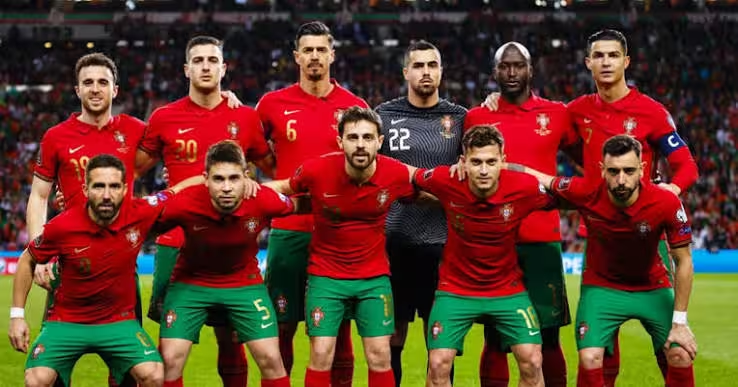
Following a period of transition that saw the end of an iconic era, Portugal has undergone a remarkable renaissance. With a golden generation of young attacking talent emerging alongside battle-hardened veterans, the Navigators have re-established themselves as genuine contenders for the sport’s ultimate prizes. This comprehensive profile breaks down the architectural design of the active senior roster, foundational history, individual records, and up-to-date tournament performance data.
Brief History and Core Continental Achievements
The Portuguese Football Federation (FPF) was founded in 1914 and joined FIFA in 1923. On the European stage, Portugal stands as a heavyweight, capturing one UEFA European Championship title (2016 in France) and finishing as runners-up in 2004 on home soil. The nation has also claimed the UEFA Nations League title in 2019, completing a clean sweep of major UEFA trophies in a remarkable four-year period.
Global Breakthrough and World Cup Campaigns
Portugal’s footballing identity was forged on the global stage by the legendary Eusébio, who propelled the nation to their first World Cup success in 1966, finishing third in England—a feat not matched until 2024. Over nine completed World Cup appearances, Portugal’s absolute global peak arrived in 2006 when they reached the semi-finals, finishing fourth. The 2022 tournament in Qatar saw the Navigators reach the quarter-finals, while their best modern performance includes a Round of 16 appearance in 2010 and group stage exits in 2014 and 2018.
Technical Roster Breakdown
The modern Portuguese squad operates with remarkable tactical flexibility, capable of deploying in multiple formations including a fluid 4-3-3, a diamond 4-4-2, or a possession-dominant 3-5-2. The tactical template places an absolute premium on technical security, positional interchangeability, and devastating vertical transitions orchestrated by one of the greatest playmakers in football history.
1. Goalkeepers
The Portuguese goalmouth requires elite shot-stopping reflexes, exceptional distribution under pressure, and commanding organizational presence.
- Diogo Costa: The undisputed first-choice goalkeeper and a modern sweeper-keeper in every sense. Costa brings elite reflex shot-stopping, extraordinary composure under high-stakes international pressure, and progressive passing metrics that rival outfield players. His ability to initiate attacks from the back and make crucial one-on-one saves has made him indispensable.
- José Sá: A vastly experienced veteran shot-stopper who provides elite starting-caliber backup depth. Sá’s shot-stopping reliability, penalty-box command, and physical presence offer immense security in the goalkeeping department.
- Rui Patrício: The legendary former starter and all-time great who continues to provide invaluable leadership and experience. Patrício’s 100+ international caps and Euro 2016 heroics ensure the goalkeeping unit is anchored by a proven winner.
2. Defenders
The defensive backline is engineered for tactical versatility, strict spatial containment, and progressive ball-playing capabilities from every position.
- Rúben Dias: The defensive anchor, structural leader, and heartbeat of the Portuguese backline. Operating at the elite European first-division level, Dias provides world-class recovery speed, robust physical tackling power, and exceptional organizational intelligence. His leadership and composure make him the undisputed commander of the defense.
- António Silva & Gonçalo Inácio: Exceptionally talented young central defenders who partner Dias to form an impenetrable structural shield. Silva brings physical dominance and aerial superiority, while Inácio provides elite left-footed progressive passing and intelligent reading of the game.
- Nuno Mendes: A world-class left-back and generational talent. Operating from the lateral flank, Mendes provides blistering vertical speed, elite 1v1 touchline dribbling skills, and exceptional progressive passing lines. His attacking output is matched only by his defensive recovery capabilities.
- João Cancelo: The ultimate tactical chameleon and elite inverted full-back. Cancelo’s extraordinary technical ability, positional intelligence, and versatility allow him to operate as a traditional full-back, wing-back, or inverted midfielder. His progressive passing and creative output are unmatched from defensive positions.
- Diogo Dalot & Nélson Semedo: Highly disciplined, attack-minded right-backs responsible for providing vertical width and executing quick recovery tracking. Dalot’s youth and energy complement Semedo’s veteran experience and defensive reliability.
3. Midfielders
The midfield functions as a technically supreme, positionally fluid engine room, meticulously balancing deep possession orchestration with intense pressing traps and creative incision.
- Bernardo Silva: The midfield magician, tactical conductor, and creative heartbeat of the team. Operating in a hybrid midfield-right forward role, Bernardo utilizes world-class close control, generational passing vision, and elite defensive work rate to completely dictate tactical tempo. His positional intelligence and ability to operate in tight spaces are unparalleled.
- Bruno Fernandes: The creative linchpin and goal-scoring midfielder. Fernandes provides extraordinary final-third passing, elite chance creation metrics, and a relentless goal threat from midfield. His penalty-box entries, set-piece delivery, and long-range shooting make him one of the most dangerous attacking midfielders in world football.
- Rúben Neves & João Palhinha: The defensive midfield anchors and ball-winning enforcers. Neves brings exceptional long-range passing, press-resistant composure, and dead-ball expertise, while Palhinha provides physical dominance, relentless tackling, and aerial superiority in midfield duels.
- Vitinha & Matheus Nunes: Highly press-resistant, progressive ball-carriers who provide immense technical security and dribbling penetration from deep. Vitinha’s extraordinary close control and Nunes’s powerful ball-carrying give Portugal multiple midfield profiles.
- João Félix: The creative forward-midfielder hybrid who provides unpredictable movement, exceptional spatial intelligence, and goalscoring threat from advanced areas.
4. Forwards
The frontline provides a devastating combination of world-class finishing, blistering pace, and relentless attacking pressure.
- Cristiano Ronaldo: The captain, undisputed GOAT candidate, and talismanic legend. Operating as the central striker, Ronaldo utilizes extraordinary movement, elite aerial dominance, and a relentless goalscoring instinct that has seen him become the highest goalscorer in football history. At 40+, his leadership, experience, and clutch mentality remain invaluable.
- Rafael Leão: A world-class wide forward and generational talent. Operating from the left flank, Leão combines extraordinary explosive acceleration, elite 1v1 dribbling, and devastating goal threat. His ability to cut inside, drive at defenses, and produce match-winning moments makes him one of the most dangerous attackers in world football.
- Gonçalo Ramos: The dynamic young central striker providing a different profile. Ramos brings relentless pressing, intelligent movement, and clinical finishing. His hat-trick at the 2022 World Cup announced him as a major talent and provides Portugal with a different attacking dimension.
- João Pedro & Pedro Neto: Exceptionally fast, technically brilliant wide forwards who operate from wide spaces to generate creative angles, stretch opposition defenses, and inject unpredictable transitional flair.
- Francisco Trincão: A skilful, creative winger who provides depth and tactical flexibility, offering dribbling penetration and creative output from wide positions.
FIFA World Cup Performance Statistics
Portugal’s statistical resume highlights an international program that has consistently competed at the highest level, with a third-place finish representing their absolute peak.
World Cup Tournament History Dashboard
The table below logs Portugal’s absolute performance metrics across their completed FIFA World Cup final appearances:
| World Cup Edition | Host Country | Overall Record (W-D-L) | Goals (GF-GA) | Final Tournament Milestone / Result |
|---|---|---|---|---|
| 1966 | England | 4-0-2 | 12-6 | Third Place (Highest Historical World Cup Finish) |
| 1986 | Mexico | 1-0-2 | 2-4 | Group Stage Exit |
| 2002 | South Korea/Japan | 1-0-2 | 6-4 | Group Stage Exit |
| 2006 | Germany | 4-1-2 | 7-5 | Fourth Place (Semi-Final Exit) |
| 2010 | South Africa | 1-2-1 | 7-1 | Round of 16 Exit |
| 2014 | Brazil | 1-0-2 | 4-7 | Group Stage Exit |
| 2018 | Russia | 1-2-1 | 6-6 | Round of 16 Exit |
| 2022 | Qatar | 3-0-2 | 12-8 | Quarter-Final Exit |
| Historical Totals | 9 Tournaments | 16-5-13 | 56-41 | 1x Third Place, 1x Fourth Place |
UEFA European Championship Performance Statistics
Portugal’s dominance on the continental stage is equally impressive, highlighted by their historic 2016 triumph.
Euro Tournament History Dashboard
| Tournament Edition | Host Country | Overall Record (W-D-L) | Goals (GF-GA) | Final Tournament Milestone / Result |
|---|---|---|---|---|
| 1984 | France | 0-2-1 | 2-4 | Semi-Final Exit |
| 1996 | England | 2-1-1 | 5-4 | Quarter-Final Exit |
| 2000 | Netherlands/Belgium | 4-0-1 | 10-4 | Semi-Final Exit |
| 2004 | Portugal | 3-1-2 | 8-9 | Runners-Up |
| 2008 | Austria/Switzerland | 2-0-2 | 7-6 | Quarter-Final Exit |
| 2012 | Poland/Ukraine | 3-1-2 | 6-6 | Semi-Final Exit |
| 2016 | France | 3-5-1 | 9-5 | Champions |
| 2020 | Europe (Multiple) | 4-0-0 | 10-4 | Round of 16 Exit |
| Historical Totals | 9 Tournaments | 21-10-10 | 57-42 | 1x Champions, 1x Runners-Up |
All-Time Cap and Scoring Leaderboards
The tables below document the historical all-time record holders for senior international appearances and goals scored for the Portugal men’s national team:
| Rank | Most Capped Players | Total International Caps | Career Era | Goals Scored |
|---|---|---|---|---|
| 1 | Cristiano Ronaldo | 217 | 2003–Present | 135 |
| 2 | Joao Moutinho | 146 | 2005–2022 | 7 |
| 3 | Pepe | 141 | 2007–2024 | 8 |
| 4 | Luis Figo | 127 | 1991–2006 | 32 |
| 5 | Nani | 112 | 2006–2017 | 24 |
| Rank | All-Time Top Goalscorers | Goals Scored | Matches Played | World Cup Goals |
|---|---|---|---|---|
| 1 | Cristiano Ronaldo | 135 | 217 | 8 |
| 2 | Pauleta | 47 | 88 | 4 |
| 3 | Eusébio | 41 | 64 | 9 |
| 4 | Luis Figo | 32 | 127 | 0 |
| 5 | Nuno Gomes | 29 | 79 | 1 |
Elite Individual Benchmarks
The Ultimate Goalscoring Apex
Cristiano Ronaldo stands as the undisputed greatest goalscorer in football history, with an extraordinary 135 senior international goals—a record unmatched in the men’s game. His unparalleled consistency across five World Cup tournaments, five European Championships, and two decades of elite performance has redefined the boundaries of sporting excellence.
The Appearance Record Monolith
With 217 international appearances, Ronaldo also holds the record for the most-capped European player in history and the all-time record for any male international. His longevity and durability are as remarkable as his goalscoring feats.
The Euro 2016 Triumph
The 2016 European Championship victory ended Portugal’s 92-year wait for a major international trophy, with Ronaldo’s emotional leadership from the sidelines after injury symbolizing the collective spirit that defined the campaign. Eder’s extra-time winner against France in Paris sealed the nation’s greatest sporting achievement.
The Golden Era
The duo of Ronaldo and Pepe represented the spine of Portuguese football for over a decade and a half, with Pepe’s defensive excellence, leadership, and 141 caps making him one of the greatest defenders in Portuguese history. Their partnership defined an era of consistent deep tournament runs.
Tactical Identity: Fluid Possession and Devastating Transition
The contemporary tactical blueprint of the Navigators operates primarily out of a sophisticated, positionally fluid 4-3-3 or 3-5-2 matrix. The core philosophy centers on total territorial control through geometric triangles and relentless ball circulation.
Rather than engaging in static, safe lateral recycling, Portugal utilizes the world-class deep orchestration of Bernardo Silva and the vertical thrust of Bruno Fernandes to break lines instantly. While playmakers like Vitinha draw out opposing defensive pivots, deep anchors switch the play wide to release the explosive acceleration of Rafael Leão, whose direct running terrorizes isolated defenders.
Fullbacks like Nuno Mendes and João Cancelo provide overlapping width and underlapping runs to stretch opposition lines horizontally, creating massive spaces inside the penalty box for the movement of Cristiano Ronaldo. This technical compression triggers immediate vertical exploitation, transforming deep possession containment into clinical final-third execution.
The pressing system is equally sophisticated. Portugal triggers coordinated high presses through Ronaldo’s relentless leadership, with wingers squeezing inside to trap opposition against touchlines. The midfield trio of defensive anchors and creative playmakers ensures both defensive solidity and immediate transition threat.
Conclusion
The Portugal men’s national football team stands as a magnificent monumental pillar of European and world football history, blending unmatched technical heritage, generational talent, and modern tactical sophistication with the immortal Cristiano Ronaldo continuing to write history, the generational brilliance of Rafael Leão, the tactical intelligence of Bernardo Silva, the creative output of Bruno Fernandes, and the defensive leadership of Rúben Dias, the Navigators possess every structural asset necessary to challenge for the sport’s ultimate prizes and cement their status as one of the most formidable forces in world football.