The Uzbekistan men’s national football team, known across the global sporting landscape as the Oq Boʻrilar (White Wolves), represents one of the most compelling and rapidly evolving football narratives in Asian football. After decades of agonizing near-misses and heartbreaking qualification heartbreaks, the Central Asian powerhouse has finally achieved its ultimate dream: qualification for the FIFA World Cup. Their debut at the 2026 tournament in North America marks a historic milestone, crowning more than three decades of relentless development since the nation’s independence from the Soviet Union in 1991.
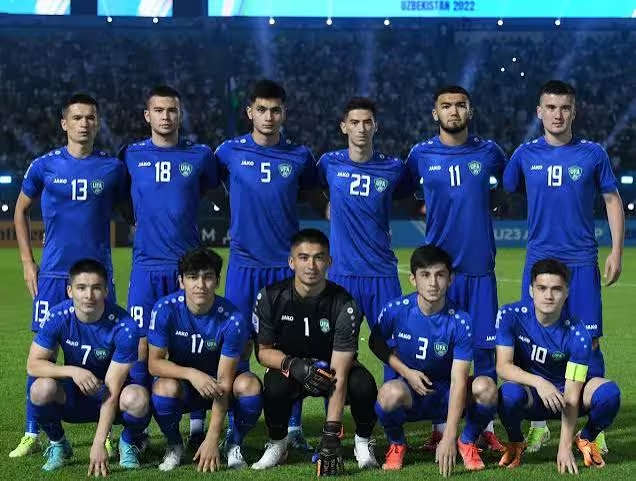
Operating within the fiercely competitive landscape of Asian football, Uzbekistan has systematically built a reputation for blending tactical discipline with physical resilience and growing technical sophistication. Under the guidance of a World Cup-winning legend, the White Wolves now stand ready to test themselves against the global elite, bringing a settled squad, a clear tactical identity, and a burning desire to prove their place on the world’s biggest stage.
Brief History and Core Continental Achievements
The Uzbekistan Football Association was established in 1992, joining FIFA and the Asian Football Confederation in 1994 following the nation’s independence. Since then, Uzbekistan has qualified for every AFC Asian Cup, establishing itself as one of the most consistent teams in the continent. Their best continental performance came at the 2011 Asian Cup in Qatar, where they reached the semi-finals for the first time in their history, ultimately finishing fourth.
The White Wolves have also tasted success at other regional competitions. They won the gold medal at the 1994 Asian Games in Hiroshima as debutants, defeating China 4-2 in the final. In 2025, they added the CAFA Nations Cup to their trophy cabinet. Their consistent presence in the latter stages of Asian competitions has cemented their reputation as Central Asia’s most successful football nation.
The Road to World Cup 2026: A Historic Breakthrough
Uzbekistan’s journey to the 2026 World Cup was built on a foundation of consistency and resilience. Across both rounds of AFC qualification, the White Wolves lost just one of their 16 matches, a 3-2 defeat in Qatar. Their campaign was defined by hard-fought draws against continental giants Iran, with all four meetings between the two sides ending level.
The historic moment arrived on June 5, 2025, when a scoreless draw against the United Arab Emirates in Abu Dhabi finally secured Uzbekistan’s place at the global finals. This achievement made Uzbekistan the first Central Asian nation and the third former Soviet republic after Russia and Ukraine to qualify for a World Cup.
Technical Roster Breakdown
The modern Uzbek squad operates primarily within a disciplined 3-4-2-1 formation, which transforms into a compact 5-4-1 without possession. The tactical blueprint emphasizes defensive solidity, mid-block pressing, and devastating counter-attacking transitions, a philosophy brought to the team by their World Cup-winning coach.
1. Goalkeepers
The Uzbek goalmouth demands commanding presence, exceptional shot-stopping reflexes, and authoritative box management.
- Utkir Yusupov
The undisputed first-choice goalkeeper and a key architect of Uzbekistan’s historic qualification. Yusupov’s penalty-saving heroics in the two matches against North Korea proved pivotal in securing crucial points, cementing his status as a reliable last line of defense.
Backup Options
While Yusupov stands as the clear starter, the goalkeeping department benefits from experienced backups who provide solid competition and dependable depth for the squad.
2. Defenders
The defensive backline serves as the tactical bedrock of the team, engineered for absolute physical dominance, strict spatial containment, and the disciplined execution of the defensive system.
- Abdukodir Khusanov
The rapid Manchester City centre-back is the most recognizable face in the Uzbek squad and the first player from Uzbekistan to feature in the Premier League. The 21-year-old has enjoyed a breakthrough season at the highest level, earning praise from his manager as a “top signing” who is “so coachable.” His jerseys are reportedly available at bazaars across the country, reflecting his status as a national icon.
- Rustam Ashurmatov & Abdullaev
The towering central defensive enforcers who partner Khusanov to form an impenetrable structural shield inside the box. Together, they provide the physical presence and aerial dominance required to neutralize opposition attacks.
- Sayfiev & Nazrullaev
Highly disciplined wing-backs responsible for providing vertical width in transition while executing quick recovery tracking. The right flank is particularly crucial, as it will be tasked with containing dangerous opposition wingers.
- Young Prospect – Behruz Karimov
Born in 2007, the teenage right-back has been one of the breakthrough stories in Uzbek football. After making his professional debut in March 2025, he soon earned a senior call-up and recovered from a broken toe in time to be considered for the World Cup squad.
3. Midfielders
The midfield functions as a tireless, structurally disciplined engine room, meticulously balancing defensive screening with quick transitions into attacking channels.
- Otabek Shukurov & Mozgovoy
- Jaloliddin Masharipov
A veteran midfielder whose experience and creativity are invaluable. His absence due to a back injury is a significant blow for the White Wolves, placing additional responsibility on the younger generation to step up.
- Abbosbek Fayzullaev
The 22-year-old winger voted Asia’s best young player in 2023. Operating in the advanced midfield positions of the 3-4-2-1, Fayzullaev’s playing style has drawn comparisons to a certain Champions League-winning winger. He scored four goals during World Cup qualifying, including crucial strikes against North Korea and Iran. His close-control dribbling, spatial intelligence, and creative vision unlock opposition defenses.
- Oston Urunov
The creative partner to Fayzullaev in the advanced midfield roles, Urunov provides additional creative spark and goal threat from deeper positions.
4. Forwards
The frontline provides a devastating combination of physical hold-up play, aerial dominance, and ruthless clinical finishing.
- Eldor Shomurodov
The captain, undisputed talisman, and all-time top goalscorer in Uzbekistan’s history with 44 goals from 84 appearances. Shomurodov brings invaluable experience from Serie A and has enjoyed the most prolific season of his club career, scoring 20 goals in 32 games for Istanbul Başakşehir. His ability to hold up the ball with his back to goal, drag defenders out of position, and create space for arriving midfielders makes him the focal point of the entire tactical structure.
Supporting Cast
The forward line is supported by quick, technically proficient wingers who stretch opposition defenses and provide width. When the direct play connects with Shomurodov’s movement, the Uzbek attack becomes an imminent threat to any opposition.
FIFA World Cup Performance Statistics
As a debutant nation, Uzbekistan has no prior World Cup record to review, though their qualification run was remarkably impressive.
2026 Qualification Campaign Dashboard
| Stage | Matches Played | Wins | Draws | Losses | Goals For | Goals Against | Outcome |
|---|---|---|---|---|---|---|---|
| Second Round | 6 | 4 | 2 | 0 | N/A | N/A | Advanced to Third Round |
| Third Round | 10 | 6 | 3 | 1 | 19 | 9 | Qualified |
| Total | 16 | 10 | 5 | 1 | 27 | 11 | 1st World Cup Appearance |
The campaign was defined by an unshakeable defensive resolve, with the team conceding just 11 goals across their 16 qualifiers, while the attack produced enough firepower to secure results. Their only defeat came away to Qatar, but the team’s resilience ensured they bounced back to secure their historic berth.
All-Time Cap and Scoring Leaderboards
The tables below document the historical record holders for senior international appearances and goals scored:
| Rank | Most Capped Players | Total Caps | Career Era |
|---|---|---|---|
| 1 | Server Djeparov | 128 | 2002–2017 |
| 2 | Timur Kapadze | 109 | 2002–2017 |
| 3 | Odil Ahmedov | 108 | 2007–2021 |
| 4 | Alexander Geynrikh | 97 | 2002–2017 |
| 5 | Eldor Shomurodov | 84 | 2015–Present |
| Rank | All-Time Top Goalscorers | Goals Scored | Matches Played |
|---|---|---|---|
| 1 | Eldor Shomurodov | 44 | 84 |
| 2 | Maksim Shatskikh | 34 | 61 |
| 3 | Mirjalol Qosimov | 31 | 67 |
| 4 | Alexander Geynrikh | 31 | 97 |
| 5 | Server Djeparov | 25 | 128 |
Elite Individual Benchmarks
The Goal-Scoring Apex
Towering striker Eldor Shomurodov stands as the undisputed all-time top goalscorer in Uzbek history, netting an extraordinary 44 senior goals to sit comfortably clear at the top of national records while simultaneously approaching the century cap mark.
The Appearance Record Monolith
Midfield maestro Server Djeparov remains the most-capped player in Uzbekistan’s history with 128 appearances, a testament to his enduring quality and contribution to the national team.
The Rising Star
Manchester City’s Abdukodir Khusanov represents the new generation of Uzbek talent, becoming the first player from the country to feature in the Premier League and Champions League. At just 21, his trajectory suggests he could one day challenge for both appearance and goal records.
Tactical Identity: Pragmatic Defense and Devastating Transition
The contemporary tactical blueprint of the White Wolves operates primarily out of a highly disciplined 3-4-2-1 matrix, maintained by their World Cup-winning coach following the framework established by his predecessor. The core philosophy centers on defensive solidity and mid-block suffocation.
Under this pragmatic philosophy, the team prioritizes absolute safety before considering attacking ventures. The 3-4-2-1 formation morphs into a compact 5-4-1 when out of possession, with the emphasis on narrowing spaces, forcing opposition errors in midfield, and then launching direct, devastating counter-attacks.
The team is ill-suited to playing out from the back, preferring a more direct approach that exploits the physicality of their forwards and the pace of their wingers. When the direct play connects with captain Eldor Shomurodov’s hold-up movement, the attack becomes an imminent threat, with space created for the arriving creativity of Abbosbek Fayzullaev.
The manager has described his players as “fighters at heart – they never give up.” This fighting spirit, combined with a clear tactical plan and a squad that knows each other’s game intimately, forms the foundation of Uzbekistan’s World Cup challenge.
Conclusion
The Uzbekistan men’s national football team stands as a magnificent monument to perseverance, development, and tactical evolution. After decades of heartbreak, the White Wolves have finally reached the promised land of the FIFA World Cup, fulfilling a dream that eluded a generation of legends. Their legendary qualification campaign confirms an international program masterfully engineered to systematically neutralize opposition systems while capitalizing on devastating transitions. With a World Cup-winning captain now guiding their destiny, a generational talent in Abdukodir Khusanov anchoring the defense, a creative spark in Abbosbek Fayzullaev, and the prolific captain Eldor Shomurodov leading the line, Uzbekistan possesses every structural asset necessary to make a memorable debut on the global stage. The journey to Mexico City, where they will face Colombia in their historic opening match, represents the culmination of over three decades of progress and the beginning of a new chapter for Central Asian football.