The Mexico national football team, culturally and globally known as El Tri (The Tricolor), stands as the indisputable historical titan of the CONCACAF region. Blessed with an immensely passionate footballing culture, a massive domestic sporting economy, and a rich history of technical, high-intensity play, Mexico has consistently served as a permanent fixture at major international tournaments.
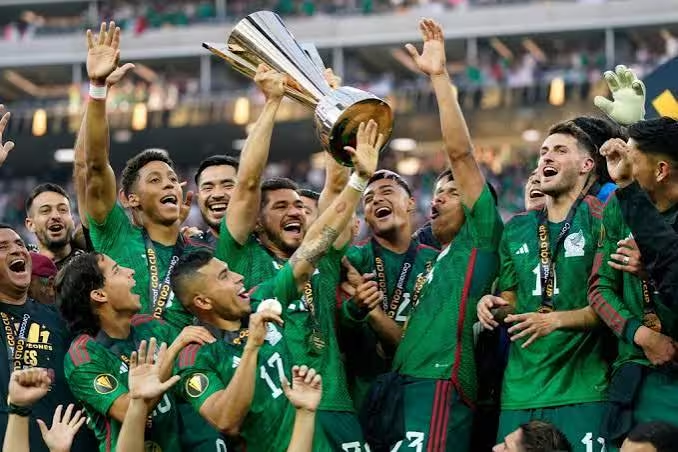
Following a period of intense structural transition and the appointment of a new coaching regime, El Tri enters the 2026 FIFA World Cup under unique sporting pressure. As co-hosts of this expanded global tournament alongside the United States and Canada, Mexico enjoys massive home-soil advantage at the iconic Estadio Azteca. This comprehensive, professional review breaks down the structural design of the active 2026 roster, historical milestones, individual records, and up-to-date tournament data.
Brief History and Core Continental Achievements
Mexico’s footballing history is marked by absolute regional dominance and a long-standing pursuit of an elusive world elite breakthrough. On the continental stage, Mexico is the most decorated nation in Central and North American history, capturing a record 12 CONCACAF Gold Cup titles alongside three historic iterations of the previous CONCACAF Championship.
The World Cup Pedigree and the “Quinto Partido”
Mexico’s international history is uniquely characterized by supreme consistency at the group stage, coupled with heartbreak in the knockout phase. El Tri hosted the FIFA World Cup in 1970 and 1986, reaching the Quarter-finals on both occasions—which stands as their highest placement. Following their return to global competition in 1994, Mexico achieved an extraordinary streak, successfully advancing past the group stage in seven consecutive tournaments from 1994 to 2018. However, they were eliminated in the Round of 16 in all seven instances, turning the pursuit of the quinto partido (the fifth game) into a national sporting obsession.
Technical Roster Breakdown (2026 Campaign)
The modern Mexican squad blends highly experienced domestic Liga MX legends with a fast, technically gifted wave of European-based inside forwards. The tactical setup emphasizes positional fluidity, intense high-pressing phases, and heavy reliance on overlapping wingers.
1. Goalkeepers
The Mexican goal area represents a generational transition, shifting away from long-serving historical figures toward modern shot-stoppers.
- Luis Malagón (#1): The active starting goalkeeper at the 2026 finals. Malagón brings exceptional close-range reflexes, strong box command, and superb penalty-saving instincts.
- Julio González (#12): A highly experienced, robust shot-stopper who provides elite starting-caliber depth from the bench.
- Alex Padilla (#23): The highly talented, young European-based keeper representing the future of the Mexican goalkeeping department.
2. Defenders
The defensive line focuses on tactical flexibility, blending physical center-backs with ball-carrying fullbacks who dictate width in attack.
- César Montes (#3) & Johan Vásquez (#5): The preferred central defensive partnership, offering robust physical height, superb clearance numbers, and comfortable left-right foot distribution symmetry out of the back.
- Jorge Sánchez (#2) & Gerardo Arteaga (#6): Highly dynamic, attack-minded fullbacks responsible for providing overlapping options and high-volume crosses.
- Israel Reyes (#4) & Jesús Orozco Chiquete (#13): Versatile defenders capable of operating across multiple positions in both three-man and four-man backlines.
- Bryan González (#15) & Alan Mozo (#22): High-energy wide options deployed to provide intense physical tracking against rapid opposition wingers.
3. Midfielders
The midfield functions as a high-work-rate unit engineered to absorb counter-attacks, control possession rhythm, and generate central overloads.
- Edson Álvarez (#4): The captain, defensive screen, and tactical heartbeat of the team. Operating at the elite European level, Álvarez acts as the structural shield protecting the center-backs while distributing play.
- Luis Chávez (#24): Renowned for world-class long-range passing, deep ball progression, and lethal technical ability on dead-ball set pieces.
- Luis Romo (#7) & Érick Sánchez (#8): Dynamic, tireless box-to-box midfielders who provide lateral coverage and late-arriving attacking numbers.
- Charly Rodríguez (#10) & Orbelín Pineda (#17): Creative playmakers tasked with finding space between opposition defensive lines and unlocking deep defensive blocks.
4. Forwards
The frontline provides a mixture of elite target presence, intricate inside-cutting movements, and direct 1v1 wing isolation.
- Santiago Giménez (#9): The premier central striker leading the line. Giménez offers elite off-the-ball movement, clinical final-third finishing, and physical hold-up capabilities.
- Santiago Muñoz (#19) & Henry Martín (#20): Direct central variants utilized to offer contrasting tactical profiles of high-volume pressing and physical link play.
- César Huerta (#21) & Alexis Vega (#11): Creative inside-forwards who operate from wide spaces to generate shooting angles or combine with overlapping fullbacks.
- Diego Lainez (#18) & Marcelo Flores (#14): Fast, technically gifted wide options deployed to inject unpredictable dribbling flair against fatigued defenders.
FIFA World Cup Performance Statistics
Mexico’s statistical resume at the FIFA World Cup ranks them among the most regular tournament participants in international football history, amassing 18 total appearances.
World Cup Tournament History Dashboard
The table below logs Mexico’s absolute performance metrics across their completed and active FIFA World Cup final appearances:
| World Cup Edition | Host Country / Nations | Overall Record (W-D-L) | Goals (GF-GA) | Final Tournament Milestone / Result |
|---|---|---|---|---|
| 1930–1966 | Various Countries | 2-3-11 | 18-42 | Highest Finish: Group Stage |
| 1970 | Mexico | 2-1-1 | 6-4 | Quarter-finals (6th Place Overall) |
| 1978–1982 | Various Countries | 0-0-3 | 2-12 | Highest Finish: Group Stage |
| 1986 | Mexico | 3-2-0 | 6-2 | Quarter-finals (6th Place Overall) |
| 1994–2018 | Various Countries | 11-8-9 | 36-35 | 7x Consecutive Round of 16 Exits |
| 2022 | Qatar | 1-1-1 | 2-3 | Group Stage Exit |
| 2026 | Mexico, USA, Canada | 1-1-0 (Active) | 2-1 | Group Stage Performance |
| Historical Totals | 18 Tournaments Entered | 20-16-25 | 62-99 | Highest Placement: Quarter-finals (1970, 1986) |
The Active 2026 World Cup Campaign
As co-hosts, Mexico bypassed the CONCACAF qualification cycles, utilizing intensive international friendly campaigns to prepare the squad. Competing in Group A on home soil at the Estadio Azteca, El Tri has engaged in highly emotional matches.
- The Group Opener: Mexico kicked off their tournament campaign on June 11, 2026, in Mexico City, grinding out a high-stakes 1-0 victory, establishing an ideal start before an ecstatic home crowd.
- The Second Matchday: On June 18, 2026, Mexico faced a highly organized, tactical opponent at the Estadio Azteca, playing out a tense 1-1 draw.
With 4 points secured, Mexico sits in prime position within Group A to safely book passage into the expanded Round of 32 knockout stages ahead of their final group stage encounter.
Legendary Individual Records and Milestones
The history of Mexican football is built upon iconic global superstars and dedicated veterans who established elite individual benchmarks.
All-Time Cap and Scoring Leaderboards
The tables below document the historical all-time record holders for senior international appearances and goals scored for the Mexican men’s national team:
| Rank | Most Capped Players | Total International Caps | Career Era | Goals Scored |
|---|---|---|---|---|
| 1 | Andrés Guardado | 179 | 2005–2024 | 28 |
| 2 | Claudio Suárez | 177 | 1992–2006 | 7 |
| 3 | Guillermo Ochoa | 151 | 2005–2024 | 0 |
| 4 | Rafael Márquez | 147 | 1997–2018 | 17 |
| 5 | Gerardo Torrado | 144 | 1999–2013 | 6 |
| Rank | All-Time Top Goalscorers | Goals Scored | Matches Played | World Cup Goals |
|---|---|---|---|---|
| 1 | Javier “Chicharito” Hernández | 52 | 109 | 4 |
| 2 | Jared Borgetti | 46 | 89 | 2 |
| 3 | Cuauhtémoc Blanco | 38 | 119 | 3 |
| 4 | Luis Hernández | 35 | 85 | 4 |
| 5 | Carlos Hermosillo | 35 | 90 | 0 |
Elite Individual Records
- The Five-Tournament Club: Legendary defender Rafael Márquez and midfielder Andrés Guardado stand in an elite tier of global football history, having both represented Mexico at five separate FIFA World Cup finals (2002 to 2018 for Márquez; 2006 to 2022 for Guardado).
- The All-Time World Cup Scorer: Luis Hernández and Javier Hernández share the national record for the most goals scored at World Cup final tournaments, netting 4 goals each.
Tactical Identity: The Modern Mexican System
The tactical blueprint of El Tri revolves around a high-tempo, heavy-pressing philosophy operating out of a fluid 4-3-3 or 4-2-3-1 structure. The foundational system aims to compress the pitch out of possession, using the central anchoring properties of Edson Álvarez to force turnovers in the middle third.
When transitioning to attack, Mexico avoids slow possession sequences, looking to feed the ball wide as quickly as possible. Fullbacks overlap to drag opposing defenders out of position, leaving space for inverted wingers to cut inside and combine with Santiago Giménez. This intensive wing overload strategy, combined with the technical long-range passing lines of Luis Chávez, turns Mexico into a highly direct and dynamic threat in the final third.
Conclusion
The Mexico national football team represents a powerful blend of historic regional supremacy, tactical intensity, and unparalleled support. Their disciplined performances at the 2026 World Cup showcase a team utilizing home-soil energy to navigate a crucial structural rebuild. As Edson Álvarez organizes the squad under immense national expectation, El Tri possesses the tactical foundation, technical execution, and physical power necessary to challenge the world’s best and write a historic chapter on the global stage.