The Paraguay national football team, culturally and universally heralded across the sporting landscape as the Albirroja (The White and Red), represents one of the most resilient, fiercely competitive, and defensively secure programs in South American football. Operating within the grueling CONMEBOL confederation, Paraguay has systematically built an international identity centered on tactical discipline, extreme physical grit, and a historical mastery of defensive structural containment.
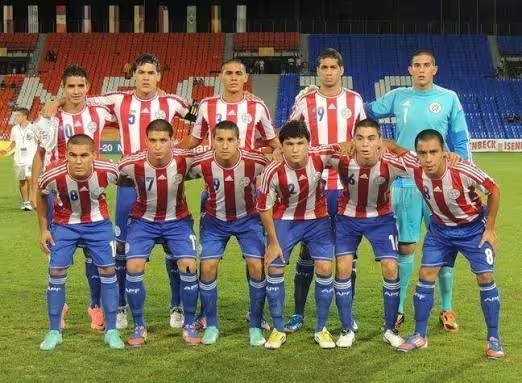
Following a highly focused technical modernization under a new coaching regime, the Albirroja enter the modern landscape as a lethal transitional threat. Combining a physically dominant European and South American club-based defensive core with an explosive wave of fast young forwards, Paraguay stands as a demanding, rugged challenge for global opponents. This comprehensive profile breaks down the structural design of the active senior roster, foundational history, individual records, and up-to-date statistical performance data.
Brief History and Core Continental Achievements
The Paraguayan Football Association was officially founded in 1906 and became a member of CONMEBOL in 1921. On their home continent, Paraguay has consistently bat well above its population weight class, establishing an elite competitive pedigree by capturing two Copa América titles in 1953 and 1979, alongside finishing as continental runners-up six times.
The Golden Age of World Cup Consistency
Paraguay’s historical pinnacle on the global stage is defined by an extraordinary golden era of international consistency between 1998 and 2010. Led by legendary, eccentric icons like goalkeeper José Luis Chilavert and robust central defenders, the Albirroja qualified for four consecutive FIFA World Cup final tournaments. Their absolute benchmark of global excellence was achieved during the 2010 FIFA World Cup in South Africa under manager Gerardo Martino, where a tactically flawless squad marched dramatically into the Quarter-finals, pushing eventual world champions Spain to the absolute limit in a razor-thin 1-0 battle.
Technical Roster Breakdown (2026 Campaign)
The modern Paraguayan squad operates primarily within a highly disciplined, compact 4-2-3-1 or a fluid, counter-attacking 4-3-3 formation. The system places a supreme premium on deep defensive low-blocks, high-volume physical duels in the defensive third, and quick transitional distribution into wide spaces.
1. Goalkeepers
The Paraguayan goal area historical template requires intense vocal box command, exceptional penalty-saving instincts, and physical robustness.
- Carlos Coronel (#1): The active first-choice starting goalkeeper. Coronel brings exceptional short-range reflexes, superb positioning, and extensive Major League Soccer experience.
- Gatito Fernández (#12): A vastly experienced veteran shot-stopper who provides elite starting-caliber depth and leadership from the bench.
- Santiago Rojas (#23): A sharp, agile backup keeper finalizing a highly secure and deeply experienced goalkeeping department.
2. Defenders
The defensive backline is the absolute pride of the Albirroja, engineered for absolute aerial dominance, rugged sliding tackles, and precise positioning.
- Gustavo Gómez (#15): The captain, undisputed defensive anchor, and emotional heartbeat of the team. Gómez offers world-class aerial power, immense physical strength, and legendary organizational leadership.
- Junior Alonso (#6) & Omar Alderete (#3): Top-tier central defenders who partner Gómez to form a highly cohesive structural shield, providing excellent left-footed balance.
- Fabian Balbuena (#4): A vastly experienced central defender providing elite depth and physical enforcement late in matches.
- Matías Espinoza (#16) & Santiago Arzamendia (#14): Highly disciplined wide fullbacks responsible for shutting down wing isolation attempts and executing recovery tracking.
- Iván Ramírez (#2) & Gustavo Velázquez (#13): Hard-tackling, physical wide options built to maintain strict structural containment against explosive wingers.
3. Midfielders
The midfield functions as a tireless, hard-pressing engine room designed to choke out opposition central passing lanes and protect the center-backs.
- Andrés Cubas (#14): The primary defensive shield and tactical anchor. Cubas excels at aggressively breaking up opposition counter-attacks and recycling possession under heavy pressure.
- Mathías Villasanti (#23): A tireless box-to-box engine. Villasanti provides relentless lateral coverage, high-volume ball-winning metrics, and transitions the ball efficiently.
- Diego Gómez (#8): A highly dynamic, rising young midfielder possessing excellent press-resistance, close-control dribbling, and robust driving lines.
- Kaku Alejandro Romero (#10): The creative centerpiece. Operating as an advanced playmaker between the lines, Kaku provides vision and technical dead-ball execution.
- Richard Sánchez (#7) & Gastón Giménez (#16): Highly experienced central anchors deployed to plug passing lanes and sustain pressing densities in the middle third.
4. Forwards
The frontline provides a mixture of elite transitional speed, creative inside-cutting movements, and intense front-line defensive pressing.
- Miguel Almirón (#10): The premier superstar forward and global icon. Operating from the right flank, Almirón utilizes world-class explosive acceleration, direct 1v1 dribbling flair, and high-intensity defensive pressing to completely unbalance opposition lines.
- Julio Enciso (#19): The prodigiously gifted young forward. Enciso offers explosive pace, unpredictable technical dribbling, and lethal long-range shooting threat from inverted wide spaces.
- Adam Bareiro (#9) & Alex Arce (#24): Physically imposing, classic central target strikers chosen to lead the front-line press and convert aerial crosses.
- Ramon Sosa (#21) & Ángel Romero (#11): Fast, direct wide assets deployed to stretch fatigued opposition backlines late in matches.
FIFA World Cup Performance Statistics
Paraguay’s statistical resume highlights an international program that stands as one of South America’s most consistent global competitors, amassing eight total appearances.
| World Cup Era | Host Countries | Overall Record (W-D-L) | Goals (GF-GA) | Final Tournament Milestone / Result |
|---|---|---|---|---|
| 1930–1958 | Various Nations | 3-2-4 | 16-20 | 3x Group Stage Exits (World Cup Debut in 1930) |
| 1986 | Mexico | 1-2-1 | 4-6 | Round of 16 Exit |
| 1998–2006 | France / Korea-Japan / Germany | 3-3-6 | 9-14 | 2x Round of 16 Exits (1998, 2002), 1x Group Stage Exit |
| 2010 | South Africa | 1-3-1 | 3-2 | Quarter-finals (Highest World Cup Finish) |
| Historical Totals | 8 Tournaments Entered | 8-10-12 | 32-42 | 4x Knockout Stage Appearances |
Legendary Individual Records and Milestones
The history of the Albirroja is built upon pioneering goalscorers and iconic, eccentric tournament veterans who established the absolute standard for South American football.
All-Time Cap and Scoring Leaderboards
The tables below document the historical all-time record holders for senior international appearances and goals scored for the Paraguayan men’s national team:
| Rank | Most Capped Players | Total International Caps | Career Era | Goals Scored |
|---|---|---|---|---|
| 1 | Paulo da Silva | 148 | 2000–2017 | 3 |
| 2 | Justo Villar | 120 | 1999–2018 | 0 |
| 3 | Roque Santa Cruz | 112 | 1999–2016 | 32 |
| 4 | Carlos Gamarra | 110 | 1993–2006 | 12 |
| 5 | Roberto Acuña | 100 | 1993–2011 | 5 |
| Rank | All-Time Top Goalscorers | Goals Scored | Matches Played | World Cup Goals |
|---|---|---|---|---|
| 1 | Roque Santa Cruz | 32 | 112 | 1 |
| 2 | José Cardozo | 25 | 82 | 0 |
| 3 | Cristian Riveros | 16 | 99 | 2 |
| 4 | Saturnino Arrúa | 13 | 26 | 0 |
| 5 | Nelson Haedo Valdez | 13 | 77 | 0 |
Elite Individual Benchmarks
- The Chilavert Revolution: Legendary goalkeeper José Luis Chilavert remains an immortal global icon, scoring 8 international goals for Paraguay via his world-class free-kick and penalty-taking abilities, including being the first goalkeeper to take a direct free-kick in World Cup history.
- The Ultimate Marksman: Forward Roque Santa Cruz stands as the undisputed all-time top goalscorer in Paraguayan international history, netting 32 senior goals across a highly decorated international career spanning three World Cup finals.
Tactical Identity: Garra Guaraní and Rigid Low Blocks
The contemporary tactical blueprint of the Albirroja operates primarily out of a highly structured, ultra-compact 4-2-3-1 matrix. The core philosophy centers on absolute defensive resilience, historically termed Garra Guaraní. Paraguay willingly surrenders high-volume possession to elite opponents, choosing to drop into a synchronized mid-to-low block that completely suffocates central lanes.
Out of possession, Andrés Cubas screens the central space with ruthless efficiency, forcing opposition sequences outward toward the touchlines, where physically imposing fullbacks execute hard tackles. Once a turnover is secured, Paraguay transitions with vertical directness. Deep pivots immediately skip midfield lines, looking to release the world-class explosive acceleration of Miguel Almirón into wide open channels, or hit physical strikers for hold-up sequences, transforming deep defensive absorption into efficient final-third execution.
Conclusion
The Paraguay national football team stands as a monumental testament to tactical discipline, extreme physical toughness, and a rich tournament legacy. Their highly organized, low-block defensive framework highlights an international program masterfully engineered to systematically neutralize and pick apart the progressive structures of global football giants. As Gustavo Gómez coordinates the backline with robust authority and Miguel Almirón triggers rapid transitions, the Albirroja possess every structural asset necessary to maintain their historic reputation as the ultimate defensive fortress of South American football.