The Spain national football team, culturally and universally heralded across the sporting landscape as La Roja (The Red) or La Furia Roja, represents the absolute pinnacle of technical sophistication, positional discipline, and tactical orchestration in football history. Renowned as the modern architects of Tiki-Taka—a high-concept philosophy centered on metronomic short-passing, constant geometric triangles, and absolute spatial domination—Spain has permanently transformed the structural and analytical evolution of the global game.
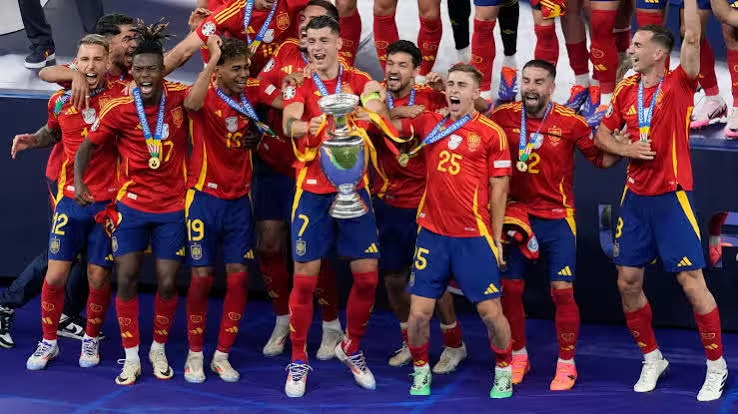
Following their spectacular continental triumph, La Roja enters the international landscape as a terrifyingly complete, multi-dimensional entity. Blending a world-class, press-resistant veteran midfield core with the most explosive, technically brilliant young wing vanguard in modern sports, Spain stands as an incredibly complex tactical puzzle for global opponents. This comprehensive profile breaks down the structural design of the active senior roster, foundational history, individual records, and up-to-date tournament performance data.
Brief History and Core Continental Achievements
The Royal Spanish Football Federation (RFEF) was founded in 1913 and helped co-found UEFA in 1954. On their home continent, Spain stands entirely unrivaled as the most successful nation in European history with a record 4 UEFA European Championships (1964, 2008, 2012, and 2024), establishing an absolute baseline of regional supremacy that commands immense global respect.
The Immortal Triple-Crown Monopoly
Spain’s historical pinnacle on the global stage is defined by an unprecedented, historic era of absolute global monopoly between 2008 and 2012. Under the visionary management of Luis Aragonés and Vicente del Bosque, La Roja became the only nation in football history to win three consecutive major international tournaments (Euro 2008, Euro 2012, and the 2010 FIFA World Cup). Their defining global milestone arrived at the 2010 FIFA World Cup in South Africa, where a tactically flawless squad put on a masterclass of positional strangulation, culminating in Andrés Iniesta’s immortal extra-time winner to capture the FIFA World Cup trophy.
Technical Roster Breakdown
The modern Spanish squad functions inside a highly sophisticated, dominant 4-3-3 archetype. Departing from the sterile, horizontal possession loops of the previous decade, the contemporary template balances traditional short-passing circulation with lethal vertical speed from wide spaces.
1. Goalkeepers
The Spanish goalkeeping department requires exceptional ball-playing sweeping traits, elite short-range reflex capabilities, and absolute mental composure under heavy frontline pressure.
- Unai Simón (#1): The undisputed first-choice starting goalkeeper. Simón brings world-class positioning, incredible reflex metrics, and an exceptional track record for saving penalties in high-stakes international shootouts.
- David Raya (#12): A world-class shot-stopper possessing some of the most precise, progressive ball-playing distribution metrics in European football, providing starting-caliber depth.
- Alex Remiro (#23): A sharp, highly consistent domestic-league backup goalkeeper finalizing an exceptionally secure goalkeeping department.
2. Defenders
The defensive line balances physically imposing, ball-carrying center-backs with high-stamina, explosive fullbacks who look to dictate transitional width.
- Aymeric Laporte (#14) & Robin Le Normand (#3): The preferred starting central defensive partnership, offering immense structural telepathy, high-volume clearance metrics, and precise left-right passing symmetry out of the backline.
- Dani Carvajal (#2): The legendary veteran vice-captain and defensive enforcer. Operating as a robust right-back, Carvajal brings world-class 1v1 defensive isolation traits, immense big-game experience, and elite tracking capabilities.
- Marc Cucurella (#24) & Alejandro Grimaldo (#12): Highly dynamic, attack-minded left-backs responsible for providing vertical progressive width, executing overlapping combinations, and delivering high-volume crosses.
- Dani Vivian (#4) & Pau Torres (#5): Physically robust, high-speed central defensive backups built for rugged international tournament battles.
3. Midfielders
The midfield is the crown jewel and absolute tactical engine room of La Roja, combining unparalleled spatial intelligence with press-resistant ball retention and tempo modulation.
- Rodri (#16): The midfield general, structural hub, and undisputed heartbeat of the team. Widely recognized as the world’s premier deep-lying playmaker, Rodri utilizes world-class press-resistance, generational passing vision, and elite defensive screening to completely dictate the exact tempo of matches.
- Fabián Ruiz (#8) & Mikel Merino (#6): Tireless, technically secure box-to-box engine pivots. Fabián provides world-class progressive ball-carrying lines and line-breaking passing range through the half-spaces, while Merino provides immense physical tracking.
- Dani Olmo (#10): The creative centerpiece. Operating as an advanced attacking playmaker inside the pockets between lines, Olmo possesses exceptional spatial intelligence, intricate close-control dribbling, and clinical final-third execution.
- Martin Zubimendi (#18) & Pedri (#20): Elite technical playmakers deployed to absorb central pressing pressures, with Pedri offering generational spatial management and vision to unlock deep defensive structures.
4. Forwards
The frontline provides a terrifying mixture of world-class explosive transitional speed, direct 1v1 wing isolation dominance, and clinical final-third execution.
- Lamine Yamal (#19): The prodigiously gifted young superstar winger and global icon. Operating from the right flank, Lamine utilizes world-class close-control dribbling, extraordinary vision, and a lethal inside-cutting left-footed shooting threat to completely dismantle opposition backlines.
- Nico Williams (#17): A world-class inside-forward and explosive wide weapon. Operating from the left flank, Williams utilizes blistering acceleration, devastating 1v1 touchline dribbling skills, and clinical final-third execution to stretch opposing systems.
- Alvaro Morata (#7): The captain and primary central striker leading the line. Morata offers elite off-the-ball situational movement, exceptional physical hold-up play, and a proven history of scoring clutch tournament goals.
- Mikel Oyarzabal (#21) & Ayoze Pérez (#26): Highly technical inside-forwards capable of operating across the front three to execute intricate link-play and inject direct vertical speed late in matches.
- Joselu (#9): A towering, old-school central target forward utilized to wear down opposition center-backs and provide direct physical aerial presence inside the box.
FIFA World Cup Performance Statistics
Spain’s statistical resume highlights an international program that stands as one of the most regular and consistently dominant tournament competitors in international football history, amassing sixteen completed final tournament appearances.
World Cup Tournament History Dashboard
The table below logs Spain’s absolute performance metrics across their complete historical FIFA World Cup final appearances:
| World Cup Era | Final Tournaments | Overall Record (W-D-L) | Goals (GF-GA) | Final Tournament Milestones / Results |
|---|---|---|---|---|
| 1934–1950 | 2 | 4-2-3 | 14-13 | Fourth-Place Finish (1950), 1x Quarter-finals |
| 1962–1978 | 4 | 4-2-7 | 14-16 | 4x Group Stage Exits |
| 1982–1998 | 5 | 11-5-7 | 39-26 | 3x Quarter-finals, 1x Round of 16, 1x Group Exit |
| 2002–2014 | 4 | 11-3-4 | 33-16 | World Cup Champions (Gold Medal – 2010), 1x QF |
| 2018–2022 | 2 | 2-5-1 | 16-10 | 2x Consecutive Round of 16 Exits (Penalty Shootout Defeats) |
| Historical Totals | 16 Tournaments | 32-17-22 | 116-81 | 1x FIFA World Cup Title (4x Top-Eight Finishes) |
Legendary Individual Records and Milestones
The history of La Roja is written by pioneering international icons and modern centurions who established the absolute technical standards of professional football.
| Rank | Most Capped Players | Total International Caps | Career Era | Goals Scored |
|---|---|---|---|---|
| 1 | Sergio Ramos | 180 | 2005–2021 | 23 |
| 2 | Iker Casillas | 167 | 2000–2016 | 0 |
| 3 | Sergio Busquets | 143 | 2009–2022 | 2 |
| 4 | Xavi Hernández | 133 | 2000–2014 | 13 |
| 5 | Andrés Iniesta | 131 | 2006–2018 | 13 |
| Rank | All-Time Top Goalscorers | Goals Scored | Matches Played | World Cup Goals |
|---|---|---|---|---|
| 1 | David Villa | 59 | 98 | 9 (National World Cup Record) |
| 2 | Raúl González | 44 | 102 | 5 |
| 3 | Fernando Torres | 38 | 110 | 4 |
| 4 | Alvaro Morata | 36 | 80 | 3 (Highest Active Scorer) |
| 5 | David Silva | 35 | 125 | 0 |
Elite Individual Benchmarks
- The Unrivaled Cap Titan: Legendary central defender Sergio Ramos stands in an elite tier of global football history, amassing an extraordinary 180 international caps across a career that yielded a World Cup trophy and two European Championships.
- The World Cup Marksman: Prolific striker David Villa holds the absolute national record for the most goals scored at FIFA World Cup finals with 9 goals, famously capturing the Silver Boot during Spain’s historic 2010 championship campaign.
- The Golden Gloves Monolith: Legendary captain and goalkeeper Iker Casillas recorded an astonishing 5 clean sheets at the 2010 World Cup, entirely shutting out the opposition across the Round of 16, Quarter-finals, Semi-finals, and Final to secure the tournament’s Golden Glove award.
Tactical Identity: Vertical Tiki-Taka and Winger Overloads
The contemporary tactical blueprint of La Roja operates primarily out of a highly sophisticated, possession-oriented 4-3-3 matrix. The core philosophy centers on total territorial suffocation through geometric triangles. Rather than engaging in static, safe lateral recycling, Spain utilizes the world-class deep orchestration of Rodri to feed quick, line-breaking passes directly into the advanced half-spaces.
This technical compression triggers immediate vertical exploitation. While inside playmakers like Dani Olmo draw out opposing defensive pivots, deep anchors immediately switch the play to release the explosive, blistering 1v1 acceleration of Lamine Yamal and Nico Williams in wide channels. Fullbacks provide underlapping options to stretch opposition lines horizontally, creating massive spaces inside the penalty box for central strikers, transforming deep possession containment into surgical final-third execution.
Conclusion
The Spain national football team stands as a magnificent monumental pillar of global sports history, blending unmatched technical heritage, unparalleled tournament efficiency, and modern tactical sophistication. Their legendary statistics confirm an international program masterfully engineered to systematically control, pick apart, and neutralize opposition systems on the grandest global stage. As Lamine Yamal injects unpredictable creative genius into final-third sequences and Rodri locks down the midfield engine room under intense global expectation, La Roja possesses every structural asset necessary to sustain their position at the absolute mountaintop of international football.