The Colombia national football team, affectionately known on the global stage as Los Cafeteros (The Coffee Growers), represents one of South America’s most vibrant and tactically fascinating football landscapes. Known for a historical identity rooted in flair, quick short-passing, and technical brilliance, Colombia has evolved from a sleeping giant in the mid-20th century into a highly competitive powerhouse in the modern international era.
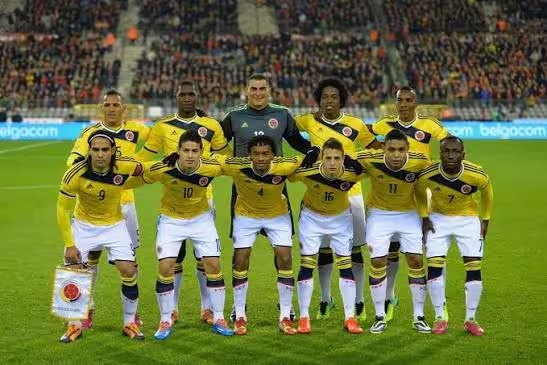
From the iconic era of Carlos Valderrama in the 1990s to the clinical Golden Generation of 2014 and the current squad competing at the 2026 FIFA World Cup, Colombia consistently injects dynamism into international football. This comprehensive, professional profile breaks down the structural makeup of the current national team, its historical trajectory, and its complete analytical and statistical record at the world’s highest level.
Brief History and Core Continental Achievements
While football was popularized in Colombia during the early 20th century, the national team did not achieve true international consistency until the late 1980s. The appointment of visionary coach Francisco Maturana introduced a localized version of “Tiki-Taka” or el toque, prioritizing possession, tactical patience, and sudden bursts of speed.
The Copa América Benchmark
Colombia’s crowning historical achievement on the continental stage came during the 2001 Copa América, which they hosted. Guided by defensive solidity and lethal transitions, Los Cafeteros completed an unprecedented campaign, winning every single match without conceding a single goal, a record that remains unmatched in the tournament’s history. Following a subsequent era of transitional rebuilding, Colombia re-emerged as a continental force, finishing as runners-up in the 2024 Copa América to set the stage for their high-profile campaign in the current 2026 World Cup cycle.
Technical Roster Breakdown (2026 Campaign)
Under the tactical leadership of Argentine manager Néstor Lorenzo, the modern Colombian squad blends physical athleticism with elite creative intelligence. The roster balances veterans who understand the pressure of international tournaments with explosive young players based across Europe and the Americas.
1. Goalkeepers
The Colombian goal has historically been protected by eccentric and pioneering figures like René Higuita. In the current era, the position is characterized by veteran experience and safe shot-stopping.
- Camilo Vargas (#12): Serving as the active starting goalkeeper, Vargas brings leadership and excellent reflexes, heavily honed in Liga MX.
- David Ospina (#1): The nation’s most-capped player in history, providing elite backup security and vast locker-room knowledge.
- Álvaro Montero (#24): A commanding physical presence who serves as a highly capable option in rotation.
2. Defenders
Lorenzo’s defensive line focuses on recovery speed and aerial dominance, which is vital for handling swift transitional counter-attacks.
- Daniel Muñoz (#2): An energetic, attack-minded right-back who operates effectively in a modern wing-back style.
- Davinson Sánchez (#23) & Jhon Lucumí (#3): The preferred central defensive pairing, offering a mix of physical power and comfortable ball distribution from the back.
- Johan Mojica (#17) & Deiver Machado (#22): Competing options at left-back, providing both defensive recovery and width in attack.
- Yerry Mina (#13): A veteran central defender renowned for his set-piece danger and physical aerial presence.
3. Midfielders
The midfield acts as the engine room, balancing ball-winning anchors with elite playmaker profiles.
- Jefferson Lerma (#16): The primary defensive shield, responsible for breaking up opposition plays and covering space.
- Richard Ríos (#6): A dynamic box-to-box midfielder with excellent ball retention skills and transitional dribbling abilities.
- James Rodríguez (#10): The captain, talisman, and creative hub, orchestrating the tempo of the entire attacking structure.
- Jhon Arias (#11) & Juan Fernando Quintero (#20): High-IQ creative options who provide dynamic positioning between the lines.
4. Forwards
The frontline provides directness, vertical speed, and physical options to convert crosses.
- Luis Díaz (#7): The undisputed star forward, utilizing world-class 1v1 dribbling and explosive pace from the left flank.
- Jhon Córdoba (#9) & Luis Suárez (#25): Direct, physically imposing central strikers chosen to lead the press and hold up the ball.
- Cucho Hernández (#19) & Andrés Gómez (#26): Versatile depth options capable of altering attacking tempos late in games.
FIFA World Cup Performance Statistics
Colombia’s history at the FIFA World Cup spans seven total appearances. Their historical record includes legendary comebacks, individual scoring awards, and deep tournament runs.
World Cup Tournament History Dashboard
The table below documents Colombia’s historical statistics across their completed and active FIFA World Cup final tournaments:
| World Cup Edition | Host Country | Overall Record (W-D-L) | Goals (GF-GA) | Final Tournament Result |
|---|---|---|---|---|
| 1962 | Chile | 0-1-2 | 5-11 | Group Stage Exit |
| 1990 | Italy | 1-1-2 | 4-4 | Round of 16 |
| 1994 | United States | 1-0-2 | 4-5 | Group Stage Exit |
| 1998 | France | 1-0-2 | 1-3 | Group Stage Exit |
| 2014 | Brazil | 4-0-1 | 12-4 | Quarter-finals (5th Place Overall) |
| 2018 | Russia | 2-1-1 | 6-3 | Round of 16 (Eliminated on Penalties) |
| 2026 | USA, Canada, Mexico | 2-0-0 (Active) | 4-0 | Advanced to Knockout Rounds |
| Historical Totals | 7 Tournament Finishes | 11-3-10 | 36-30 | Highest Placement: Quarter-finals (2014) |
The Active 2026 World Cup Campaign
Following their disappointment of missing out on the 2022 tournament in Qatar, Colombia rebounded strongly in the CONMEBOL qualification cycles to secure their place at the expanded tournament in North America.
At the current 2026 tournament, competing in Group K, Colombia enjoyed an ideal start. They opened their tournament with a commanding 3-0 victory over Uzbekistan on June 17, 2026. They followed this up with a crucial 1-0 victory over DR Congo on June 24, 2026. This victory officially made Colombia one of the early nations to book an advance spot into the Round of 32 knockout stages with a group game to spare.
Historical Legends and Individual Records
Colombia’s rich footballing history is detailed by unique individual milestones. Since it’s founding, the team has had immense impact on local as well as international Football.
Los Cafeteros Most-Capped Players of all Time
The tables below outline the historical record holders for both international appearances and goals scored for the senior men’s national team:
| Rank | Most Capped Players | Matches / Caps | Career Era |
|---|---|---|---|
| 1 | David Ospina | 130 | 2007–Present |
| 2 | James Rodríguez | 127 | 2011–Present |
| 3 | Juan Cuadrado | 116 | 2010–Present |
| 4 | Carlos Valderrama | 111 | 1985–1998 |
| 5 | Radamel Falcao | 104 | 2007–2023 |
Los Cafeteros All Time Top Scorers
| Rank | All-Time Top Goalscorers | Goals Scored | Matches Played |
|---|---|---|---|
| 1 | Radamel Falcao | 36 | 104 |
| 2 | James Rodríguez | 31 | 127 |
| 3 | Arnoldo Iguarán | 25 | 68 |
| 4 | Faustino Asprilla | 20 | 57 |
| 5 | Freddy Rincón | 17 | 84 |
Key World Cup Records and Milestones
- The 2014 Golden Boot: James Rodríguez won the FIFA World Cup Golden Boot in 2014 by scoring 6 goals in 5 matches, including a legendary volley against Uruguay that won the FIFA Puskás Award.
- The Only Olympic Goal: At the 1962 World Cup, Colombian midfielder Marcos Coll scored the only direct corner-kick goal (Olympic goal) in World Cup history, beating the legendary Soviet goalkeeper Lev Yashin during a dramatic 4-4 draw.
- Age Record Holder: In 2014, backup goalkeeper Faryd Mondragón became the oldest player to feature in a World Cup match at 43 years and 3 days old (a record later surpassed by Egypt’s Essam El-Hadary in 2018).
Tactical Identity: The Modern Style
Under Néstor Lorenzo, Colombia has shifted away from purely slow possession builds toward a hybrid model characterized by intense mid-pressing and explosive flank transitions.
When deploying a standard 4-2-3-1 or 4-3-3 formation, the tactical structure allows James Rodríguez to function as a traditional “number 10,” drifting into pockets of space to deliver defense-splitting passes. This structure relies heavily on the defensive shielding of central pivots, allowing overlapping fullbacks to combine with inverted wingers like Luis Díaz, turning Colombia into an incredibly dangerous threat from wide areas.
Conclusion
The Colombia national football team remains an essential source of passion, flair, and competitive excellence in global football. Balancing a rich historical legacy—filled with iconic moments and unique individual records—with a highly structured, modern team dynamic, Los Cafeteros continue to prove they belong among the world’s elite. Having comfortably secured their spot in the knockout stages of the 2026 World Cup, Colombia looks primed to build further on their finest footballing traditions on the global stage.