The Democratic Republic of the Congo national football team, affectionately branded across the sporting world as Les Léopards (The Leopards), holds a foundational and emotionally resonant position in African football history. Representing a nation with immense natural athletic talent and deep-rooted footballing passion, DR Congo has experienced eras of absolute continental dominance, transitional obscurity, and a modern tactical resurgence.
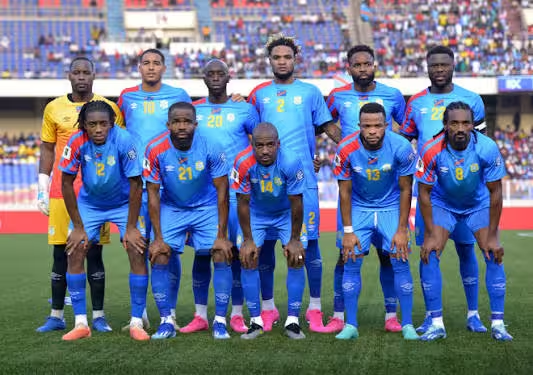
From their trailblazing historical exploits as Zaire in the 1970s to their status as one of Africa’s most dangerous and physically imposing modern sides, Les Léopards have long been feared for their explosive wing play, structural power, and elite technical resilience. This comprehensive profile examines the tactical makeup of the current roster, the historical evolution of Congolese football, and their statistical legacy at the highest level of international competition.
Brief History and Core Continental Achievements
DR Congo boasts an incredibly rich historical tapestry, highlighted by periods where they dictated the tactical direction of African football. Operating under the nation’s former name, Zaire, they emerged as a global force in the early-to-mid 1970s.
Continental Champions and Trailblazers
The golden era of Congolese football yielded two Africa Cup of Nations (AFCON) titles, clinched in 1968 (as Congo-Kinshasa) and 1974 (as Zaire). The 1974 squad, spearheaded by legendary forward Ndaye Mulamba—who scored an unmatched record of 9 goals in a single tournament—cemented their place in the record books by becoming the first-ever sub-Saharan African nation to qualify for a FIFA World Cup. Though their subsequent decades were marked by administrative inconsistencies, DR Congo re-established their competitive pedigree in the modern era, securing third-place finishes at the 2015 AFCON and finishing as semi-finalists at the 2023 edition, setting up their high-profile international campaign.
Technical Roster Breakdown (2026 Campaign)
Under the disciplined guidance of French manager Sébastien Desabre, the modern DR Congo squad functions as a highly structured, defensively resilient unit that strikes with devastating speed on the counter-attack. The roster heavily utilizes the Bicongolais diaspora, seamlessly integrating elite talent born or developed in Europe with robust domestic league stars from clubs like TP Mazembe.
1. Goalkeepers
The Congolese goal relies on commanding physical presence, vocal leadership, and high-volume shot-stopping capabilities.
- Dimitry Bertaud (#1): The active, preferred starting goalkeeper whose tactical distribution and calmness under pressure from Ligue 1 have stabilized the backline.
- Lionel Mpasi (#16): A heroic figure from recent AFCON penalty shootouts, offering elite reflexes and starting-caliber backup insurance.
- Timothy Fayulu (#23): A talented, highly reliable option providing deep positional coverage within the squad.
2. Defenders
Desabre’s defensive philosophy centers on rigid positional awareness, elite physical strength in aerial duels, and fullbacks capable of covering immense ground.
- Chancel Mbemba (#22): The captain, talisman, and undisputed defensive anchor. His world-class recovery speed and elite leadership organize the entire team structure.
- Dylan Batubinsika (#5) & Henoc Inonga (#2): Competing central options who form a physically intimidating partnership alongside Mbemba.
- Gédéon Kalulu (#4): A highly disciplined, tactically sound right-back who prioritizes defensive containment.
- Arthur Masuaku (#26) & Joris Kayembe (#12): Attack-minded left-backs providing elite crossing quality, technical overlap options, and set-piece expertise.
3. Midfielders
The midfield acts as a dynamic shield, focusing heavily on ball retention, high-intensity pressing, and rapid vertical distribution.
- Samuel Moutoussamy (#8): The tireless engine of the midfield, responsible for disrupting opposition play and recycling possession.
- Charles Pickel (#18): A robust, aggressive ball-winner who covers extensive lateral space to protect the central defenders.
- Edo Kayembe (#14): Provides a technical link, shifting the ball efficiently from defensive phases into advanced creative areas.
- Gaël Kakuta (#10): The veteran playmaker who drops into pockets of space to provide vision, precision passing, and final-third creativity.
4. Forwards
The frontline offers a devastating combination of brute physical power, direct 1v1 dribbling, and aerial presence in the penalty box.
- Yoane Wissa (#20): An explosive, highly versatile forward who thrives when cutting inside from the left flank to generate goal-scoring angles.
- Meschak Elia (#13): Renowned for his world-class speed, directness, and high-intensity defensive pressing from wide positions.
- Simon Banza (#19) & Cédric Bakambu (#9): Imposing, elite central strikers chosen to lead the line, hold up long balls, and convert aerial crosses.
- Theo Bongonda (#11): A creative, unpredictable winger who injects flair and sudden change-of-pace scenarios into the attack.
FIFA World Cup Performance Statistics
DR Congo’s history with the FIFA World Cup bridges their historic 1974 debut with a modern, highly competitive campaign on the global stage.
World Cup Tournament History Dashboard
The table below documents DR Congo’s historical statistics across their completed and active FIFA World Cup final tournaments:
| World Cup Edition | Country Name Used | Overall Record (W-D-L) | Goals (GF-GA) | Final Tournament Result |
|---|---|---|---|---|
| 1974 | Zaire | 0-0-3 | 0-14 | Group Stage Exit |
| 2026 | DR Congo (Active) | 0-1-1 | 0-1 | Group Stage Performance |
| Historical Totals | Two Tournaments | 0-1-4 | 0-15 | First Sub-Saharan African Qualifier |
The Active 2026 World Cup Campaign
Following a 52-year absence from football’s grandest stage, DR Congo successfully navigated a grueling CAF qualification group to secure their historic ticket to the expanded finals in North America.
Drawn into a highly competitive Group K, Les Léopards have displayed immense defensive resilience. They opened their historic tournament campaign with a highly disciplined 0-0 draw against Panama on June 16, 2026, securing the nation’s first-ever World Cup point. In their second group fixture on June 24, 2026, they faced South American powerhouse Colombia in Guadalajara, falling to a narrow, hard-fought 1-0 defeat. Despite the setback, their organized performance leaves them with everything to play for heading into their final group stage match against Uzbekistan.
Historical Legends and Individual Records
In Africa, the DR Congo team is a football powerhouse. Over the years, it has established individual milestones that has left an indelible mark on the continent’s sporting culture.
All-Time Cap and Scoring Leaderboards
The tables below outline the historical record holders for both international appearances and goals scored for the senior men’s national team:
| Rank | Most Capped Players | Matches / Caps | Career Era |
|---|---|---|---|
| 1 | Chancel Mbemba | 89 | 2012–Present |
| 2 | Issama Mpeko | 81 | 2011–2022 |
| 3 | Cédric Bakambu | 58 | 2015–Present |
| 4 | Robert Kidiaba | 57 | 2002–2015 |
| 5 | Youssouf Mulumbu | 45 | 2008–2019 |
The Leopards All Time Top Scorers
| Rank | All-Time Top Goalscorers | Goals Scored | Matches Played |
|---|---|---|---|
| 1 | Dieumerci Mbokani | 22 | 41 |
| 2 | Cédric Bakambu | 16 | 58 |
| 3 | Ndaye Mulamba | 14 | 24 |
| 4 | Kabamba Musasa | 11 | 27 |
| 5 | Yoane Wissa | 10 | 40 |
Key Historical Milestones and Records
- The Unbroken AFCON Scoring Record: At the 1974 Africa Cup of Nations, legendary striker Ndaye Mulamba scored 9 goals in a single tournament edition, a record that has stood completely unbroken for over half a century.
- The Iconic Kidiaba Celebration: Longtime goalkeeper Robert Kidiaba gained worldwide fame for his unique “bum shuffle” goal celebration, becoming an iconic visual symbol of Congolese club and international football success.
- The 1974 Milestone: By qualifying for the 1974 World Cup in West Germany, the team made history as the first sub-Saharan African squad to reach the tournament, breaking a significant geopolitical barrier for African sports.
Tactical Identity: The Modern Style
Under Sébastien Desabre, DR Congo has abandoned fragmented tactical approaches in favor of a highly organized 4-2-3-1 or a compact 4-3-3 shape.
The defensive phase relies on a mid-block, where the central midfielders clog passing lanes, forcing opposition teams out wide. Once the ball is won, Chancel Mbemba orchestrates distribution from the back, bypassed immediately by vertical, line-breaking passes aimed at explosive wingers like Yoane Wissa and Meschak Elia. This transition speed, coupled with the physical hold-up play of a central striker, makes DR Congo one of the most effective and dangerous transitional counter-attacking teams on the African continent.
Conclusion
The Democratic Republic of the Congo national football team embodies a powerful mixture of historical pride, raw physical power, and tactical progression. As two-time continental champions and historic global pioneers, Les Léopards continue to show they possess the quality to contend with the world’s best. With a brand of football built on structural defensive discipline and blistering speed, DR Congo remains an ascending force capable of leaving a lasting mark on the international stage.