The Uruguay national football team, culturally and universally heralded across the sporting landscape as La Celeste (The Sky Blue), represents one of the most historically decorated, structurally resilient, and identity-driven programs in global football history. Operating within the ultra-competitive CONMEBOL confederation, Uruguay has systematically defied its modest demographic scale to construct a footballing legacy defined by Garra Charrúa—an intense, unyielding blend of psychological grit, physical toughness, and tactical defiance under maximum pressure.
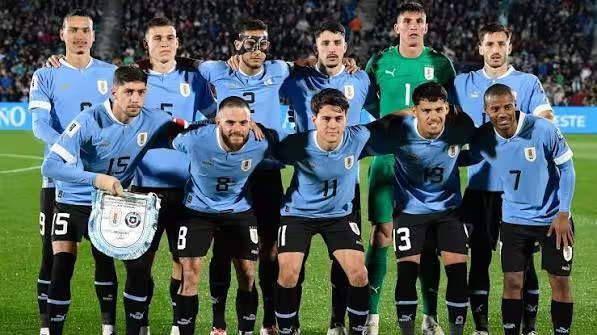
Following a brilliant technical modernization under an elite pressing regime, La Celeste enters the active international landscape as one of the most devastating transitional forces in the world. Combining a physically dominant European club-based spine with a wave of technically proficient, relentless young midfielders, Uruguay represents a complex and demanding structural puzzle for global opponents. This comprehensive profile breaks down the structural architecture of the active senior roster, historical milestones, individual records, and up-to-date tournament performance data.
Brief History and Core Continental Achievements
The Uruguayan Football Association (AUF) was founded in 1900, admitted to FIFA in 1923, and helped co-found CONMEBOL in 1916. On their home continent, Uruguay stands as an absolute, permanent titan, capturing a staggering 15 Copa América titles—a metric that ranks them as the joint-most successful nation in South American history alongside Argentina.
The Immortal World Cup Pioneers
Uruguay occupies an immortal, pioneering position at the absolute genesis of international football folklore. The nation hosted and won the inaugural 1930 FIFA World Cup in Montevideo, defeating Argentina 4-2 to claim the maiden global crown. Twenty years later, La Celeste engineered arguably the most famous shock in sporting history, defeating hosts Brazil 2-1 at the Maracanã Stadium to win the 1950 FIFA World Cup—a historic event immortalized as the Maracanazo. With two World Cup titles and two early Olympic gold medals (1924, 1928) recognized as world championships, Uruguay’s four-star crest represents an elite baseline of global supremacy.
Technical Roster Breakdown
The modern Uruguayan squad operates primarily out of a highly dynamic, high-pressing 4-3-3 or a fluid 4-2-3-1 matrix. Under contemporary tactical principles, the system places a supreme premium on intense vertical counter-pressing traps, high-volume athletic duels in the middle third, and lightning-fast transitions targeted at isolating direct forwards.
1. Goalkeepers
The Uruguayan goalmouth requires exceptional reflex shot-stopping, commanding aerial box organization during corner routines, and swift sweeping traits to support high-line structures.
- Sergio Rochet (#1): The preferred first-choice starting goalkeeper. Rochet brings immense composure, elite positioning, world-class penalty box collection metrics, and exceptional shot-stopping consistency under maximum pressure.
- Santiago Mele (#12): A highly agile, technical reflex keeper who provides elite, starting-caliber backup depth and robust South American top-flight pedigree.
- Franco Israel (#23): A sharp, young European-based backup shot-stopper finalizing an exceptionally secure goalkeeping department.
2. Defenders
The defensive line balances physically robust, heavy-tackling central markers with highly aggressive fullbacks who push high up the pitch to execute structural pressing triggers.
- Federico Pereira (#2) & Mathías Olivera (#16): Highly dynamic, modern ball-playing central defenders who form a cohesive partnership out of the back, with Olivera providing superb left-footed versatility.
- José María Giménez (#2): The veteran vice-captain and defensive enforcer. Giménez utilizes world-class aerial dominance, immense physical strength, and a decade of elite European club experience to protect the central zones.
- Ronald Araújo (#4): A world-class modern defender. Possessing explosive ground pace, intimidating upper-body strength, and elite 1v1 defensive isolation traits, Araújo operates seamlessly across central and right fullback channels.
- Matías Viña (#17) & Lucas Olaza (#22): Highly disciplined left-backs responsible for providing vertical progressive width in transition and executing quick recovery tracking.
- Guillermo Varela (#4) & Nahitan Nández (#8): Relentless, hyper-aggressive fullbacks who utilize immense physical engines to enforce structural containment on the lateral flanks.
3. Midfielders
The midfield is the crown jewel and absolute tactical engine room of La Celeste, combining unparalleled physical stamina with world-class press-resistance and elite ball-winning metrics.
- Federico Valverde (#15): The captain, superstar icon, and undisputed emotional heartbeat of the team. Widely recognized as one of the world’s premier box-to-box dynamos, Valverde utilizes world-class press-resistance, a ferocious long-range shooting threat, and an endless physical engine to completely dominate the middle third.
- Manuel Ugarte (#5): The primary defensive shield and tactical anchor. Ugarte excels at aggressively breaking up opposition transitions, executing high-volume tackles, and protecting the backline.
- Nicolás de la Cruz (#7): A highly dynamic, creative playmaker. Operating in advanced half-spaces, de la Cruz provides press-resistant ball retention, intricate close-control dribbling, and visionary passing to unlock deep blocks.
- Rodrigo Bentancur (#6): An exceptionally technical, elegant progressive pivot possessing elite spatial intelligence, tempo modulation, and press-resistant ball recycling out of high-pressure zones.
- Giorgian de Arrascaeta (#10) & Agustín Canobbio (#14): High-IQ attacking variants utilized to find pockets between opposition lines and sustain high-intensity mid-block pressing densities.
4. Forwards
The frontline provides a terrifying mixture of blistering vertical speed, relentless front-line defensive pressing, and elite clinical finishing execution.
- Darwin Núñez (#9): The premier central striker leading the line. Núñez offers a world-class combination of explosive physical pace, brute upper-body strength, tireless channel running, and a highly prolific scoring record in international qualifiers.
- Facundo Pellistri (#11) & Cristian Olivera (#21): Blistering, exceptionally fast wide forwards deployed to stretch opposition fullbacks, isolate defenders, and cut inside to generate rapid shooting angles.
- Brian Rodríguez (#7) & Maximiliano Araújo (#20): Dynamic, direct wingers tasked with executing rapid vertical transitions and stretching tired defenses late in matches.
- Luciano Rodríguez (#19): A prodigiously gifted young attacking forward variant representing the technical depth of the future Uruguayan frontline.
FIFA World Cup Performance Statistics
Uruguay’s statistical resume highlights an international program that stands as one of global sports history’s most efficient tournament competitors, amassing a rich lineage of historical championships and deep modern knockout runs.
World Cup Tournament History Dashboard
The table below logs Uruguay’s absolute performance metrics across their historical FIFA World Cup final appearances:
| World Cup Era | Final Tournaments | Overall Record (W-D-L) | Goals (GF-GA) | Final Tournament Milestones / Results |
|---|---|---|---|---|
| 1930–1950 | 2 | 7-1-0 | 25-9 | 2x FIFA World Cup Champions (1930, 1950) |
| 1954–1974 | 5 | 8-3-10 | 35-34 | 2x Fourth-Place Finishes (1954, 1970), 1x Quarter-finals |
| 1986–2002 | 4 | 1-6-6 | 11-23 | 2x Round of 16 Exits, 2x Group Stage Exits |
| 2010–2018 | 3 | 8-2-4 | 22-14 | Fourth-Place Finish (2010), 1x QF (2018), 1x R16 |
| 2022 | 1 | 1-1-1 | 2-2 | Group Stage Exit |
| Historical Totals | 15 Tournaments | 25-13-21 | 89-76 | 2x FIFA World Cup Titles (5x Top-Four Finishes) |
Legendary Individual Records and Milestones
The history of La Celeste is written by pioneering global superstars and modern icons who established the absolute highest standards for international football longevity and striking efficiency.
All-Time Cap and Scoring Leaderboards
The tables below document the historical all-time record holders for senior international appearances and goals scored for the Uruguayan men’s national team:
| Rank | Most Capped Players | Total International Caps | Career Era | Goals Scored |
|---|---|---|---|---|
| 1 | Diego Godín | 161 | 2005–2022 | 8 |
| 2 | Luis Suárez | 138 | 2007–2024 | 69 |
| 3 | Edinson Cavani | 136 | 2008–2022 | 58 |
| 4 | Fernando Muslera | 133 | 2009–2022 | 0 |
| 5 | Maximiliano Pereira | 125 | 2005–2018 | 3 |
| Rank | All-Time Top Goalscorers | Goals Scored | Matches Played | World Cup Goals |
|---|---|---|---|---|
| 1 | Luis Suárez | 69 | 138 | 7 |
| 2 | Edinson Cavani | 58 | 136 | 5 |
| 3 | Diego Forlán | 36 | 112 | 6 (2010 World Cup Golden Ball Winner) |
| 4 | Héctor Scarone | 31 | 52 | 0 (2x Olympic Gold Winner) |
| 5 | Angel Romano | 28 | 69 | 0 |
Elite Individual Benchmarks
- The Immortal Pistolero Legacy: Legendary forward Luis Suárez stands entirely unrivaled at the absolute apex of Uruguayan sports history, amassing an extraordinary 69 international goals to sit comfortably as the country’s all-time top goalscorer.
- The Golden Ball Masterclass: Playmaker Diego Forlán executed one of the most iconic individual campaigns in tournament history at the 2010 World Cup, scoring 5 spectacular goals to capture the tournament’s Golden Ball award as the best player.
- The Defensive Appearance Pillar: Central defender Diego Godín remains the undisputed most-capped player in Uruguayan history with 161 caps, anchoring the backline through three World Cup cycles.
Tactical Identity: High-Intensity Verticality and Counter-Pressing
The contemporary tactical blueprint of La Celeste operates primarily out of an aggressive, physically overwhelming 4-3-3 matrix heavily influenced by modern vertical pressing models. The cornerstone of the entire system is suffocating space in the middle third. Uruguay completely abandons passive, defensive low blocks, choosing instead to implement an intense, highly synchronized front-line press that isolates opposition deep pivots and forces quick turnover sequences.
Once a tactical turnover is secured, Uruguay transitions with terrifying speed, completely avoiding slow, risk-heavy ball-handling loops inside their own half. The world-class engine room of Federico Valverde and Manuel Ugarte immediately shifts the ball forward via vertical line-breaking passing arcs, unleashing Darwin Núñez to aggressively manipulate center-backs through direct channel running, transforming mid-block containment into clinical final-third execution within a matter of single-digit seconds.
Conclusion
The Uruguay national football team stands as a magnificent monumental pillar of global sports history, blending unmatched technical heritage, unyielding physical grit, and modern tactical sophistication. Their legendary statistics confirm an international program masterfully engineered to systematically control and dismantle opposition frameworks through raw athletic intensity. As Federico Valverde orchestrates tempos from the center circle and Darwin Núñez injects clinical vertical ruthlessness into transitions under intense global expectation, La Celeste possesses every structural asset necessary to maintain its historic reputation among the elite of international football.