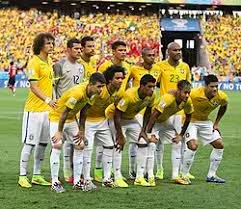
The Brazil national football team, known universally as the Seleção (The Chosen Ones) or Canarinho (Little Canary), stands as the most historically successful and culturally iconic football program on the planet. As the spiritual curators of O Jogo Bonito (The Beautiful Game), Brazil has historically defined global footballing excellence through a lineage of generational superstars who combined unparalleled technical expression, creative improvisation, and explosive athleticism.
Following a highly intense CONMEBOL qualification cycle and tactical adjustments under a new technical regime, the Seleção enters the 2026 FIFA World Cup as a perennial, definitive pre-tournament favorite. Tasked with meeting the astronomical expectations of a nation obsessed with sporting supremacy, the modern squad balances a world-class European club core with a devastatingly fast wave of young forward talent. This comprehensive profile breaks down the structural architecture of Brazil’s active senior roster, foundational history, individual records, and up-to-date tournament performance data.
Brief History and Core Continental Achievements
The Brazilian Football Confederation was founded in 1914 and helped co-found CONMEBOL in 1916. On their home continent, Brazil stands as a historical powerhouse, capturing 9 Copa América titles and consistently setting the technical benchmark for South American football.
The Undisputed Kings of the World Cup
Brazil is the absolute apex entity of international football history, holding the record for the most FIFA World Cup titles with 5 trophies (1958, 1962, 1970, 1994, and 2002). They boast the unique distinction of being the only nation to have competed in every single edition of the FIFA World Cup since the tournament’s inception in 1930. From the legendary 1958 breakthrough of a teenage Pelé to the tactically flawless 1970 squad—widely regarded as the greatest team ever assembled—and the lethal efficiency of the Ronaldo-led 2002 side, Brazil’s history is the very foundation of global football folklore.
Technical Roster Breakdown (2026 Campaign)
The modern Brazilian squad operates primarily within a highly dynamic 4-2-3-1 or a fluid, attack-minded 4-3-3 formation. The tactical system places a supreme premium on defensive solidity from deep structural anchors, high-volume progressive passing lines through the half-spaces, and lightning-fast wide combinations that isolate elite dribblers in 1v1 touchline scenarios.
1. Goalkeepers
The Brazilian goalmouth represents one of the most secure, technically elite departments in modern international football, characterized by world-class sweeping capabilities and distribution.
- Alisson Becker (#1): The premier starting goalkeeper. Alisson brings world-class 1v1 positioning, unparalleled spatial management, and exceptional composure under high-press situations.
- Ederson Moraes (#23): A world-class shot-stopper possessing the most precise, long-range passing distribution metrics in the global game, providing elite starting-caliber depth.
- Bento (#12): A highly agile, dependable young domestic goalkeeper providing secure structural coverage in reserve.
2. Defenders
The backline balances physically dominant, world-class central markers with explosive, high-stamina fullbacks who look to dictate width during attacking phases.
- Gabriel Magalhães (#4) & Marquinhos (#3): The preferred starting center-back pairing, offering elite aerial dominance, superb anticipation metrics, and highly accurate left-right footed passing symmetry.
- Éder Militão (#14) & Bremer (#6): Physically robust, high-speed central defenders deployed to absorb counter-attacks and lock down elite opposition forwards across open spaces.
- Danilo (#2): The veteran captain and defensive anchor. Operating as a conservative right-back, Danilo often tucks inside to form a three-man structural shield during possession phases.
- Yan Couto (#13) & Wendell (#16): Highly dynamic, attack-minded fullbacks responsible for executing overlapping runs and delivering high-volume crosses from wide areas.
- Lucas Beraldo (#5): A highly talented young ball-playing defender representing the absolute future of the Brazilian backline.
3. Midfielders
The midfield functions as a robust tactical engine room, meticulously balancing deep possession-recycling duties with aggressive mid-block pressing.
- Bruno Guimarães (#5): The midfield maestro and structural hub. Guimarães provides elite press-resistance, world-class line-breaking passing vision, and deep tactical orchestration.
- Douglas Luiz (#8) & João Gomes (#15): Tireless, physical box-to-box anchors responsible for disrupting opposition counter-attacks and covering open space to protect the center-backs.
- Lucas Paquetá (#10): The creative centerpiece. Operating in the advanced playmaker slot, Paquetá utilizes exceptional spatial intelligence, intricate close-control, and vision to link midfield phases with final-third attacks.
- Andreas Pereira (#18) & Éderson (#17): Dynamic, high-work-rate tactical options utilized to sustain pressing densities in the middle third.
4. Forwards
The frontline provides a terrifying mixture of world-class transitional speed, intricate inside-cutting movements, and elite clinical finishing execution.
- Vinícius Júnior (#7): The undisputed superstar forward and global icon. Operating from the left flank, Vinícius utilizes world-class acceleration, devastating 1v1 dribbling skills, and clinical final-third execution to completely dismantle opposition backlines.
- Rodrygo Goes (#11): A highly technical, tactically intelligent forward capable of operating across the front three to execute intricate link-play and unlock deep defensive blocks.
- Endrick (#9): The prodigiously gifted central striker leading the line. Endrick offers explosive power, elite off-the-ball movement, and clinical finishing instincts inside the penalty box.
- Raphinha (#19) & Gabriel Martinelli (#22): Blistering, high-intensity wide assets deployed to isolate fullbacks and inject unpredictable transitional flair.
- Savinho (#20) & Vitor Roque (#21): The highly energetic new wave of rapid young forwards representing the technical depth of the frontline.
FIFA World Cup Performance Statistics
Brazil’s statistical resume at the FIFA World Cup stands entirely alone as the gold standard of international sports history, amassing the most wins, goals, and trophies in the competition’s existence.
World Cup Tournament History Dashboard
The table below logs Brazil’s absolute statistical metrics across their complete historical FIFA World Cup final appearances:
| World Cup Era | Tournaments | Overall Record (W-D-L) | Goals (GF-GA) | Final Tournament Headlines / Titles |
|---|---|---|---|---|
| 1930–1954 | 5 | 11-4-4 | 55-25 | Runners-up (1950), Third Place (1938) |
| 1958–1970 | 4 | 19-3-2 | 56-25 | 3x World Cup Champions (1958, 1962, 1970) |
| 1974–1990 | 5 | 19-8-5 | 53-24 | Third Place (1978), Fourth Place (1974) |
| 1994–2002 | 3 | 17-1-3 | 47-17 | 2x World Cup Champions (1994, 2002), Runners-up (1998) |
| 2006–2022 | 5 | 18-4-6 | 48-27 | Fourth Place (2014), 4x Quarter-finalists |
| Historical Totals | 22 Tournaments | 84-20-20 | 259-118 | 5x World Cup Titles (Absolute Global Record) |
Legendary Individual Records and Milestones
The narrative of the Seleção is written by pioneering global legends and modern icons who established the technical standards of professional football.
All-Time Cap and Scoring Leaderboards
The tables below document the historical all-time record holders for senior international appearances and goals scored for the Brazilian men’s national team:
| Rank | Most Capped Players | Total International Caps | Career Era | Goals Scored |
|---|---|---|---|---|
| 1 | Cafu | 142 | 1990–2006 | 5 |
| 2 | Neymar Jr. | 128 | 2010–2024 | 79 |
| 3 | Dani Alves | 126 | 2006–2022 | 8 |
| 4 | Roberto Carlos | 125 | 1992–2006 | 11 |
| 5 | Thiago Silva | 113 | 2008–2023 | 7 |
| Rank | All-Time Top Goalscorers | Goals Scored | Matches Played | World Cup Goals |
|---|---|---|---|---|
| 1 | Neymar Jr. | 79 | 128 | 8 |
| 2 | Pelé | 77 | 92 | 12 (3x World Cup Winner) |
| 3 | Ronaldo Nazário | 62 | 98 | 15 (2x World Cup Winner) |
| 4 | Romário | 55 | 70 | 5 (1x World Cup Winner) |
| 5 | Zico | 48 | 71 | 5 |
Elite Individual Benchmarks
- The Immortal Pelé Legacy: King Pelé remains the only footballer in human history to win three separate FIFA World Cups (1958, 1962, and 1970), establishing a record that is universally considered mathematically untouchable.
- The Scoring Chart Crown: Forward Neymar Jr. stands as the undisputed all-time top goalscorer in Brazilian international history, having scored 79 official senior goals to surpass Pelé’s long-standing benchmark of 77.
- The World Cup Efficiency: Ronaldo Nazário remains one of the most devastating tournament strikers in history, scoring 15 goals across his World Cup campaigns, including a legendary brace in the 2002 Final.
Tactical Identity: Modernized Ginga
The contemporary tactical blueprint of the Seleção operates as a highly coordinated, balanced engine that bridges structural European discipline with traditional Brazilian flair. The hallmark of the entire system is spatial manipulation. Rather than relying entirely on individual chaos, Brazil utilizes the technical press-resistance of Bruno Guimarães to comfortably recycle possession through the half-spaces, forcing the opposition’s defensive block to shift horizontally.
Out of possession, Brazil implements an aggressive, highly synchronized counter-press. Endrick and Lucas Paquetá lead the front-line tracking to choke central progressive lanes, forcing opposition clearouts wide toward the touchlines, where athletic anchors quickly regain the ball. Once a turnover is forced, the Seleção strikes with vertical ruthlessness. Deep pivots immediately look to slide vertical passes into wide channels, unleashing the explosive 1v1 acceleration of Vinícius Júnior and Rodrygo Goes to isolate defenders and execute surgical final-third combinations.
Conclusion
The Brazil national football team stands as a supreme monumental pillar of global sports history, blending unmatched technical heritage, unparalleled tournament efficiency, and modern tactical sophistication. Their legendary statistics confirm an international program engineered to occupy the absolute mountaintop of global footballing achievement. As Vinícius Júnior dictates the tempo of final-third transitions and a physically dominant backline locks down opposition systems under intense global expectation, the Seleção possesses every structural asset necessary to claim a historic sixth world title.