The Japan national football team, culturally and universally heralded across the sporting landscape as the Samurai Blue, represents the gold standard of structural organization, technical precision, and elite developmental strategy within the Asian Football Confederation (AFC). Historically viewed as a minor competitive entity prior to the late 20th century, Japan has executed a masterful, long-term blueprint to transform its international identity into a perennially feared global powerhouse.
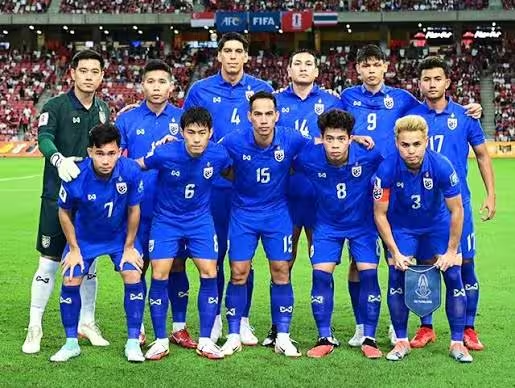
Following an incredibly dominant run on the international stage, the Samurai Blue enter the active international cycle as a highly mature, tactically flexible contender capable of executing complex positional models against traditional footballing hierarchies. Blending a world-class core of superstars playing across the absolute top divisions of European club football with unmatched internal group synergy, Japan stands as a formidable challenge for global opponents. This comprehensive profile breaks down the structural design of the active senior roster, foundational history, individual records, and up-to-date tournament performance data.
Brief History and Core Continental Achievements
The Japan Football Association (JFA) was founded in 1921 and officially admitted to FIFA in 1929. While the nation captured a historic bronze medal at the 1968 Summer Olympics in Mexico City, their modern era of professional ascendancy truly ignited with the launch of the domestic J.League in 1993.
The Undisputed Kings of Asia
Since their transition into a fully professionalized footballing ecosystem, Japan has established absolute continental supremacy, capturing a record four AFC Asian Cup titles (1992, 2000, 2004, and 2011) alongside finishing as runners-up in 2019. On the global stage, the Samurai Blue have qualified for seven consecutive FIFA World Cup final tournaments since their debut in 1998, systematically advancing past the group stage on four separate occasions (2002, 2010, 2018, and 2022) to cement their reputation as Asia’s most consistent representative at the highest level of international sports.
Technical Roster Breakdown (2026 Campaign)
Under highly disciplined tactical management, the modern Japanese squad operates primarily within a fluid 4-2-3-1 or a highly aggressive, asymmetric 3-4-2-1 structure. The system places a supreme premium on fluid positional rotations in the half-spaces, high-intensity counter-pressing traps, and lightning-fast vertical transitions spearheaded by elite wide playmakers.
1. Goalkeepers
The Japanese goalmouth requires exceptional reflex shot-stopping, commanding aerial box organization during set-piece routines, and comfortable ball-playing distribution out of the back.
- Zion Suzuki (#1): The preferred first-choice starting goalkeeper. Suzuki brings world-class, short-range reflex stopping, a physically imposing frame, and immense composure under high-pressure situations.
- Keisuke Osako (#12): A highly commanding, athletic shot-stopper who provides elite starting-caliber depth and robust domestic pedigree.
- Kosei Tani (#23): A sharp, high-reflex backup goalkeeper finalizing a secure and technically gifted goalkeeping department.
2. Defenders
The backline balances tactically sophisticated central markers who excel at distributing out of heavy pressure with rapid fullbacks who provide high-stamina width.
- Ko Itakura (#4) & Koki Machida (#15): The preferred starting central defensive partnership, offering an exceptional mixture of physical height, high-volume clearance metrics, and precise left-right passing symmetry out of the back.
- Shogo Taniguchi (#3): The veteran defensive anchor who provides immense organizational authority, spatial awareness, and aerial dominance late in matches.
- Yukinari Sugawara (#2) & Hiroki Ito (#22): Highly dynamic, modern fullbacks responsible for providing width in transition, with Ito offering excellent defensive balance on the left and Sugawara delivering high-volume crosses on the right.
- Daiki Hashioka (#5) & Tsuyoshi Watanabe (#16): Physically robust, versatile defenders capable of operating across multiple roles in both three-man and four-man backlines.
3. Midfielders
The midfield is the absolute crown jewel and tactical engine room of the Samurai Blue, combining unparalleled technical IQ with press-resistant ball retention and high-work-rate tracking.
- Wataru Endo (#6): The captain, primary defensive shield, and undisputed emotional heartbeat of the team. Operating at the highest elite European club level, Endo excels at aggressively breaking up opposition transitions, winning central duels, and protecting the center-backs.
- Hidemasa Morita (#5) & Ao Tanaka (#17): Tireless, technically secure box-to-box anchors who partner Endo to absorb central overloads, recycle possession out of tight spaces, and execute late attacking box entries.
- Takefusa Kubo (#20): The prodigiously gifted young superstar playmaker. Operating between lines or drifting wide, Kubo possesses world-class close-control dribbling, extraordinary vision, and a lethal left-footed shooting threat inside the final third.
- Daichi Kamada (#8) & Reo Hatate (#14): Highly intelligent, fluid playmakers tasked with finding pockets of space between opposition lines and executing intricate combinations.
4. Forwards
The frontline provides a terrifying mixture of world-class transitional speed, direct 1v1 wing isolation dominance, and intense front-line defensive pressing.
- Kaoru Mitoma (#7): A world-class superstar inside-forward and global icon. Operating from the left flank, Mitoma utilizes an elite, mathematically studied dribbling technique, explosive acceleration, and clinical final-third execution to completely dismantle opposition fullbacks.
- Takumi Minamino (#10): A highly technical, versatile forward who operates seamlessly as an advanced playmaker or a secondary striker, providing clinical edge and relentless front-line pressing.
- Ritsu Doan (#11): An explosive, physically robust wide forward deployed to isolate fullbacks, cut inside onto his dominant left foot, and net clutch international goals.
- Ayase Ueda (#9): The premier central striker leading the line. Ueda offers excellent physical hold-up capabilities, clinical penalty box presence, and a proven history of high-volume scoring.
- Kyogo Furuhashi (#19) & Keito Nakamura (#13): Blistering, exceptionally fast attacking variants utilized to stretch fatigued opposition backlines and inject rapid vertical speed late in matches.
FIFA World Cup Performance Statistics
Japan’s statistical resume at the FIFA World Cup highlights an international program that stands as a model of consistent global progression, amassing seven consecutive tournament finishes since 1998.
World Cup Tournament History Dashboard
The table below logs Japan’s absolute performance metrics across their completed FIFA World Cup final appearances:
| World Cup Edition | Host Country / Nations | Overall Record (W-D-L) | Goals (GF-GA) | Final Tournament Milestone / Result |
|---|---|---|---|---|
| 1998 | France | 0-0-3 | 1-4 | Group Stage Exit (World Cup Debut) |
| 2002 | South Korea / Japan | 2-1-1 | 5-3 | Round of 16 Exit (First-Ever Knockout Mark) |
| 2006 | Germany | 0-1-2 | 2-7 | Group Stage Exit |
| 2010 | South Africa | 2-1-1 | 4-2 | Round of 16 Exit (Eliminated on Penalties) |
| 2014 | Brazil | 0-1-2 | 2-6 | Group Stage Exit |
| 2018 | Russia | 1-1-2 | 6-7 | Round of 16 Exit (Pushed Belgium to 3-2 Limit) |
| 2022 | Qatar | 2-1-1 | 5-4 | Round of 16 Exit (Defeated Germany and Spain) |
| Historical Totals | 7 Tournaments Entered | 7-6-12 | 25-33 | 4x Knockout Stage Appearances |
Legendary Individual Records and Milestones
The history of the Samurai Blue is built upon pioneering global icons and dedicated tournament veterans who established elite individual benchmarks for Asian football.
All-Time Cap and Scoring Leaderboards
The tables below document the historical all-time record holders for senior international appearances and goals scored for the Japanese men’s national team:
| Rank | Most Capped Players | Total International Caps | Career Era | Goals Scored |
|---|---|---|---|---|
| 1 | Yasuhito Endo | 152 | 2002–2015 | 15 |
| 2 | Yuto Nagatomo | 142 | 2008–2022 | 4 |
| 3 | Maya Yoshida | 126 | 2010–2022 | 12 |
| 4 | Masami Ihara | 122 | 1988–1999 | 5 |
| 5 | Shinji Okazaki | 119 | 2008–2019 | 50 |
| Rank | All-Time Top Goalscorers | Goals Scored | Matches Played | World Cup Goals |
|---|---|---|---|---|
| 1 | Kunishige Kamamoto | 75 | 76 | 0 (Highest Goal Ratio: 0.99) |
| 2 | Kazuyoshi “Kazu” Miura | 55 | 89 | 0 |
| 3 | Shinji Okazaki | 50 | 119 | 2 |
| 4 | Hiromi Hara | 38 | 75 | 0 |
| 5 | Keisuke Honda | 37 | 98 | 4 (National Record) |
Elite Individual Benchmarks
- The Untouchable Olympic Icon: Striker Kunishige Kamamoto remains the undisputed all-time top goalscorer in Japanese history with 75 international goals in just 76 caps, single-handedly firing Japan to a bronze medal at the 1968 Olympics.
- The World Cup Marksman: Midfield icon Keisuke Honda holds the absolute national record for the most goals scored at FIFA World Cup finals with 4 goals, netting across three consecutive tournaments (2010, 2014, and 2018) to establish his legacy as a premier big-game player.
- The Midfield Appearance Monolith: Metronomic playmaker Yasuhito Endo stands entirely alone at the apex of Japanese sports history, amassing an extraordinary 152 international caps to sit comfortably as the most-capped male footballer in country history.
Tactical Identity: Synchronized Gegenpressing and Vertical Speed
The contemporary tactical blueprint of the Samurai Blue operates primarily out of a highly sophisticated, possession-oriented 4-2-3-1 or a fluid 3-4-2-1 structure. The cornerstone of the entire system is spatial manipulation through synchronized, high-intensity collective pressing triggers. Rather than individual chasing, Japan coordinates structural traps in the middle third, using the central anchoring presence of Wataru Endo to suffocate opposition passing routes.
When transitioning to attack, Japan avoids slow, safe lateral build-ups inside their own half. Deep pivots immediately fire line-breaking vertical distributions directly into the half-spaces, unleashing the explosive 1v1 acceleration of Kaoru Mitoma on the left flank or the creative genius of Takefusa Kubo on the right. This high-speed synchronization pushes opposition backlines deep, creating massive pockets for late-arriving midfielders to execute surgical combinations and finish final-third actions within a matter of single-digit seconds.
Conclusion
The Japan national football team stands as a magnificent testament to long-term structural planning, technical brilliance, and unmatched group ethics. Their coordinated, high-speed attacking style highlights an international program masterfully engineered to systematically control and dismantle the defensive frameworks of global football giants on the grandest stage. As Takefusa Kubo injects unpredictable creative genius into final-third sequences and Wataru Endo locks down the midfield engine room under intense national expectation, the Samurai Blue possess every structural asset necessary to sustain their position among the elite of international football.