The Belgium national football team, culturally and universally heralded across the sporting landscape as the Red Devils or Les Diables Rouges, represents one of western Europe’s most high-profile and structurally fascinating programs. Having navigated a highly scrutinized era under the weight of their historic “Golden Generation,” Belgian football enters the active international cycle under a technical regime dedicated to structural modernization and youth integration.
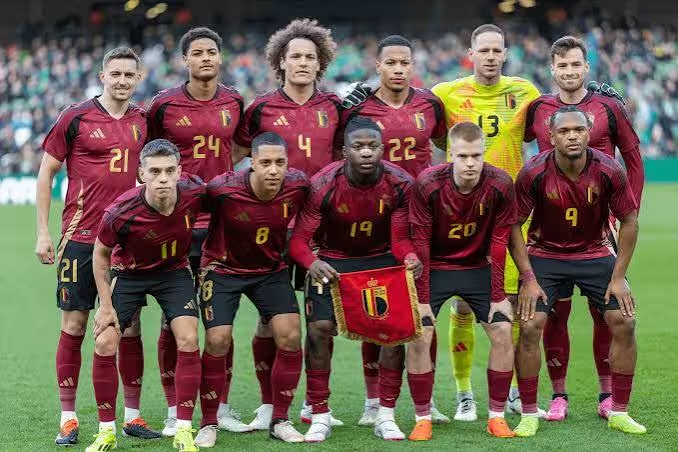
The modern Belgian squad balances elite, world-class tournament veterans with a blistering wave of young, dynamic attacking talent establishing themselves across Europe’s top-flight domestic leagues. This comprehensive profile breaks down the structural architecture of Belgium’s active roster, foundational tournament history, legendary player milestones, and modern tactical philosophy.
Brief History and Core Continental Achievements
The Royal Belgian Football Association (RBFA) was founded in 1895 and holds monumental historic prestige as a founding member of both FIFA in 1904 and UEFA in 1954. On their home continent, Belgium has consistently demonstrated elite credentials, capturing an Olympic Gold Medal in 1920 and finishing as runners-up at the 1980 UEFA European Championship in Italy.
The Global Peak of the Golden Generation
Belgium’s absolute statistical pinnacle on the global stage arrived during the 2018 FIFA World Cup in Russia. Spearheaded by Eden Hazard, Kevin De Bruyne, and Romelu Lukaku, the Red Devils put on a breathtaking display of high-speed transitional football. By eliminating five-time champions Brazil in the Quarter-finals, Belgium marched to a historic Bronze Medal finish, ranking as the number one nation in the official FIFA World Rankings for an uninterrupted four-year period between 2018 and 2022.
Technical Roster Breakdown (2026 Campaign)
The modern Belgian squad operates primarily within a highly versatile 4-3-3 or a fluid, asymmetric 3-4-2-1 structure. The system places a massive premium on deep possession recycling through a technical midfield axis, creating defensive overloads, and isolating world-class wide playmakers in high-stakes 1v1 situations.
1. Goalkeepers
The Belgian goalkeeping department focuses on exceptional physical length, reliable shot-stopping reflexes under pressure, and elite ball-playing distribution metrics.
- Koen Casteels (#1): The preferred first-choice starting goalkeeper. Casteels brings immense veteran calmness, world-class positioning, and extensive German Bundesliga pedigree.
- Matz Sels (#12): A highly commanding, athletic shot-stopper who provides elite starting-caliber depth and robust English Premier League experience.
- Thomas Kaminski (#23): A sharp, high-reflex backup keeper finalizing a highly secure goalkeeping department.
2. Defenders
The defensive line balances physically imposing central markers with rapid, high-stamina fullbacks who possess the recovery speed to operate in aggressive high-line structures.
- Wout Faes (#4): The central defensive anchor and structural leader. Faes provides robust physical tackling power, exceptional reading of passing lines, and high-volume clearance numbers.
- Zeno Debast (#2) & Arthur Theate (#3): Highly talented, modern ball-playing central defenders who form a highly cohesive partnership out of the back, with Theate providing excellent left-footed balance.
- Timothy Castagne (#21): A vastly experienced, tactically sound fullback responsible for providing overlapping options and executing recovery tracking.
- Maxim De Cuyper (#5) & Ameen Al-Dakhil (#15): High-speed wide options deployed to provide intense physical tracking against rapid opposition wingers.
3. Midfielders
The midfield functions as the absolute tactical engine room, meticulously balancing intense possession-oriented screening with creative, line-breaking passing sequences.
- Kevin De Bruyne (#7): The captain, all-time icon, and undisputed heartbeat of the team. De Bruyne remains one of the world’s premier midfield generals, utilizing world-class press-resistance, visionary passing range, and lethal crossing metrics to completely dictate the exact tempo of matches.
- Amadou Onana (#6): The primary defensive shield and physical enforcer. Onana excels at aggressively breaking up opposition transitions, winning central aerial duels, and protecting the central defenders.
- Youri Tielemans (#8): A highly technical progressive midfielder possessing excellent press-resistance, close-control ball retention, and dangerous long-range shooting capabilities.
- Orel Mangala (#16) & Arthur Vermeeren (#18): Dynamic, high-work-rate central anchors deployed to plug passing lanes and sustain central pressing densities.
4. Forwards
The frontline provides a devastating combination of clinical final-third finishing, blistering transitional speed, and elite 1v1 wing isolation dominance.
- Romelu Lukaku (#9): The premier central striker leading the attack. Lukaku offers world-class physical hold-up capabilities, immense upper-body strength, and an unmatched goalscoring record in international football.
- Jérémy Doku (#11): A world-class superstar winger and global icon. Operating from the left flank, Doku utilizes explosive acceleration, devastating close-control 1v1 dribbling skills, and unpredictable transitional flair to completely dismantle opposition fullbacks.
- Leandro Trossard (#10): A highly technical inside-forward capable of operating across the front line to execute intricate link-play and unlock deep defensive blocks.
- Johan Bakayoko (#19) & Dodi Lukebakio (#20): Blistering, exceptionally fast wide forwards deployed to stretch opposing fullbacks and cut inside to generate angles.
- Loïs Openda (#14): A lightning-fast central striker utilized to alter forward depths and inject vertical ruthlessness into transitions late in matches.
FIFA World Cup Performance Statistics
Belgium’s statistical resume highlights an international program that stands as one of the most regular and consistently resilient global tournament competitors, amassing fourteen final tournament finishes.
World Cup Tournament History Dashboard
The table below logs Belgium’s absolute performance metrics across their historical FIFA World Cup final appearances:
| World Cup Era | Final Tournaments | Overall Record (W-D-L) | Goals (GF-GA) | Final Tournament Milestones / Results |
|---|---|---|---|---|
| 1930–1954 | 5 | 1-1-8 | 10-25 | 5x Consecutive Group Stage Exits |
| 1970–1982 | 3 | 4-1-6 | 13-17 | Second Round Exit (1982) |
| 1986–2002 | 5 | 10-5-10 | 33-36 | Fourth-Place Finish (1986), 4x Round of 16 |
| 2014–2022 | 3 | 11-2-3 | 27-15 | Third Place (Bronze Medal – 2018), 1x QF, 1x Group |
| Historical Totals | 14 Tournaments Entered | 26-9-27 | 83-93 | Highest Achievement: Bronze Medal (2018) |
All-Time Cap and Scoring Leaderboards
The tables below document the historical all-time record holders for senior international appearances and goals scored for the Belgian men’s national team:
| Rank | Most Capped Players | Total International Caps | Career Era | Goals Scored |
|---|---|---|---|---|
| 1 | Jan Vertonghen | 157 | 2007–2024 | 10 |
| 2 | Axel Witsel | 132 | 2008–2024 | 12 |
| 3 | Toby Alderweireld | 127 | 2009–2022 | 5 |
| 4 | Eden Hazard | 126 | 2008–2022 | 33 |
| 5 | Romelu Lukaku | 119 | 2010–Present | 85 |
| Rank | All-Time Top Goalscorers | Goals Scored | Matches Played | World Cup Goals |
|---|---|---|---|---|
| 1 | Romelu Lukaku | 85 | 119 | 5 (All-Time National Record) |
| 2 | Eden Hazard | 33 | 126 | 3 |
| 3 | Bernard Voorhoof | 30 | 61 | 2 |
| 4 | Paul Van Himst | 30 | 81 | 0 |
| 5 | Marc Wilmots | 28 | 70 | 5 |
Elite Individual Benchmarks
- The Global Scoring Titan: Center forward Romelu Lukaku stands entirely unrivaled at the absolute apex of Belgian sports history, amassing an extraordinary 85 international goals to sit comfortably as one of the most prolific male marksmen in the history of international football.
- The Defensive Appearance Monolith: Central defender Jan Vertonghen remains the undisputed most-capped player in Belgian history with 157 caps, cementing his legacy over nearly two decades of elite competition.
- The Playmaking Visionary: Captain Kevin De Bruyne enters recent international fixtures rapidly approaching the elite 110-cap tier, sitting as the premier creative anchor of the modern Belgian football ecosystem.
Tactical Identity: High-Speed Transitions and Wide Isolation
The contemporary tactical blueprint of the Red Devils operates primarily out of a highly flexible, explosive 4-3-3 matrix. The cornerstone of the entire system is spatial exploitation through the wide areas. Rather than indulging in prolonged, slow lateral possession build-ups in their own defensive half, Belgium utilizes the deep progressive orchestration of Kevin De Bruyne to feed line-breaking passes directly into wide channels.
This movement triggers immediate vertical isolation lines. Jérémy Doku utilizes world-class close-control dribbling and explosive acceleration to unbalance fullbacks in 1v1 touchline scenarios, while fullbacks overlap to stretch opposition lines. This high-speed wide overload model allows inside playmakers to deliver low, precise horizontal distributions inside the box, maximizing the physical hold-up capabilities and clinical final-third execution of Romelu Lukaku.
Conclusion
The Belgium national football team represents a magnificent blend of historic continental prestige, generational technical genius, and modern tactical maturity. Their highly structured, high-speed transitional style highlights an international program masterfully engineered to systematically exploit and break down opposition shapes. As Kevin De Bruyne orchestrates tempos from the center circle and Jérémy Doku injects unpredictable wide chaos into final-third sequences, the Red Devils possess every structural asset necessary to sustain their position among the elite of international football.