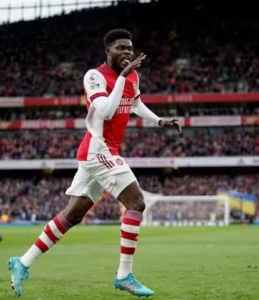
The Iran national football team, culturally and universally celebrated across the sporting landscape as Team Melli, represents the absolute standard of defensive resilience, physical grit, and tactical durability within the Asian Football Confederation (AFC). Renowned for an international identity combining an uncompromising defensive matrix with lethal transitional power, Iran has permanently occupied the upper echelon of Asian football across multiple generations.
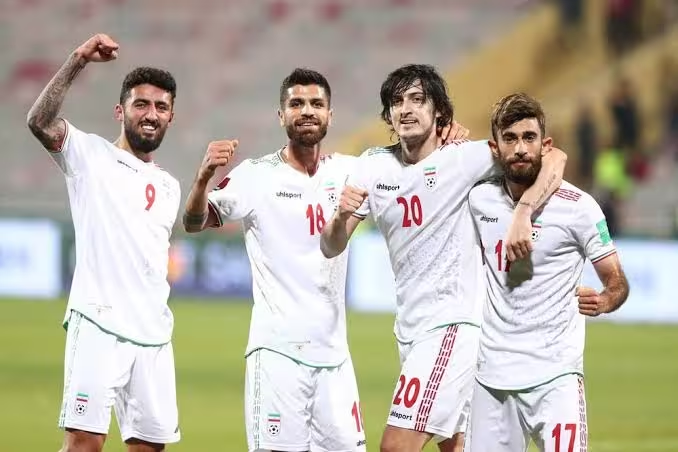
Following a dominant qualification cycle, Team Melli enters the active international landscape as a highly mature, dangerous competitor. Blending an elite wave of European league veterans with a physical, battle-hardened core, Iran stands as a formidable challenge for global opponents. This comprehensive profile breaks down the structural architecture of the active senior roster, foundational history, individual records, and up-to-date tournament performance data.
Brief History and Core Continental Achievements
The Football Federation Islamic Republic of Iran was founded in 1920 and officially admitted to FIFA in 1948, later becoming a founding member of the AFC in 1954. On their home continent, Iran’s golden footprint was etched during an extraordinary era of absolute dominance between 1968 and 1976. During this period, Team Melli captured three consecutive AFC Asian Cup titles (1968, 1972, and 1976), establishing an elite benchmark of regional supremacy that commands immense institutional respect.
World Cup Consistency and Big-Game Heroics
Iran made their long-awaited debut on the global stage at the 1978 FIFA World Cup in Argentina. Across subsequent decades, the nation transformed into a regular final tournament fixture, qualifying for six total editions (1978, 1998, 2006, 2014, 2018, and 2022). Their historical milestones are marked by high-stakes emotional triumphs, highlighted by a legendary 2-1 victory over the United States in 1998 and dramatic clean-sheet displays against Morocco and Wales in recent editions, establishing a standard of fearless competitive edge.
Technical Roster Breakdown (2026 Campaign)
Under rigid, highly organized technical management, the modern Iranian squad sets up primarily inside a compact 4-3-3 or a fluid, counter-attacking 4-4-2 or 4-2-3-1 structure. The system places an absolute premium on a synchronized defensive mid-block, ferocious aerial containment, and lightning-fast vertical transitions through central channels.
1. Goalkeepers
The Iranian goalmouth requires exceptional close-range reflex capabilities, highly secure ball handling under heavy physical contact, and commanding penalty box communication.
- Alireza Beiranvand (#1): The preferred first-choice starting goalkeeper and iconic defensive anchor. Beiranvand brings world-class positioning, incredible reflex metrics, and a legendary, world-record arm distribution range to trigger immediate counter-attacks.
- Payam Niazmand (#12): A highly physical, authoritative shot-stopper who provides elite starting-caliber depth and excellent penalty-box collection numbers from the bench.
- Hossein Hosseini (#22): A vastly experienced, dependable backup keeper finalizing a highly secure goalkeeping department.
2. Defenders
The defensive backline is engineered for absolute physical dominance, rugged tackling execution, and precise structural containment against wide isolation attempts.
- Shojae Khalilzadeh (#4) & Hossein Kanaanizadegan (#13): The preferred central defensive axis, offering an imposing physical presence, high-volume clearance metrics, and exceptional reading of central crossing lines.
- Milad Mohammadi (#5): A highly dynamic, high-stamina left-back responsible for providing vertical progressive width in transition and executing quick recovery tracking.
- Ramin Rezaeian (#23) & Sadegh Moharrami (#2): Incredibly disciplined, tactically sound right-backs responsible for locking down lateral channels and delivering high-volume crosses.
- Amin Hazbavi (#3): A highly talented young center-back deployed to provide robust central defensive depth.
3. Midfielders
The midfield functions as a tireless, hard-pressing engine room designed to choke out opposition central progressive lanes and protect the center-backs.
- Saeid Ezatolahi (#6): The primary defensive shield and tactical general. Operating as a robust deep-lying pivot, Ezatolahi excels at aggressively breaking up opposition transitions, winning central aerial duels, and recycling possession out of pressure.
- Saman Ghoddos (#14): The creative centerpiece and midfield maestro. Operating between the lines, Ghoddos provides press-resistance, spatial vision, and technical dead-ball set-piece execution.
- Alireza Jahanbakhsh (#7): The veteran vice-captain. Operating across the midfield axis or drifting wide, Jahanbakhsh utilizes exceptional positional intelligence, high-intensity tracking, and powerful long-range shooting threat.
- Mohammad Mohebi (#8) & Ali Gholizadeh (#11): Highly energetic, creative wing-midfielders tasked with finding pockets of space and executing rapid transitions through the half-spaces.
4. Forwards
The frontline features a devastating mixture of world-class physical target presence, vertical speed, and clinical final-third execution.
- Mehdi Taremi (#9): The undisputed superstar forward, global icon, and talismanic leader. Operating at the absolute highest European club level, Taremi offers world-class tactical link-play, clinical penalty-box finishing with both feet, and exceptional off-the-ball situational IQ.
- Sardar Azmoun (#20): A world-class inside-forward and prolific marksman. Known for extraordinary aerial power, clinical positioning, and sharp spatial movements, Azmoun forms a lethal central partnership alongside Taremi.
- Shahriyar Moghanlou (#10): A towering, physically robust central target forward utilized to wear down opposition center-backs and provide direct aerial options late in matches.
- Mehdi Ghayedi (#17): A blistering, exceptionally fast wide wildcard deployed to isolate tired fullbacks and inject unpredictable technical flair late in matches.
FIFA World Cup Performance Statistics
Iran’s statistical resume at the FIFA World Cup highlights an international program that stands as one of Asia’s most regular and consistently resilient tournament competitors, amassing six completed final tournament appearances.
World Cup Tournament History Dashboard
The table below logs Iran’s absolute performance metrics across their historical FIFA World Cup final appearances:
| World Cup Edition | Host Country | Overall Record (W-D-L) | Goals (GF-GA) | Final Tournament Milestone / Result |
|---|---|---|---|---|
| 1978 | Argentina | 0-1-2 | 2-8 | Group Stage Exit (World Cup Debut) |
| 1998 | France | 1-0-2 | 2-4 | Group Stage Exit (Defeated United States 2-1) |
| 2006 | Germany | 0-1-2 | 2-6 | Group Stage Exit |
| 2014 | Brazil | 0-1-2 | 1-4 | Group Stage Exit (Pushed Argentina to 1-0 Limit) |
| 2018 | Russia | 1-1-1 | 2-2 | Group Stage Exit (Narrow 4-Point Finish in Group) |
| 2022 | Qatar | 1-0-2 | 4-7 | Group Stage Exit (Defeated Wales 2-0) |
| Historical Totals | 6 Tournaments | 3-4-11 | 13-31 | Highest Achievement: Group Stage |
Legendary Individual Records and Milestones
The history of Team Melli is written by pioneering icons and prolific global marksmen who established elite individual benchmarks for international football.
All-Time Cap and Scoring Leaderboards
The tables below document the historical all-time record holders for senior international appearances and goals scored for the Iranian men’s national team:
| Rank | Most Capped Players | Total International Caps | Career Era | Goals Scored |
|---|---|---|---|---|
| 1 | Javad Nekounam | 149 | 2000–2015 | 39 |
| 2 | Ali Daei | 148 | 1993–2006 | 108 |
| 3 | Ali Karimi | 127 | 1998–2012 | 38 |
| 4 | Jalal Hosseini | 115 | 2007–2018 | 8 |
| 5 | Ehsan Hajsafi | 114 | 2008–2024 | 7 |
| Rank | All-Time Top Goalscorers | Goals Scored | Matches Played | World Cup Goals |
|---|---|---|---|---|
| 1 | Ali Daei | 108 | 148 | 0 (First Male to 100 Goals) |
| 2 | Sardar Azmoun | 55 | 83 | 0 (Highest Active Scorer) |
| 3 | Karim Bagheri | 50 | 87 | 0 (Midfield Scoring Mark) |
| 4 | Mehdi Taremi | 51 | 85 | 2 (National World Cup Record) |
| 5 | Javad Nekounam | 39 | 149 | 0 |
Elite Individual Benchmarks
- The Immortal King of Goals: Striker Ali Daei stands as an immortal monument in global sports folklore, finishing his highly decorated career with 108 international goals to become the first male footballer in human history to cross the legendary century mark.
- The Modern Scoring Surge: Prolific forwards Mehdi Taremi and Sardar Azmoun remain locked in an elite race at the upper tier of the national charts. Taremi holds the absolute national record for the most goals scored at World Cup finals (2), while Azmoun sits as the nation’s highest active overall scorer with 55 senior international strikes.
- The Midfield Appearance Peak: Defensively rigid midfield general Javad Nekounam stands entirely alone at the apex of Iranian appearance history, amassing an extraordinary 149 international caps.
Tactical Identity: The Positional Mid-Block and Linear Transitions
The contemporary tactical blueprint of Team Melli operates primarily out of a highly flexible, ultra-compact 4-3-3 matrix that seamlessly compresses space out of possession. The cornerstone of the entire system is territorial structural security. Iran willingly surrenders high-volume ball possession to elite global opponents, choosing to drop rapidly into a synchronized mid-to-low block shape that completely suffocates central passing routes.
Out of possession, Saeid Ezatolahi screens the central center-back space with clinical discipline, forcing opposition combinations outward toward the lateral touchlines where physical fullbacks execute hard tackles. Once an aggressive turnover is secured, Iran completely avoids slow possession build-ups inside their own half. Deep anchors immediately trigger linear transitions, firing direct vertical balls to utilize the world-class physical hold-up capabilities and elite situational IQ of Mehdi Taremi and Sardar Azmoun, transforming deep defensive containment into clean final-third goals within a matter of seconds.
Conclusion
The Iran national football team stands as a magnificent testament to structural organization, tactical discipline, and immense physical resilience. Their highly synchronized, defensive counter-attacking framework highlights an international program masterfully engineered to systematically neutralize and pick apart the progressive systems of global football giants on the grandest stage. As Mehdi Taremi injects clinical world-class execution into final-third sequences and Alireza Beiranvand anchors the backline, Team Melli possesses every structural parameter necessary to maintain their historic reputation as a premier force in global football.