The Haiti national football team, culturally and historically celebrated across the sporting landscape as Les Grenadiers (The Soldiers) or Le Sélection Nationale, represents one of the most culturally profound and historically significant football programs in the Caribbean. Operating within the CONCACAF region, Haiti has built a legacy defined by immense raw athletic talent, technical flair, and an unyielding competitive spirit that frequently challenges the established continental hierarchy.
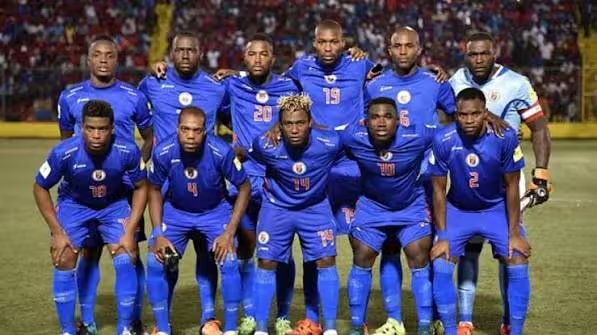
Following a highly focused structural reconstruction under centralized technical management, Les Grenadiers continue to emerge as a highly dangerous, physical competitor on the international stage. Combining an elite wave of diaspora talent playing in the premier domestic leagues of Europe and North America with a highly unified tactical identity, Haiti stands as a complex and demanding challenge for global opponents. This comprehensive profile breaks down the structural design of the active senior roster, foundational history, individual records, and up-to-date statistical performance data.
Brief History and Core Continental Achievements
The Haitian Football Federation was officially founded in 1904 and became an official member of FIFA in 1934. On their home continent, Haiti’s golden footprint was etched during the 1970s, a period where they dictated the tactical direction of Caribbean football.
Continental Champions and the 1974 Breakthrough
Haiti’s crowning historical achievement arrived when they won the 1973 CONCACAF Championship on home soil in Port-au-Prince. By lifting the continental trophy, Les Grenadiers broke massive geopolitical barriers, finishing ahead of regional powerhouses like Mexico to become the first-ever Caribbean nation to qualify for a FIFA World Cup via the qualification process, representing the region at the 1974 finals in West Germany. In the modern era, Haiti restored its elite regional pedigree by marching to a historic semi-final finish at the 2019 CONCACAF Gold Cup, proving their competitive edge remains a permanent asset.
Technical Roster Breakdown (2026 Campaign)
The modern Haitian squad operates primarily out of a highly structured 4-2-3-1 or a compact, transition-minded 4-3-3 formation. The system places a supreme premium on explosive vertical pace, high-intensity physical pressing in the middle third, and heavy reliance on rapid wingers to isolate defenders in 1v1 touchline scenarios.
1. Goalkeepers
The Haitian goal area requires exceptional reflex shot-stopping, commanding aerial dominance during set-piece phases, and physical robustness.
- Johny Placide (#1): The legendary veteran captain and long-serving protector of the national team. Placide brings world-class positioning, extensive European experience, and vocal organizational leadership from deep in his box.
- Alexandre Pierre (#12): A highly agile, technically gifted young keeper providing elite starting-caliber backup depth.
- Garissone Innocent (#23): A physically imposing shot-stopper completing a highly secure and deeply experienced goalkeeping department.
2. Defenders
The defensive line focuses on absolute recovery speed, robust tackling metrics, and utilising fullbacks capable of covering immense ground to act as wide outlet triggers in transition.
- Carlens Arcus (#2): A world-class, highly disciplined right-back operating at the European first-division level. Arcus provides electric tracking speed, elite 1v1 wide containment, and strong overlapping traits.
- Ricardo Adé (#4): The central defensive anchor, offering exceptional physical height, high-volume clearances, and immense locker-room authority.
- Garven Metusala (#6) & Jean-Kévin Duverne (#3): The preferred central axis partnership, blending modern speed with precise timing in tackles.
- Alex Christian (#22): A vastly experienced left-back known for his tactical positioning, high-stamina recovery runs, and crossing capabilities.
- Duke Lacroix (#15) & Stéphane Lambese (#13): Versatile, hard-tackling wide defenders deployed to maintain strict structural containment on the flanks.
3. Midfielders
The midfield functions as a tireless, hard-pressing engine room designed to choke out opposition central passing channels before triggering immediate vertical counters.
- Carl Sainte (#8): The primary defensive shield and tactical anchor. Sainte excels at breaking up opposition counter-attacks and recycling possession efficiently under heavy pressure.
- Leverton Pierre (#6): A robust, box-to-box central midfielder responsible for covering extensive lateral space to protect the backline.
- Danley Jean Jacques (#17): A highly dynamic midfield link-man possessing exceptional press-resistance, close-control dribbling, and progressive driving lines.
- Derrick Etienne Jr. (#10): The creative centerpiece. Operating as an advanced playmaker or an inside-forward, Etienne utilizes exceptional spatial intelligence, intricate passing, and vision to unlock deep defensive blocks.
- Bryan Alceus (#14): A high-work-rate central pivot utilized to maintain mid-block pressing densities.
4. Forwards
The frontline provides a devastating combination of clinical final-third finishing, blistering transitional speed, and immense physical target presence.
- Frantzdy Pierrot (#9): The premier central striker leading the attack. Pierrot offers world-class physical hold-up capabilities, immense aerial power to convert crosses, and an elite scoring record in domestic European and continental competitions.
- Duckens Nazon (#7): The iconic talismanic forward. Known for his explosive acceleration, clinical power finishing, and immense technical flair, Nazon can operate centrally or drift wide to isolate center-backs.
- Fafà Picault (#11) & Louicius Don Deedson (#19): Blistering, highly direct wingers deployed to stretch opposing backlines and cut inside to generate rapid shooting angles.
- Mondy Prunier (#20): A clinical, high-intensity forward variant utilized to stretch fatigued central defenders late in matches.
FIFA World Cup Performance Statistics
Haiti’s statistical resume at the FIFA World Cup highlights an international program that stands as a historic pioneer for Caribbean sports, highlighted by an iconic campaign on European soil.
World Cup Tournament History Dashboard
The table below logs Haiti’s absolute performance metrics across their historical FIFA World Cup final appearances:
| World Cup Edition | Host Country | Overall Record (W-D-L) | Goals (GF-GA) | Final Tournament Milestone / Result |
|---|---|---|---|---|
| 1974 | West Germany | 0-0-3 | 2-14 | Group Stage Exit (First-Ever Caribbean Qualifier via Groups) |
| Historical Totals | 1 Tournament | 0-0-3 | 2-14 | Historic Goals Scored vs Italy and Argentina |
Legendary Individual Records and Milestones
The history of Les Grenadiers is written by pioneering global goalscorers and dedicated international veterans who set the absolute standard for Caribbean football longevity.
All-Time Cap and Scoring Leaderboards
The tables below document the historical all-time record holders for senior international appearances and goals scored for the Haitian men’s national team:
| Rank | Most Capped Players | Total International Caps | Career Era | Goals Scored |
|---|---|---|---|---|
| 1 | Mechack Jérôme | 80 | 2008–2022 | 4 |
| 2 | Johny Placide | 68 | 2011–Present | 0 |
| 3 | Wilde-Donald Guerrier | 62 | 2010–2021 | 11 |
| 4 | Duckens Nazon | 55 | 2014–Present | 28 |
| 5 | Emmanuel Sanon | 49 | 1970–1981 | 47 |
| Rank | All-Time Top Goalscorers | Goals Scored | Matches Played | World Cup Goals |
|---|---|---|---|---|
| 1 | Emmanuel Sanon | 47 | 49 | 2 (National Record) |
| 2 | Duckens Nazon | 28 | 55 | 0 |
| 3 | Frantzdy Pierrot | 21 | 32 | 0 |
| 4 | Golman Pierre | 21 | 25 | 0 |
| 5 | Jean-Philippe Peguero | 16 | 28 | 0 |
Elite Historical Benchmarks
- The Immortal Sanon Record: Striker Emmanuel Sanon holds an eternal position in global football folklore. At the 1974 World Cup, Sanon scored a legendary goal against Italy, shattering the iconic Italian goalkeeper Dino Zoff’s world-record streak of 1,142 consecutive minutes without conceding a goal, before netting a second against Argentina.
- The Modern Scoring Surge: Strikers Duckens Nazon and Frantzdy Pierrot remain locked in an elite race at the upper end of Haiti’s modern scoring charts, maintaining world-class international goal-per-game ratios to sit comfortably behind Sanon’s historic record.
Tactical Identity: The Direct Transitional Template
The contemporary tactical blueprint of Les Grenadiers functions primarily within an explosive 4-2-3-1 matrix. The hallmark of the entire system is lightning-fast verticality. Rather than engaging in slow, risk-heavy possession build-ups inside their own defensive third, Haiti utilizes the structural press-resistance of Danley Jean Jacques to progress the ball efficiently into wide spaces.
Out of possession, Haiti avoids frantic, disconnected high-pressing triggers, choosing instead to form a highly synchronized, compact mid-block shape. Ricardo Adé organizes the central line with robust physical authority, forcing opposition combinations outward toward the touchlines. Once a turnover is secured, the team transitions with devastating speed. Wide wingers isolate fullbacks in open space, delivering quick distributions to maximize the towering aerial height of Frantzdy Pierrot or the clinical edge of Duckens Nazon, transforming defensive block containment into rapid final-third execution.
Conclusion
The Haiti national football team stands as a magnificent testament to resilience, immense natural athletic talent, and an ascending modern tactical dynamic. Their structured, high-speed transitional style highlights a program masterfully engineered to systematically neutralize and exploit the defensive shapes of continental giants. As Johny Placide commands the backline from his box and Frantzdy Pierrot extends modern scoring benchmarks under intense national expectation, Les Grenadiers possess all the technical parameters, structural cohesion, and competitive drive necessary to sustain a highly competitive era on the global stage.