PLAYER SNAPSHOT: At a Glance
| Category | Details |
|---|---|
| Full Name | Mohamed Salah Hamed Mahrous Ghaly |
| Date of Birth | 15/06/1992 (Age: 34) |
| Place of Birth | Nagrig, Nile Delta, Egypt |
| Nationality | Egyptian |
| Height | 5 ft 9 in / 175 cm |
| Position | Right Winger / Forward |
| Squad Number | #10 (Egypt), #11 (Liverpool) |
| Current Club | Free Agent (Left Liverpool 2026) |
| Previous Clubs | El Mokawloon, Basel, Chelsea, Fiorentina, Roma, Liverpool |
| International Caps | 100+ caps / 68 goals for Egypt |
| World Cup Appearances | 2018, 2026 |
| Contract Until | — |
| Market Value | — |
The Frozen Moment
The wait was over. After 92 years of trying, Egypt had finally won a World Cup match. And of course, it was Mohamed Salah who made it happen.
In Vancouver, the Egyptian captain delivered a performance that will be remembered for generations. His 67th-minute goal against New Zealand gave Egypt a 3-1 comeback victory, securing their first-ever World Cup win at their ninth attempt. The scenes that followed told the story of a nation unburdened. Journalists leapt from their seats, hugged their compatriots, and punched the air in sheer elation. Years of heartbreak had finally given way to history.
For Salah, this victory carried deeper meaning than most could ever comprehend. At 34, he had carried the weight of Egyptian football on his shoulders for over a decade. Since his international debut in 2011, he had scored the goals that propelled Egypt into two World Cups, but victory had always remained agonisingly out of reach. His World Cup journey had been defined by injury, disappointment, and near-misses.
In 2018, he faced a desperate race against time to recover from a shoulder injury sustained in the Champions League final. Even Egypt’s Minister of Health was reportedly involved in his recovery. He made the squad but started on the bench in their opening defeat to Uruguay. His converted penalty against Russia was merely a consolation in a 3-1 loss, and he missed a sitter as Egypt suffered a humiliating defeat to Saudi Arabia. The fallout was immense, with Salah accusing Egypt’s FA of disrupting preparations and reports that he was close to quitting international football entirely.
Four years later, things got worse. Egypt failed to qualify for Qatar 2022. Salah’s World Cup dreams appeared to be slipping away.
But in Vancouver, everything changed. After a lacklustre first half where Egypt looked dreadful going forward, Hossam Hassan switched things around. Salah pushed higher, operating almost as a centre-forward rather than his traditional right-wing role. The trick worked immediately. Egypt equalised through a Mostafa Ziko header in the 58th minute, and then Salah struck.
The goal was typical Salah. He received a back-heel pass from Ziko and swept it home with the kind of clinical finishing that has defined his Liverpool career. It was his third World Cup goal, making him Egypt’s all-time top scorer in the competition. More significantly, it was his 68th international goal, leaving him just one short of equalling Hossam Hassan’s all-time national record.
Salah celebrated by pumping his fist before being mobbed by his teammates. When he was substituted in the 85th minute, the sellout crowd at BC Place Stadium gave him a standing ovation.
“It’s a great achievement for all the players. It’s a great win. It’s a great vibe,” Salah said afterwards.
Origins
To understand what this moment means, you have to understand where Salah came from. Nagrig is a modest farming village in Egypt’s Nile Delta, 80 miles north of Cairo. Its unpaved roads are part of the mythology of how Salah worked his way to stardom.
Born to a government employee and a homemaker, Salah was the eldest of four children. Football was played on patchy pitches with makeshift goals. There was no grand academy, no fancy facilities. There was just a ball, a dusty pitch, and a burning desire to escape the confines of rural Egypt.
His talent was spotted by a freelance scout, who brought him to the Arab Contractors’ development league in Cairo. The commute was brutal. Every day at 7am, Salah would walk a kilometre, ride a bike to Basyoun, transfer to a bus to Tanta, transfer again to Cairo, and then take a final bus to the club. The four-hour journey would then be repeated in reverse, getting him home around midnight. He never complained.
Within two years of his professional debut, he was on a plane to Switzerland, signing for Basel. From there, he moved to Chelsea, then Fiorentina and Roma in Italy, before finally landing at Liverpool in 2017 for a then-club-record fee of £36.9 million.
The European Forge
Basel was Salah’s European proving ground. He won two Swiss Super League titles and announced himself on the continental stage with goals against Chelsea in the Champions League. It was that performance that caught the eye of José Mourinho, who signed him for Chelsea in 2014.
But Salah’s first stint in the Premier League was a struggle. Limited opportunities at Stamford Bridge led to loan moves to Fiorentina and Roma in Italy, where he would truly find his feet. At Fiorentina, he rediscovered his confidence. At Roma, he became a star—scoring 34 goals in two seasons and establishing himself as one of Serie A’s most lethal attackers.
Chelsea was a failure for Salah. He couldn’t displace the stars in Mourinho’s squad. But the setback was a catalyst. In Italy, he flourished. The transfer, and his later stints at major Italian clubs, coincided with Salah beginning to flourish on the field for Egypt.
Salah started as a traditional winger, hugging the touchline and using his pace to beat defenders. But by the time he reached Liverpool, he had evolved into a goal-scoring phenomenon. He became a right-sided forward who cut inside onto his lethal left foot, creating havoc for fullbacks and goalkeepers alike. “This specific kind of player is irreplaceable,” Jürgen Klopp once said. “The numbers Mo produces, they are unmatched from that position. For a striker they are pretty much unmatched.”
The Debut
In 2017, Liverpool signed Salah from Roma for a then-club-record fee of £36.9 million. The reaction was muted. He had failed at Chelsea. Was he good enough for the Premier League? The question was answered within months. Salah scored on his debut against Watford and never looked back.
The Liverpool version of Salah was not the nervous Chelsea version. He arrived with confidence, swagger, and a relentless work ethic. His first season was explosive: 44 goals in all competitions, 32 in the Premier League, a record haul. He was crowned the Premier League Golden Boot winner and PFA Players’ Player of the Year.
“Mo Salah, the Egyptian King”—the chant echoed around Anfield. He was no longer just a player; he was a phenomenon. In 2019, his penalty helped Liverpool to their first Champions League title since 2005. He was the heartbeat of a dynasty.
The Anatomy of His Game
Salah is a left-footed dribbling machine. His low centre of gravity, combined with explosive acceleration, makes him almost unplayable in one-on-one situations. He has the rare ability to drift past defenders with minimal effort, using quick feints and sharp changes of direction. His trademark is cutting inside from the right wing, shifting onto his left foot, and curling the ball into the far corner.
Out of possession, Salah’s defensive contribution improved significantly under Klopp, becoming a key component of Liverpool’s famed high press. His intelligence in pressing triggers and his ability to win the ball back in dangerous areas make him a valuable asset even without the ball.
He is fast, strong, and remarkably durable. Salah rarely missed games for Liverpool, playing over 50 matches in eight of his nine seasons at Anfield. His acceleration over five yards is elite, and his ability to ride challenges while maintaining balance is exceptional.
His right foot is significantly weaker than his left—155 of his 193 Premier League goals have been scored with his left foot. Defenders have learned to show him outside, but even then, his pace and skill often make the tactic redundant. Additionally, his aerial presence is minimal, though this is rarely a requirement for his role.
The Numbers Game
Salah’s numbers showcase a player who, not only dominated the Premier League, but also holds the title as Egypt’s greatest-ever goal-scorer.
TABLE A: The Data Snapshot (Career Overview)
| Season | Club | League | Apps | Goals | Assists | Minutes Played |
|---|---|---|---|---|---|---|
| 2014-2016 | Chelsea | Premier League | 19 | 2 | 2 | — |
| 2014-2015 | Fiorentina (Loan) | Serie A | 26 | 9 | 4 | — |
| 2015-2017 | Roma | Serie A | 83 | 34 | — | — |
| 2017-2026 | Liverpool | Premier League | 435 | 255 | 120 | — |
| 2005-2026 | Egypt | International | 100+ | 68 | — | — |
TABLE B: Performance Metrics (2025/26 Season)
| Metric | Salah (2025/26) | League Average | Percentile Rank |
|---|---|---|---|
| Goals | 12 | — | Top 5% |
| Assists | 10 | — | Top 5% |
| Pass Completion % | ~80% | — | — |
| Shots per 90 | 2.85 | — | — |
| G+A per 90 | 0.59 | — | — |
TABLE C: The Impact Table (Goal Contributions by Competition)
| Competition | Apps | Goals | Assists | Goal Involvements | Avg. Rating |
|---|---|---|---|---|---|
| Premier League (Liverpool) | 310 | 193 | 94 | 287 | — |
| Champions League (Liverpool) | 50+ | 52+ | — | — | — |
| Other Competitions | — | — | — | — | — |
| International (Excl. World Cup) | — | 65 | — | — | — |
| World Cup | 7 | 3 | 3 | 6 | — |
| TOTAL | 435+ | 255 | 120 | 375 | — |
TABLE D: Heatmap / Positional Activity
Salah operates predominantly on the right wing, cutting inside to create goal-scoring opportunities.
                         ATTACKING THIRD
                   ┌─────────────────────────┐
                   │     LW     ST     RW     │
                   │    [15%]   [25%]   [60%]  │
                   ├─────────────────────────┤
                   │     LCM    CAM    RCM    │
                   │    [5%]    [10%]   [5%]   │
                   ├─────────────────────────┤
                   │     LDM    CDM    RDM    │
                   │    [0%]    [0%]    [0%]   │
                   ├─────────────────────────┤
                   │     LB     CB     RB     │
                   │    [0%]    [0%]    [0%]   │
                   └─────────────────────────┘
                         DEFENSIVE THIRD

              Mohamed Salah's Average Touch Map
                (Liverpool 2025/26 Season)
                    (Higher % = More Activity)
TABLE E: Career Milestones
| Year | Achievement | Details |
|---|---|---|
| 2010 | Professional Debut | Made debut for El Mokawloon in Egyptian Premier League |
| 2014 | Move to Europe | Signed for Chelsea for £11 million |
| 2017 | Move to Liverpool | Signed for club-record £36.9 million |
| 2018 | Golden Boot | First Premier League Golden Boot (32 goals) |
| 2019 | Champions League Winner | Scored penalty in final vs Tottenham |
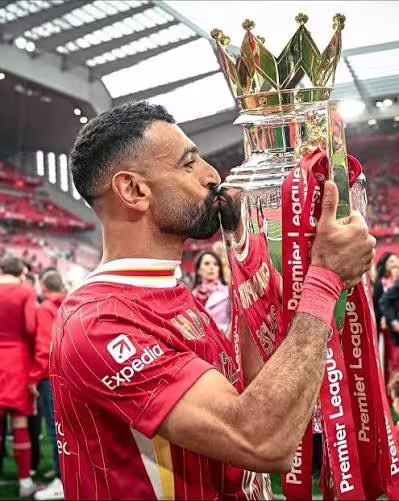
| 2020 | Premier League Winner | First Premier League title for Liverpool |
| 2022 | FA Cup Winner | Won FA Cup with Liverpool |
| 2022 | FA Cup Winner | Won FA Cup with Liverpool |
| 2023 | All-Time Top Scorer | Became Liverpool’s top Premier League scorer |
| 2025 | Second Premier League Title | Won second title under Arne Slot |
| 2026 | World Cup History | First Egyptian to score in multiple World Cups |
| 2026 | Egypt All-Time Top Scorer (Pending) | 68 goals, one behind Hossam Hassan |
TABLE F: Comparison with Peers
| Player | Goals | Assists | Key Passes p/90 | Dribbles p/90 | Tackles p/90 | Pass Acc % |
|---|---|---|---|---|---|---|
| Mohamed Salah | 193 | 94 | — | — | — | ~80% |
| Sadio Mané | 111 | — | — | — | — | — |
| Didier Drogba | 104 | 55 | — | — | — | — |
| Thierry Henry | 175 | — | — | — | — | — |
TABLE G: World Cup Record (Tournament-by-Tournament)
| Tournament | Host Nation | Apps | Goals | Assists | Minutes Played | Stage Reached |
|---|---|---|---|---|---|---|
| 2018 | Russia | 3 | 2 | 0 | — | Group Stage |
| 2026 | USA/Canada/Mexico | 3+ | 1 | 3 | — | Round of 32 |
| TOTAL | — | 6+ | 3 | 3 | — | — |
TABLE H: World Cup Knockout Stage Performance
| Round | Year | Opponent | Result | Goals | Assists | Rating |
|---|---|---|---|---|---|---|
| Round of 32 | 2026 | Australia | W 1-1 (pens) | 0 | 0 | — |
| TOTAL | — | — | — | — | — | — |
What these figures reveal is a player whose consistency at the highest level is almost unmatched—over 430 appearances for Liverpool, 255 goals, and records that will stand for decades. His three World Cup goals make him Egypt’s all-time top scorer in the competition, and his 68 international goals place him just one behind the national record.
The Present Tense
At 34, Salah’s final season at Liverpool was a twilight campaign. He played 27 matches, scoring 7 goals and providing 7 assists in the league. It was a dip from his monumental 2024/25 season, where he registered 34 goals and 23 assists from 52 games. But the drop in club form was offset by his importance to Egypt. In World Cup qualifying, he scored 9 goals in 10 matches, becoming the top scorer in African World Cup qualifying history. “He is one of the best players globally,” said Egyptian coach Hossam Hassan. “I’m very lucky to work with him.”
At Liverpool, Salah’s chemistry with Sadio Mané and Roberto Firmino defined an era. In his final seasons, he formed a new partnership with Luis Díaz and Darwin Núñez, but the magic had faded. At the World Cup, he has been the creative heartbeat of Egypt, providing key assists for the Pharaohs in their breakthrough tournament. His assist in the 1-1 draw with Belgium and his goal and assist against New Zealand showed his enduring class.
Under Arne Slot, Salah’s role changed. He was frequently benched and publicly criticized the club for “throwing me under the bus.” The manager’s system was more conservative, less reliant on the individual brilliance that had defined the Klopp era. For Egypt, under Hossam Hassan, Salah plays a freer, more central attacking role. “He has surpassed the capabilities that people had expected of him so far,” Hassan said. The freedom has revitalised him.
This is Salah’s final World Cup. After Egypt’s failure to qualify for Qatar 2022, the 2026 tournament was seen as his last chance to build an international legacy. The Pharaohs have already achieved history—their first-ever World Cup victory and first knockout stage appearance. “What happened today is history for us as Egyptians,” Salah said after the New Zealand win. “We see a lot of teams win games, but for us as Egyptian, it doesn’t happen often, first time in history.”
Beyond the Touchline
Salah is famously private. Unlike many modern superstars, he shares little of his personal life. But his devotion to his family and his faith is well-known. His wife, Maggi, and their children are a constant presence in his life. He is known to be a humble, religious man who rarely courts controversy. His pre-match rituals are simple: focus, prayer, and preparation.
Beyond football, Salah is a style icon and a philanthropist. In Nagrig, his legacy includes a renovated school, a hospital, and infrastructure projects funded by his wealth. He has donated millions to Egyptian charities, often quietly. His impact on his hometown is so profound that the village school was renamed in his honour. In Nagrig, giant painted murals of Salah’s face were plastered on the sides of buildings, young children wearing jerseys emblazoned with his name still play football in the streets.
Salah’s psychological resilience is remarkable. He failed at Chelsea, could have faded into obscurity, but rebuilt himself in Italy. He handled the pressure of Liverpool’s title drought, the weight of Egypt’s World Cup hopes, and the constant comparisons to the all-time greats. “I can’t explain in words to anyone not part of this club,” he said when leaving Liverpool. “Liverpool is not just a football club. It’s a passion, it’s a history, it’s a spirit.”
The 2018 World Cup was a mixed experience for Salah. He scored twice but Egypt crashed out in the group stage. The 2026 tournament, however, is different. He is the captain, the leader, the record-breaker. Salah, so often reserved in public, danced to Egyptian songs in the dressing room before joining supporters celebrating in the streets. The weight of carrying a nation has finally given way to shared joy.
The Verdict from the Camp
Jürgen Klopp, former Liverpool manager:
“This specific kind of player is irreplaceable. The numbers Mo produces, they are unmatched from that position. The numbers for a winger are ridiculous. For a striker they are pretty much unmatched.”
Hossam Hassan, Egypt head coach:
“He is one of the best players globally and I’m very lucky to work with him and I’m very happy with our work together so far. I have managed to deploy him tactically and technically speaking and he has surpassed the capabilities that people had expected of him so far.”
Mohamed Salah, after Egypt’s first-ever World Cup victory:
“What happened today is history for us as Egyptians. We see a lot of teams win games, but for us as Egyptian, it doesn’t happen often, first time in history.”
Dawn news analysis on Salah’s legacy:
“Salah’s significance extends beyond the goals he scores or the trophies he has lifted. He emerged from Nagrig to become the face of one of England’s biggest clubs at a time when football’s brightest stars largely came from Europe or South America. As an Egyptian, an Arab and an African, he challenged long-held perceptions about who could occupy the sport’s biggest stages.”
Where Next?
He has won everything at club level—two Premier League titles, a Champions League, an FA Cup, a Club World Cup, and two League Cups. He has broken records that may never be touched: the most goals and assists by an African player in Premier League history, the most goal involvements for a single club, and the most Golden Boots by an African player. His ambition now is international: to become Egypt’s all-time top scorer and to lead the Pharaohs to the World Cup knockout stage.
Salah’s World Cup legacy is already secure. He is Egypt’s all-time top scorer in the tournament. He has led his country to their first-ever World Cup victory and first knockout-stage appearance. But there is more to achieve. If Egypt can overcome Australia, they will play for a place in the quarter-finals—a feat that would cement Salah as the greatest Egyptian footballer of all time. His World Cup performances could determine his next move.
Salah left Liverpool as a free agent in 2026 after a breakdown of relations with Arne Slot. “Unfortunately the day has come,” he said in an Instagram post. His club future beyond the World Cup is uncertain. But his performances in the tournament will likely attract interest from clubs in Europe, the Middle East, and perhaps even the United States. Wherever he goes, he will leave behind a legacy at Liverpool that is unparalleled.
The ball sat on the penalty spot in Alexandria. The weight of a nation rested on Mohamed Salah’s shoulders. He didn’t miss. He never does. Whether he is representing Egypt or Liverpool, Salah has always been a player who delivers when it matters most. In Dallas, against Australia, the spotlight will be on him again. The Egyptian King has one more crown to win: a legacy that transcends club football and places him among the all-time greats of the international stage.