The New Zealand men’s national football team, culturally and universally heralded across the sporting landscape as the All Whites, represents the undisputed geometric center, organizational engine, and athletic powerhouse of the Oceania Football Confederation (OFC). Historically navigating an isolated geographical territory, New Zealand football has successfully constructed a modern international identity focused on immense physical durability, tactical low-block discipline, and exploiting deep aerial channels.
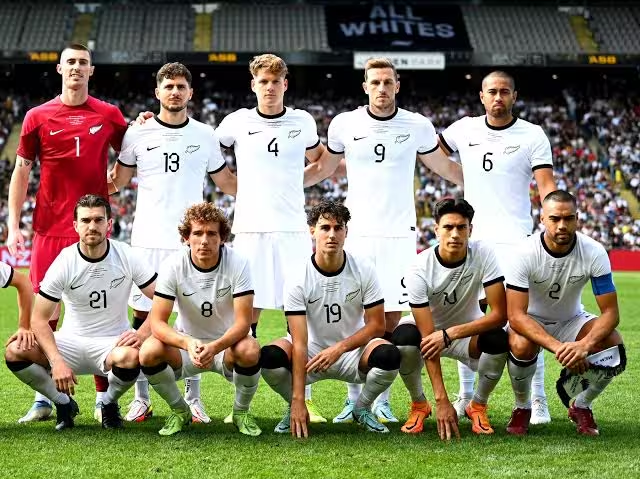
Following a dominant multi-year preliminary cycle, the All Whites have entered the current international cycle as a highly mature, dangerous competitor. Benefiting from Oceania’s first-ever direct, guaranteed qualification slot for the expanded global tournament, New Zealand matches its legendary physical foundation with a fast, technical wave of diaspora talent playing across the top professional tiers of Europe and North America. This comprehensive profile breaks down the structural design of the active senior roster, foundational tournament history, individual milestones, and modern tactical identity.
Brief History and Core Continental Achievements
The New Zealand Football Association was founded in 1891 and officially admitted to FIFA in 1948, later helping co-found the OFC in 1966. On their home continent, the All Whites stand as the absolute, undisputed historic giant, capturing a record six OFC Nations Cup titles (1973, 1998, 2002, 2008, 2016, and 2024), establishing a permanent baseline of regional supremacy.
The Historic Unbeaten World Cup Legacy
New Zealand’s historical pedigree on the global stage is marked by extraordinary bouts of resilience. They made their monumental final tournament debut at the 1982 FIFA World Cup in Spain, battling ruggedly against global titans. Their absolute pinnacle of international acclaim arrived during the 2010 FIFA World Cup in South Africa. Placed in a deeply tactical group alongside reigning world champions Italy, Paraguay, and Slovakia, the All Whites shocked the global sporting community by playing out three consecutive, heroic draws. Finishing the tournament as the only undefeated team in the entire competition, New Zealand etched an immortal page into global sports folklore.
Technical Roster Breakdown
The modern New Zealand squad operates primarily within a highly structured 4-2-3-1 or a rigid, defensively dense 3-4-2-1 formation. The system places a supreme premium on low-block defensive synchronization, ferocious physical duels in the defensive third, and generating asymmetric wide overloads to target a world-class central striker.
1. Goalkeepers
The New Zealand goal area requires exceptional cross-claiming metrics, highly secure handling under physical aerial pressure, and vocal penalty box command.
- Alex Paulsen (#1): The preferred first-choice starting goalkeeper. Paulsen brings world-class positioning, incredible reflex metrics, and superior ball-playing distribution properties.
- Oliver Sail (#12): A highly physical, authoritative shot-stopper who provides elite starting-caliber backup depth and excellent box command.
- Max Crocombe (#23): A sharp, vastly experienced backup goalkeeper finalizing a highly secure goalkeeping department.
2. Defenders
The defensive backline is engineered for absolute aerial dominance, rugged clearance metrics inside the box, and fullbacks built for high-stamina tracking.
- Liberato Cacace (#3): The vice-captain, primary defensive catalyst, and world-class left-back. Operating at the highest elite European first-division tier, Cacace provides blistering recovery speed, elite 1v1 wide isolation containment, and progressive driving lines.
- Michael Boxall (#4) & Nando Pijnaker (#5): Towering, physically robust central defensive enforcers who form an impenetrable structural shield inside the six-yard box.
- Tyler Bindon (#15) & Tommy Smith (#6): High-speed modern central defenders deployed to absorb quick counter-attacks, with Smith providing immense veteran leadership.
- Tim Payne (#2) & Dalton Wilkins (#16): Highly disciplined, tactically sound wide fullbacks responsible for shutting down wing isolation attempts and executing recovery tracking.
3. Midfielders
The midfield functions as a tireless, hard-pressing engine room, meticulously balancing possession-recycling duties with intense mid-block pressing traps.
- Joe Bell (#8): The midfield maestro and deep-lying pivot. Bell acts as the vital strategic link, utilizing world-class press-resistance, positional authority, and line-breaking progressive passes to dictate tempos out of high-pressure zones.
- Marko Stamenic (#6): A highly dynamic, powerhouse box-to-box engine. Operating at the elite European level, Stamenic provides a blend of explosive physical driving lines, robust ball-winning tackles, and spatial vision.
- Matt Garbett (#10): The creative centerpiece. Operating in the advanced play-maker slot, Garbett provides press-resistant ball retention, close-control dribbling, and technical dead-ball set-piece execution.
- Sarpreet Singh (#7) & Elijah Just (#11): Highly energetic, technically gifted progressive midfielders tasked with finding pockets of space and executing rapid transitions through the half-spaces.
4. Forwards
The frontline provides a devastating combination of elite physical target presence, vertical speed, and clinical final-third execution.
- Chris Wood (#9): The captain, all-time legend, and undisputed talisman. Operating at the absolute pinnacle of European club football, Wood is a world-class target forward, offering unparalleled aerial power, elite physical hold-up play, and highly clinical finishing execution inside the penalty box.
- Ben Waine (#19): A highly dynamic inside-forward whose tireless channel running lines and explosive acceleration inject sudden vertical power late in matches.
- Kosta Barbarouses (#11): The legendary wide forward variant chosen to stretch fatigued opposition backlines and deploy immense big-game experience.
- Alex Greive (#20) & Max Mata (#17): Direct attacking variants deployed to lead the frontline defensive press and absorb heavy physical contact from center-backs.
FIFA World Cup Performance Statistics
New Zealand’s statistical resume highlights an international program that stands as a model of tournament efficiency, famously remaining undefeated across their primary modern appearance.
World Cup Tournament History Dashboard
The table below logs New Zealand’s absolute performance metrics across their completed FIFA World Cup final appearances:
| World Cup Edition | Host Country / Nations | Overall Record (W-D-L) | Goals (GF-GA) | Final Tournament Milestone / Result |
|---|---|---|---|---|
| 1982 | Spain | 0-0-3 | 2-12 | Group Stage Exit (World Cup Final Tournament Debut) |
| 2010 | South Africa | 0-3-0 | 2-2 | Group Stage Exit (Only Undefeated Team in Tournament) |
| Historical Totals | 2 Tournaments Entered | 0-3-3 | 4-14 | Highest Achievement: Group Stage (Unbeaten in 2010) |
All-Time Cap and Scoring Leaderboards
The tables below document the historical all-time record holders for senior international appearances and goals scored for the New Zealand men’s national team:
| Rank | Most Capped Players | Total International Caps | Career Era | Goals Scored |
|---|---|---|---|---|
| 1 | Ivan Vicelich | 88 | 1995–2013 | 7 |
| 2 | Chris Wood | 78 | 2009–Present | 36 |
| 3 | Simon Elliott | 69 | 1995–2011 | 6 |
| 4 | Vaughan Coveny | 64 | 1992–2006 | 29 |
| 5 | Tommy Smith | 61 | 2010–Present | 2 |
| Rank | All-Time Top Goalscorers | Goals Scored | Matches Played | World Cup Goals |
|---|---|---|---|---|
| 1 | Chris Wood | 36 | 78 | 0 (Highest Active Scorer) |
| 2 | Vaughan Coveny | 29 | 64 | 0 |
| 3 | Shane Smeltz | 24 | 58 | 1 (Iconic Goal vs Italy in 2010) |
| 4 | Chris Killen | 16 | 48 | 0 |
| 5 | Jock Newall | 16 | 10 | 0 (Highest Goal Ratio: 1.60) |
Elite Individual Benchmarks
- The Ultimate Marksman: Captain Chris Wood stands as the undisputed all-time top goalscorer in New Zealand international history, amassing 36 official senior goals to sit comfortably clear of previous historical records while rapidly approaching the country’s absolute cap record.
- The Unrivaled Clean Sheet King: Midfield shield Ivan Vicelich remains the undisputed most-capped player in national history with 88 caps, anchored by a historic international career spanning nearly two decades of elite regional competition.
Tactical Identity: The Aerial Overload and Low-Block Rigor
The contemporary tactical blueprint of the All Whites operates primarily out of a highly flexible, structurally robust 4-2-3-1 matrix. The core philosophy centers on spatial manipulation through the wide areas to maximize physical superiorities. New Zealand willingly surrenders high-volume ball possession to elite opponents, choosing to drop into a synchronized, hyper-disciplined low-to-mid block that completely suffocates central lanes.
Out of possession, Joe Bell and Marko Stamenic screen the central zone with clinical discipline, forcing opposition sequences outward toward the lateral touchlines where physical fullbacks execute hard tackles. Once a tactical turnover is secured, the team transitions with calculated precision. Rather than engaging in slow, safe build-ups, Liberato Cacace utilizes world-class acceleration to overlap the left flank, delivering high-volume horizontal crossing arcs into the penalty box. This movement triggers a devastating aerial overload phase designed to maximize the world-class physical hold-up capabilities and elite final-third execution of Chris Wood.
Conclusion
The New Zealand men’s national football team stands as a magnificent testament to systematic long-term planning, extreme physical toughness, and tactical maturity. Their highly organized, low-block counter-attacking framework highlights an international program masterfully engineered to systematically control and neutralize opposition systems on the grandest stage. As Chris Wood injects world-class clinical execution into final-third sequences and Liberato Cacace orchestrates wide transitions under intense national expectation, the All Whites possess every structural asset necessary to cement their status among the rising elite of international football.