Kylian Mbappé stands as one of the most transformative and accomplished footballers of his generation. At just 27 years old, the French captain and Real Madrid forward has already accumulated a trophy cabinet and a collection of personal records that place him in the pantheon of the game’s all-time greats. From his World Cup-winning exploits as a teenager to his emergence as France’s all-time leading goalscorer and a record-breaker on the global stage, his journey has been one of relentless ambition and phenomenal achievement. This profile explores the player’s history, club career, international performances, and statistical impact that define his remarkable career.
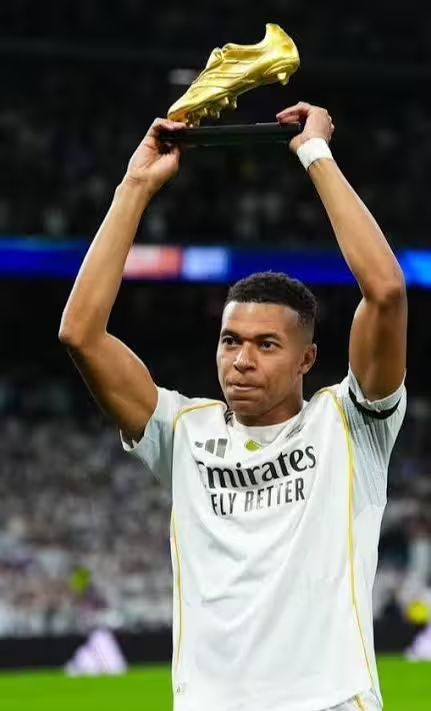
Brief History
Born on December 20, 1998, in the Parisian suburb of Bondy, Kylian Mbappé was seemingly destined for footballing greatness. His father, Wilfried, was a coach at local club AS Bondy, while his mother, Fayza Lamari, was a professional handball player. The family home overlooked the pitches where a young Kylian would hone his skills. From a very young age, Mbappé was focused and driven, with a “Project Mbappé” mindset, a concept that encapsulated his family’s meticulous planning for his future.
As a child, he was obsessed with football, idolizing Cristiano Ronaldo and studying the game of Zinedine Zidane. His immense talent was evident early on, leading to a stint at the prestigious Clairefontaine academy. Even there, he was not immediately the standout; he was often played out wide and was known for a sulky demeanor, but a growth spurt transformed his game. At 14, he had trials with top clubs like Chelsea and Real Madrid, but his family wisely chose a developmental path at AS Monaco.
The nickname “Kyky” was given to him by his teammates, and from those early days in Bondy, it was clear that he possessed an extraordinary gift. His father’s coaching and his mother’s athletic discipline provided the perfect environment for his talents to flourish. The “Project Mbappé” was not merely about football success; it was about holistic development, ensuring that the young prodigy remained grounded while his abilities were carefully nurtured. By the time he reached his teenage years, scouts from across Europe were already monitoring his progress, and his decision to remain in France rather than move to a foreign academy would prove to be a pivotal moment in his development.
Club History
AS Monaco (2015-2017)
Mbappé made his professional debut for Monaco in December 2015 at the age of 16 years and 347 days, breaking a record previously held by Thierry Henry. He quickly became the club’s youngest-ever scorer, foreshadowing a spectacular breakthrough. The 2016-17 season was his true arrival on the world stage. He played a pivotal role in Monaco’s stunning Ligue 1 title win, ending Paris Saint-Germain’s dominance, and was instrumental in their run to the UEFA Champions League semi-finals. His pace, dribbling, and clinical finishing made him one of the most sought-after young talents in football.
During that remarkable season, Monaco’s attacking trio of Mbappé, Radamel Falcao, and Bernardo Silva terrorized defenses across Europe. Mbappé’s contribution of 26 goals in all competitions was staggering for a player of his age. His performances in the Champions League knockout stages, particularly against Manchester City and Borussia Dortmund, announced his arrival on the global stage. The football world took notice when he became the youngest player to score in a Champions League semi-final, and by the end of the season, every major club in Europe was vying for his signature.
His development at Monaco was carefully managed by then-manager Leonardo Jardim, who used him primarily as a winger but also deployed him as a central striker when needed. The tactical flexibility he developed during this period would become a hallmark of his game. Despite his youth, Mbappé displayed remarkable composure in front of goal and an innate understanding of space and movement that belied his age. The decision to leave Monaco was difficult, but the allure of competing for the biggest trophies at PSG proved irresistible.
Paris Saint-Germain (2017-2024)
In 2017, in a then-record transfer that would make him the most expensive teenager in history, Mbappé joined Paris Saint-Germain. The move was initially a loan before becoming permanent for a fee of €180 million. At PSG, Mbappé’s career skyrocketed. He became the club’s all-time top scorer with 256 goals and won an astonishing 14 trophies, including six Ligue 1 titles. He was named Ligue 1’s top scorer a record six consecutive times between 2018 and 2024. During his seven years in Paris, he formed a formidable attacking partnership with Neymar and Lionel Messi, but the ultimate prize—the UEFA Champions League—remained elusive, with PSG reaching the final in 2020 but losing to Bayern Munich. His time at PSG was also marked by significant off-field power and influence, as his family was deeply involved in his career management.
The partnership with Neymar was initially one of the most electrifying attacking duos in world football. Their chemistry on the pitch was undeniable, with Mbappé’s pace complementing Neymar’s creativity perfectly. The arrival of Lionel Messi in 2021 created a “Galactico” trio that was expected to dominate European football. However, the trio never quite achieved the synergy that was anticipated, and PSG’s repeated failures in the Champions League became a source of frustration for Mbappé.
During his time in Paris, Mbappé’s goal-scoring output was nothing short of extraordinary. He consistently averaged over 30 goals per season across all competitions, with his best campaign coming in 2022-23 when he scored 41 goals in 43 appearances. His ability to produce in big games was evident, with memorable performances against Barcelona, Real Madrid, and Bayern Munich. However, the lack of a Champions League trophy would eventually become the deciding factor in his departure.
The political dynamics at PSG were also complex. Mbappé’s influence extended beyond the pitch; he was involved in discussions about managerial appointments, transfer targets, and even had a say in the club’s strategic direction. This level of power for a player in his early twenties was unprecedented in modern football and often drew criticism from pundits who felt he had become bigger than the club.
Real Madrid (2024-Present)
The long-anticipated transfer to Real Madrid finally materialized in July 2024 when Mbappé joined the Spanish giants on a free transfer after his PSG contract expired. He immediately stepped into the spotlight at the Santiago Bernabéu, fulfilling a childhood dream. His second season at the club, the 2025-26 campaign, was historically prolific. Across 56 appearances in all competitions, he scored 53 goals and added 11 assists, totaling a staggering 64 goal contributions. Despite his immense individual success and finishing as La Liga’s top scorer, Real Madrid failed to win a trophy, leading to some fan frustration and scrutiny of his overall contribution, particularly his defensive work rate.
The transition to Real Madrid was expected to be seamless, given Mbappé’s admiration for the club and his relationship with manager Carlo Ancelotti. His debut season, 2024-25, was solid if not spectacular, with 33 goals in 48 appearances. However, the 2025-26 season was when he truly exploded, scoring at a rate of nearly a goal per game. His hat-tricks against Barcelona and Atletico Madrid became instant classics, and his performances in the Champions League group stage were reminiscent of his World Cup heroics.
Yet, the trophy-less season raised questions about whether individual brilliance was enough to succeed at Real Madrid, a club defined by collective success. The pressure at the Bernabéu is unlike anywhere else, and Mbappé found himself under intense scrutiny from both the media and the fans. His defensive work rate, or perceived lack thereof, became a point of contention, with some comparing him unfavorably to his predecessor, Karim Benzema, who was renowned for his all-round contribution.
Despite these criticisms, Mbappé remained committed to the club and continued to break records. His adaptability to La Liga’s tactical nuances improved as the season progressed, and his partnership with Vinícius Júnior and Jude Bellingham began to flourish. The club’s hierarchy remained confident that trophies would follow, and Mbappé himself expressed his determination to bring the Champions League back to Madrid.
Club Career Statistics (Selected Competitions)
| Season | Club | Competition | Appearances | Goals | Assists | Notes |
|---|---|---|---|---|---|---|
| 2016-17 | AS Monaco | Ligue 1 / UCL | 44 | 26 | 8 | Ligue 1 Champion; UCL Semi-finalist |
| 2017-18 | Paris SG | Ligue 1 / UCL | 46 | 21 | 13 | Ligue 1 Champion |
| 2018-19 | Paris SG | Ligue 1 / UCL | 43 | 39 | 13 | Ligue 1 Champion |
| 2019-20 | Paris SG | Ligue 1 / UCL | 34 | 30 | 9 | UCL Finalist |
| 2020-21 | Paris SG | Ligue 1 / UCL | 47 | 42 | 11 | |
| 2021-22 | Paris SG | Ligue 1 / UCL | 46 | 39 | 21 | |
| 2022-23 | Paris SG | Ligue 1 / UCL | 43 | 41 | 10 | |
| 2023-24 | Paris SG | Ligue 1 / UCL | 48 | 44 | 10 | |
| 2024-25 | Real Madrid | La Liga / UCL | 48 | 33 | 9 | |
| 2025-26 | Real Madrid | La Liga / UCL | 56 | 53 | 11 | 64 Goal Contributions |
Note: UCL statistics across his career: 98 appearances, 70 goals, 25 assists.
International Career and World Cup Performance
Mbappé’s impact on the international stage is perhaps his most defining trait. While his club career has been marked by domestic dominance and near-misses in Europe, his performances for France have consistently elevated him to legendary status.
2018 FIFA World Cup (Russia)
At just 19, Mbappé was the breakout star of the tournament. He scored four goals, including a crucial brace in the Round of 16 against Argentina, and a calm finish in the final against Croatia, becoming the second teenager after Pelé to score in a World Cup final. He was named the tournament’s Best Young Player as France lifted the trophy. His performance against Argentina, where he tore through the defense with electrifying pace and composure, was a coming-of-age moment that announced to the world that a new superstar had arrived.
The final against Croatia was a testament to his maturity under pressure. While others might have been overwhelmed by the occasion, Mbappé displayed remarkable calmness, scoring a goal that effectively sealed the victory for France. His celebration, a simple fist pump, was in stark contrast to the exuberance one might expect from a teenager achieving the sport’s greatest honor. This composure would become a recurring theme throughout his career.
2022 FIFA World Cup (Qatar)
Mbappé cemented his status as a global superstar. He won the Golden Boot as the tournament’s top scorer with eight goals, including a sensational hat-trick in the final against Argentina. Despite his heroics, France lost on penalties in a 3-3 draw, and he was later criticized for his perceived lack of defensive contribution. The final in Qatar was one of the greatest matches in World Cup history, and Mbappé was at the center of it. His hat-trick, which included two goals in the final ten minutes of normal time and one in extra time, showcased his ability to single-handedly drag his team back into a game.
The defeat on penalties was a bitter pill to swallow, but Mbappé emerged from the tournament with his reputation enhanced. He had become the first player since Pelé in 1958 to score a World Cup final hat-trick and had joined an elite group of players who have won both the Golden Boot and the Best Young Player award at different World Cups.
2026 FIFA World Cup (USA, Mexico, Canada)
Leading France as captain, Mbappé added new chapters to his legendary status. The 2026 tournament was always going to be significant for Mbappé, as it provided an opportunity to cement his legacy as the greatest World Cup player of all time.
Record Goalscorer:
He scored twice in France’s opener against Senegal to surpass Olivier Giroud as France’s all-time leading scorer, with 58 goals in 99 caps. It also brought his World Cup tally to 14, moving him past Pelé. The achievement was particularly poignant, as it came in a tournament where he was carrying the weight of captaincy and the expectations of a nation.
Dominant Group Stage:
Mbappé scored 4 goals and provided 2 assists in 3 group stage matches, showing not only goal-scoring prowess but also improved leadership and defensive work. His performances against Senegal, Denmark, and Australia were masterclasses in attacking play, combining individual brilliance with a newfound commitment to the collective.
Knockout Stage Record:
In the Round of 16, he scored a brace against Sweden, taking his World Cup tally to 18 goals. This broke the record for most goals in World Cup knockout matches, surpassing the previous record held by Gerd Müller and Pelé. He also surpassed Lionel Messi’s tournament record, moving him to second on the all-time list behind Miroslav Klose’s 16 goals, requiring only one more to equal the record.
World Cup Career Statistics
| Year | Appearances | Goals | Assists | Achievement |
|---|---|---|---|---|
| 2018 | 7 | 4 | 1 | Winner; Best Young Player |
| 2022 | 7 | 8 | 2 | Golden Boot; Finalist |
| 2026 | 4 | 6 | 2 | Record-breaking performance (ongoing) |
| Total | 18 | 18 | 5 | All-time World Cup knockout top scorer |
Playing Style and Attributes
Mbappé is more than just a goal-scorer; he is a complete forward. His game is built on several key attributes that combine to make him one of the most devastating attackers in football history.
- Blistering Pace: His acceleration and top speed make him one of the fastest players in the world, allowing him to consistently beat defenders and run in behind defenses. His ability to go from a standing start to full speed in a matter of strides gives him an almost unfair advantage over defenders. This pace is not just about straight-line speed; it is combined with the ability to change direction at high velocity, making him virtually unplayable in one-on-one situations.
- Exceptional Finishing: He is a composed and clinical finisher with either foot. His ability to strike the ball cleanly and place it with precision makes him a constant threat in the box. Whether it is a first-time volley, a driven shot from outside the area, or a delicate chip over the goalkeeper, Mbappé possesses the full repertoire of finishing techniques. His two-footedness is particularly valuable, as it means he can score from almost any angle without needing to adjust his body position.
- Dribbling Skill: Mbappé can glide past defenders at full speed, using close control and clever changes of direction. He is particularly dangerous when cutting in from the left wing, where his ability to use his right foot to curl shots into the far corner has become a trademark. His dribbling is characterized by its efficiency; he rarely uses unnecessary tricks, instead relying on subtle feints and changes of pace to create separation.
- Off-the-ball Movement: His intelligent runs and positional awareness allow him to consistently find space in dangerous areas. He is especially adept at timing his runs to beat the offside trap. His understanding of space, both to exploit it and to create it for teammates, is exceptional. This intelligence is often overlooked in discussions of his physical attributes, but it is arguably his most important quality.
- Versatility: Mbappé is capable of playing anywhere across the forward line. He has been deployed as a central striker, a left winger, and even as a right winger on occasion. His ability to adapt his game to different tactical systems and positional requirements makes him a manager’s dream. This versatility was particularly evident during his time at PSG, where he often had to adjust his positioning to accommodate the presence of both Messi and Neymar.
Defensive Critiques
One persistent criticism has been his defensive contribution, especially in his early career. However, as France captain, he has publicly vowed to improve this aspect of his game, acknowledging its importance for team success and showing greater work rate and tactical discipline in the 2026 World Cup. The criticism is not entirely unfounded; there have been instances in big games where Mbappé’s lack of tracking back has been identified as a tactical weakness. However, his willingness to address this criticism demonstrates a maturity and self-awareness that bodes well for his continued development.
The challenge for managers has always been to balance his attacking freedom with the need for defensive solidity. At Real Madrid, Carlo Ancelotti has worked diligently to integrate Mbappé into the team’s defensive structure without curbing his attacking instincts. This is a delicate balance, and the 2025-26 season showed that there is still work to be done in this area.
Leadership and “Project Mbappé”
The concept of “Project Mbappé” is often used to describe the calculated, family-driven approach to his career. From a young age, he and his family managed every step with precision, from choosing to stay in France as a teenager to eventually joining his dream club, Real Madrid. This project was not simply about football; it was about building a brand, managing finances, and ensuring that every decision was made with long-term success in mind. The involvement of his mother, Fayza, as his agent and chief advisor, has been a constant throughout his career.
As a leader, he has evolved from a “self-centred guy” to a “proper leader” who understands the weight of the captain’s armband, balancing his ambition with collective goals. His appointment as France captain in 2023 was a significant moment in his career. He took over from Hugo Lloris, a figure of immense respect in the French dressing room. Initially, there were questions about whether the young forward had the maturity to lead the national team, but his performances in the 2026 World Cup have largely silenced his critics.
His leadership style is characterized by leading from the front. He scores goals, he makes decisive contributions in big games, and he is willing to shoulder the burden of expectation. In the 2026 tournament, he was frequently seen organizing his teammates, offering encouragement, and even taking responsibility for defensive duties. This evolution from a precocious talent to a true leader has been one of the most impressive aspects of his career.
Legacy and Future
Kylian Mbappé’s legacy is still being written, but it is already one of sporting greatness. He is a World Cup winner, a record-breaking international goalscorer, and a serial winner of domestic titles. With 18 World Cup goals in 18 matches, he is on the verge of becoming the tournament’s all-time top scorer, and at 27, time is on his side. The ultimate individual accolades, the Ballon d’Or and a UEFA Champions League title, are widely expected to follow. He has already become France’s greatest-ever goalscorer and is on a trajectory to be considered the best player his nation has ever produced.
However, his career is not without its challenges. The 2025-26 season at Real Madrid highlighted that even the greatest players cannot win trophies alone. The failure to secure any silverware, despite his individual brilliance, has led to questions about whether he can truly lead a team to glory in the same way that players like Messi and Ronaldo have done. The pressure at Real Madrid is immense, and the club’s expectations are always for the highest honors.
His relationship with the French national team is also complex. While he is now the captain and the symbol of French football, there have been controversies, including a dispute over image rights, which have occasionally created tension. However, his performances on the pitch have consistently been the best response to any off-field issues.
Looking to the future, Mbappé has the potential to break almost every major goalscoring record in football. At his current rate, he could finish his career with over 500 club goals and 100 international goals. The 2030 World Cup, where he would be 31, is also a distinct possibility, and he could potentially add to his already remarkable World Cup tally.
Conclusion
The narrative of Mbappé’s career is one of ambition, success, and a relentless pursuit of greatness. His journey from the suburbs of Paris to the pinnacle of world football is a testament to his talent, his work ethic, and the meticulous planning of his family. As he continues to rewrite record books, one thing is clear: Kylian Mbappé is a player for the history books, driven by an insatiable hunger to win at all costs. His legacy will not only be defined by the goals he scores but by the trophies he wins and the leadership he provides to his teams.