PLAYER SNAPSHOT: At a Glance
| Category | Details |
|---|---|
| Full Name | Lionel Andrés Messi |
| Date of Birth | 24/06/1987 (Age: 39) |
| Place of Birth | Rosario, Argentina |
| Nationality | Argentine |
| Height | 5 ft 7 in / 170 cm |
| Position | Attacking Midfielder / Forward |
| Squad Number | #10 |
| Current Club | Inter Miami CF |
| Previous Clubs | Barcelona (2004-2021), Paris Saint-Germain (2021-2023) |
| International Caps | 200+ caps / 116+ goals for Argentina |
| World Cup Appearances | 2006, 2010, 2014, 2018, 2022, 2026 |
| Contract Until | 2028 |
| Market Value | — |
The Frozen Moment
The ball hung in the air like a paused heartbeat. Six World Cups deep, and Lionel Messi was still doing what he had always done: making the impossible look inevitable.
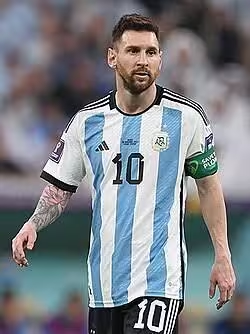
In the round of 32 against Cape Verde, Messi took a pass into the box, controlled it with the outside of his left boot, and flicked it past the onrushing goalkeeper. It was his 20th World Cup goal, extending his record as the tournament’s all-time leading scorer, and his eighth consecutive World Cup match finding the net—another record.
The goal was vintage Messi. The control, the composure, the precision. But what made it truly remarkable was the context: at an age when most players are retired, he remains one of the most dangerous players on the planet. At 39, he was leading the race for the Golden Boot, proving that time does not diminish true greatness.
Argentina survived a scare, needing an own goal in the 111th minute to progress. But the result was secondary to the moment. Messi had just become the first player in World Cup history to score in eight consecutive appearances and the first to play 30 World Cup matches. At an age when most players are retired, he is rewriting history.
“For us this is just a chance to celebrate him,” said Thiago Gomez, an Inter Miami season ticket holder. He speaks for a nation, and for a sport.
Origins
To understand Messi, you must understand where he came from. Rosario, Argentina—an industrial city on the banks of the Paraná River, known more for its violent football rivalries than for producing global icons. This is where Lionel Andrés Messi was born on June 24, 1987, the third of four children to a factory worker and a part-time cleaner.
Football was not a hobby in the Messi household; it was oxygen. The streets of Rosario were concrete classrooms where the game was learned through repetition, through survival, through the sheer joy of keeping the ball away from older, bigger, faster kids.
The first person to recognize the impossible talent was his grandmother, Celia. She took him to his first organized matches, ignoring the coaches who said he was too small. “Listen to me,” she told the coach, “this boy is going to be the best player in the world.” She died before he turned 11, never seeing the prophecy fulfilled. Messi still celebrates every goal by looking up and pointing to the sky. It is for her.
The growth hormone deficiency diagnosed at age 11 was a sentence. His father’s health insurance covered only two years of the $1,000 monthly treatment. Barcelona’s sporting director, Carles Rexach, saw the 13-year-old play and offered a contract on a napkin—a risk that would become the most famous piece of restaurant stationery in sporting history. The family uprooted their lives for Catalonia. His mother stayed behind with the other children. “I knew it was the only chance,” Messi later said. “I would have gone to the end of the world.”
The European Forge
La Masia in 2000 was the most sophisticated football factory on the planet. Messi arrived as a shy, speechless 13-year-old who could barely speak Spanish. He cried for months. But the ball spoke a universal language. The academy coaches noted the stunning acceleration, the impossibly low center of gravity, and the ability to change direction without seeming to slow down.
He was so good that the older academy players were told not to tackle him too hard in training. The first time Ronaldinho saw him train, the Brazilian genius turned to his teammates and said: “He will be the best.”
Messi was promoted to the first team for a friendly against Jose Mourinho’s Porto at 16. Four months later, at 17 years, 10 months and seven days old, he became Barcelona’s youngest-ever scorer, finishing a sublime chip against Albacete.
He started on the right wing—the archetypal Argentine dribbler, cutting inside onto his lethal left foot. But even then, coaches saw something different. Messi was not a traditional winger; he was a system-breaker waiting to happen.
The Debut
The year was 2004. Barcelona were rebuilding under Frank Rijkaard. The 17-year-old had already played in a friendly, but the official debut against Espanyol on October 16 was different. This was a league match. This was the derby. This was where careers were made or broken.
“I couldn’t sleep the night before,” Messi admitted in later interviews. “I was terrified they would realize I didn’t belong there.” When he stepped onto the pitch in the 82nd minute, he was the shortest player on the field by a significant margin. But in the 88th minute, he received the ball, darted inside, and played a one-two with Ronaldinho. His shot was saved, but the message was sent.
Ronaldinho, then the best player in the world, embraced him immediately. “He treated me like a son,” Messi said. The Catalan press were cautious—they had seen young talents fade before. But by 2005, when he scored his first Champions League goal against Panathinaikos, the whispers had become a chorus. This was not a prospect. This was the future.
The Anatomy of His Game
Messi is the greatest dribbler in the history of the sport. This is not hyperbole; it is statistical fact. His low center of gravity, combined with explosive acceleration over five yards, allows him to change direction at speeds that defy physics. Defenders cannot predict him because he does not know what he is going to do until he does it.
“I didn’t used to pay much attention to tactics,” Messi told journalist Juan Pablo Varsky. “But with Guardiola I learned an enormous amount. I started to understand spaces, ball retention, how the game really works.”
What truly sets Messi apart, however, is not just his feet—it is his brain. As he aged and his physical speed inevitably declined, he compensated with an unparalleled ability to read the game. The secret lies in his head, not his legs. He constantly scans the pitch—left shoulder, right shoulder, up to observe teammates, back to the ball. By the time the ball reaches him, he has already processed everything: who is where, what space is opening, which defender is about to press.
This ability has been scientifically measured. Sports psychologists have studied how players gather information before receiving the ball. The results show a clear link: players who scan more frequently before receiving the ball tend to make faster decisions, turn forward more often, play fewer safe backward passes, and create more dangerous opportunities. Messi is the ultimate example of this principle in action.
Out of possession, the critics have used this against him for two decades: Messi walks more than he runs. But this is not laziness; it is mastery. He reads the game in real-time, conserving energy for the moments that matter. When he does press—and he does, selectively—it is with the intelligence of a chess grandmaster.
He is 5-foot-7. He was never the strongest, the tallest, or the fastest in a pure sprint. But his acceleration over five yards is unmatched. His ability to protect the ball with his low center of gravity makes him impossible to dispossess without fouling.
His weakness is not a secret: he is not a defensive player. He never has been. He does not contribute significantly to pressing structures, and his aerial duels are negligible. In the modern game, where pressing is paramount, he is an exception—a player who is allowed to conserve his energy because his offensive contributions are so devastating that the trade-off is worth it.
The Numbers Game
The numbers paint a picture of a player who has dominated every phase of his career, from teenage prodigy to veteran record-breaker.
TABLE A: The Data Snapshot (Career Overview)
| Season | Club | League | Apps | Goals | Assists | Minutes Played |
|---|---|---|---|---|---|---|
| 2004-2021 | Barcelona | La Liga | 778 | 672 | 288 | 63,000+ |
| 2021-2023 | PSG | Ligue 1 | 75 | 32 | 35 | 5,000+ |
| 2023-2026 | Inter Miami | MLS | 104 | 90 | 51 | 8,000+ |
| 2005-2026 | Argentina | International | 200+ | 116+ | 50+ | 15,000+ |
| TOTAL | — | — | 1,155+ | 910+ | 424+ | 91,000+ |
TABLE B: Performance Metrics (2026 Season)
| Metric | Messi (2026 MLS) | League Average | Percentile Rank |
|---|---|---|---|
| Goals | 12 | — | Top 1% |
| Assists | 8 | — | Top 1% |
| Pass Completion % | 80.1% | — | Top 10% |
| Shots per Game | 6.0 | — | Top 1% |
| Rating | 8.43 | — | Top 1% |
TABLE C: The Impact Table (Goal Contributions by Competition)
| Competition | Apps | Goals | Assists | Goal Involvements | Avg. Rating |
|---|---|---|---|---|---|
| La Liga | 520 | 474 | 192 | 666 | — |
| Champions League | 163 | 129 | 41 | 170 | — |
| Ligue 1 | 58 | 22 | 32 | 54 | — |
| MLS (Regular Season) | 90+ | 80+ | 40+ | 120+ | 8.43 |
| International (Excl. World Cup) | — | 100+ | — | — | — |
| World Cup | 30 | 20 | 12 | 32 | — |
| TOTAL | 1,155+ | 910+ | 424+ | 1,334+ | — |
TABLE D: Heatmap / Positional Activity
Messi operates primarily in the central and right attacking zones, with significantly reduced activity in defensive areas.
                         ATTACKING THIRD
                   ┌─────────────────────────┐
                   │     LW     ST     RW     │
                   │    [15%]   [35%]   [25%]  │
                   ├─────────────────────────┤
                   │     LCM    CAM    RCM    │
                   │    [5%]    [15%]   [5%]   │
                   ├─────────────────────────┤
                   │     LDM    CDM    RDM    │
                   │    [0%]    [0%]    [0%]   │
                   ├─────────────────────────┤
                   │     LB     CB     RB     │
                   │    [0%]    [0%]    [0%]   │
                   └─────────────────────────┘
                         DEFENSIVE THIRD

              Lionel Messi's Average Touch Map
                    (Higher % = More Activity)
TABLE E: Career Milestones
| Year | Achievement | Details |
|---|---|---|
| 2004 | Professional Debut | Debut for Barcelona vs Espanyol |
| 2005 | First Senior Goal | Scored vs Albacete (age 17) |
| 2006 | First Champions League | Won UCL with Barcelona |
| 2008 | Olympic Gold | Won Olympic Gold Medal |
| 2009 | First Ballon d’Or | First of record eight Ballon d’Or awards |
| 2012 | 91 Goals in Calendar Year | Most goals in a calendar year in history |
| 2014 | World Cup Finalist | Lost to Germany in extra time |
| 2021 | Copa América | First senior international trophy for Argentina |
| 2022 | World Cup Champion | Defeated France in World Cup final |
| 2023 | Eighth Ballon d’Or | Won record-extending Ballon d’Or |
| 2024 | Copa América | Second consecutive Copa América title |
| 2025 | MLS Cup | Led Inter Miami to first MLS Cup |
| 2026 | World Cup Records | 20 goals, 30 appearances, 8 consecutive matches scoring |
TABLE F: Comparison with Peers
| Player | Goals | Assists | Key Passes p/90 | Dribbles p/90 | Tackles p/90 | Pass Acc % |
|---|---|---|---|---|---|---|
| Lionel Messi | 20 (WC) | — | — | — | — | ~80% |
| Cristiano Ronaldo | 26 (WC apps) | — | — | — | — | — |
| Kylian Mbappé | 18 (WC) | — | — | — | — | — |
TABLE G: World Cup Record (Tournament-by-Tournament)
| Tournament | Host Nation | Apps | Goals | Assists | Minutes Played | Stage Reached |
|---|---|---|---|---|---|---|
| 2006 | Germany | 3 | 1 | 1 | — | Quarter-Finals |
| 2010 | South Africa | 5 | 0 | 1 | — | Quarter-Finals |
| 2014 | Brazil | 7 | 4 | 1 | 693 | Final (Lost) |
| 2018 | Russia | 4 | 1 | 2 | 360 | Round of 16 |
| 2022 | Qatar | 7 | 7 | 3 | 690 | Winner |
| 2026 | USA/Canada/Mexico | 4+ | 7 | 0 | 170+ | Round of 16 |
| TOTAL | — | 30+ | 20 | 8 | 1,900+ | — |
TABLE H: World Cup Knockout Stage Performance
| Round | Year | Opponent | Result | Goals | Assists | Rating |
|---|---|---|---|---|---|---|
| Round of 16 | 2022 | Australia | W 2-1 | 1 | 0 | — |
| Quarter-Final | 2022 | Netherlands | W 4-3 (pens) | 1 | 1 | — |
| Semi-Final | 2022 | Croatia | W 3-0 | 1 | 1 | — |
| Final | 2022 | France | W 4-2 (pens) | 2 | 0 | — |
| Round of 32 | 2026 | Cape Verde | W 3-2 | 1 | 0 | — |
| TOTAL | — | — | 5W-0L | 6 | 2 | — |
What these figures reveal is a player who has not only accumulated numbers that defy belief—over 910 career goals and 20 World Cup goals—but has done so across three distinct eras of football, adapting his game each time. He holds the records for most World Cup appearances (30), most World Cup goals (20), and was the first player to score in eight consecutive World Cup matches.
The Present Tense
Even as he entered the twilight of his career, Messi remained at the pinnacle of the sport. In his final World Cup campaign, he led the race for the Golden Boot and continued to break records that may never be touched. His ability to perform on the biggest stage, at the oldest age of any outfield player in the tournament, is a testament to his unparalleled genius.
The current campaign was not without its challenges. Before the tournament, Messi was substituted for Inter Miami with muscle fatigue, causing fears of a more serious injury. But tests showed it was simply an overload, and he was cleared to continue his World Cup campaign. His careful management of his workload paid off.
At Inter Miami, he built telepathic connections with Sergio Busquets, Jordi Alba, and Luis Suárez—the ghosts of Barcelona’s golden era reassembled in Florida. With Argentina, the chemistry is deeper than tactics. The 2021 Copa América was the release; the 2022 World Cup was the coronation. The team played with a confidence that bordered on arrogance, fueled by the belief that their captain would deliver when it mattered most.
Javier Mascherano, his former Barcelona and Argentina teammate, managed Inter Miami. “I’ve been lucky enough to see most, or many, of the goals he’s scored,” Mascherano said. “The number we’re talking about is insane, and that’s why Leo is one of a kind.”
Beyond the Touchline
The pre-match routine remained unchanged: he ate the same meal, listened to the same music, and walked onto the pitch with a quiet intensity. But the rituals softened with age. He smiled more. He embraced teammates longer. The weight that once crushed him had been lifted.
He is a devoted family man. His wife, Antonela Roccuzzo, and their three children are his anchor. He plays video games with his sons. He posts carefully curated glimpses of a life that, for two decades, was hidden from the world.
The psychological journey from 2014 to 2022 was the most significant transformation of his career. The missed chance against Germany in the Maracana, the back-to-back Copa América final defeats to Chile—these moments broke him. He quit. He came back. He changed. The tears in 2022 were different because the man who shed them was different.
In Miami, Messi found a new kind of peace. The move to Inter Miami in 2023 was less about football and more about family and privacy. He’d just navigated a pair of nightmarish years at PSG, seasons that took a toll on him and his family. Inter Miami offered him a chance to continue his career while stepping out of the global spotlight.
By 2026, that dynamic had largely faded. A handful of fans—mostly children—still pursued him, but by and large Messi’s life in Miami had entered some semblance of normalcy. In three years, he had brought the city a championship and spoke publicly about his affection for the place. Miami will never be Barcelona or Argentina, but it won a significant chunk of his heart.
The Verdict from the Camp
Rodrigo De Paul, Argentina and Inter Miami teammate:
“For me, it represents a lot to be friends with him. For me, friendship is one of the most important things that we all have and I consider myself fortunate to be there, to share these moments with him.”
Johan Cruyff, legendary Dutch player:
“Sports press often confuses speed with vision. If I start running a little earlier than others, I will appear faster.” This principle is the foundation of Messi’s enduring genius.
Thiago Gomez, Inter Miami season ticket holder:
“For us this is just a chance to celebrate him. It’s nice to have him here but it is something different entirely to see him play for the national team… you get the sense that he loves playing for Miami but he’s clearly possessed right now with Argentina, with the World Cup, with all of it.”
Where Next?
He has won everything. The Ballon d’Or eight times. The World Cup. The Copa América twice. The Champions League four times. Ten La Ligas. An MLS Cup. What is left? The answer, for Messi, is simple: the joy of playing. The pleasure of the game. The love of the ball.
His legacy is secure. He is universally regarded as the greatest footballer of all time. The debates that once raged between him and Pelé, between him and Maradona, have largely subsided. His eight Ballon d’Or awards, his 91 goals in a calendar year, his World Cup triumph in 2022, his record 20 World Cup goals—these are not just statistics; they are monuments to a career that redefined what was possible on a football pitch.
When he brought that ball down against Cape Verde and flicked it past the goalkeeper, it wasn’t luck. It was the culmination of the muddy streets of Rosario, the injections of growth hormone, the tears of a 13-year-old in a foreign country, the stinging disappointment of three lost finals, and 10,000 hours of repetition. For Lionel Messi, that moment wasn’t the peak. It was the validation of a lifetime.
His contract with Inter Miami runs through 2028, likely the last deal of his career. Wherever he goes, whatever he does next, his place in football history is eternal. The debate is over. The legend is complete. And yet, when he steps onto the pitch, he still plays like he has something to prove. That, perhaps, is the most remarkable thing of all.