The Scotland national football team, historically and culturally revered across the sporting world as the Tartan Army, occupies a foundational position in football history. Alongside England, Scotland participated in the first official international football match in 1872. Known for a footballing identity historically rooted in fierce competitive spirit, tactical discipline, and a dense production line of technical midfielders, Scotland has established itself as an incredibly resilient European competitor.
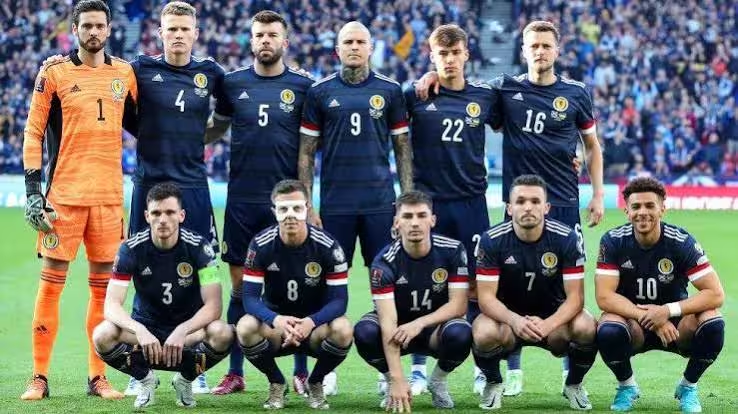
Following a highly intense European qualification cycle, Scotland enters the current international landscape as an ascending force. Combining an elite core of seasoned Premier League veterans with a highly organized defensive matrix, the Tartan Army represents a complex tactical challenge for global opponents. This comprehensive profile breaks down the structural design of the active senior roster, foundational history, individual records, and up-to-date tournament performance data.
Brief History and Core Historical Eras
Scotland’s early footballing history is marked by pioneering international success, capturing multiple British Home Championships and helping distribute tactical passing philosophies across the globe. Throughout the mid-to-late 20th century, Scotland became a highly consistent global competitor, qualifying for five consecutive FIFA World Cup final tournaments between 1974 and 1990 under legendary managers like Willie Ormond, Ally MacLeod, and Sir Alex Ferguson.
The Modern Tournament Resurgence
Following a prolonged transitional absence from the grandest international stages at the turn of the century, Scotland engineered a spectacular modern resurgence in the 2020s. Under tactical models focused on high-intensity defensive structures and efficient wing-back transitions, the Tartan Army successfully qualified for back-to-back European Championships at UEFA Euro 2020 and UEFA Euro 2024. This systematic tactical evolution restored their status as a regular and highly respected fixture within the absolute upper tiers of European football competition.
Technical Roster Breakdown (2026 Campaign)
The modern Scottish squad operates primarily within a highly disciplined, tactically flexible 3-4-2-1 or a compact, structural 5-4-1 formation. The system places a massive premium on deep defensive low-blocks, high-volume lateral pressing, and utilizing flying wing-backs to trigger immediate vertical counter-attacks.
1. Goalkeepers
The Scottish goalmouth focuses on extensive physical height, reliable shot-stopping consistency, and vocal box command during defensive set-piece phases.
- Angus Gunn (#1): The preferred first-choice starting goalkeeper. Gunn brings world-class positioning, exceptional short-range reflex stopping, and immense calmness under high-intensity tournament pressure.
- Zander Clark (#12): A physically robust, highly agile veteran shot-stopper who provides elite starting-caliber depth from the bench.
- Liam Kelly (#21): A sharp backup goalkeeper finalizing a secure and deeply experienced goalkeeping department.
2. Defenders
The backline focuses on rigid defensive synchronization, aerial dominance in the penalty box, and utilising overlapping center-backs to support structural midfield buildups.
- Andy Robertson (#3): The captain, undisputed world-class icon, and tactical heartbeat of the team. Operating as a relentless left wing-back, Robertson provides world-class acceleration, elite 1v1 wide crossing lines, and immense vocal leadership.
- John Souttar (#5) & Grant Hanley (#4): The preferred starting central defensive axis, offering an exceptional mixture of physical height, high clearance numbers, and robust tackling power.
- Ryan Porteous (#15) & Jack Hendry (#6): Highly aggressive, modern central defenders deployed to absorb quick counter-attacks and lock down open spaces.
- Anthony Ralston (#2): A highly disciplined, robust right-back providing exceptional defensive containment and tireless recovery tracking.
- Scott McKenna (#16) & Greg Taylor (#14): Tactically sound wide and central defensive depth options built for rugged tournament battles.
3. Midfielders
The midfield functions as the absolute tactical engine room, meticulously balancing intense possession-oriented screening with explosive vertical runs.
- John McGinn (#7): The premier attacking midfielder and vice-captain. McGinn utilizes exceptional lower-body strength, press-resistance, and close-control dribbling to completely unbalance opposing midfields, frequently scoring late-arriving box goals.
- Billy Gilmour (#14): The midfield maestro. Blessed with world-class press-resistance and vision, Gilmour operates as the primary deep-lying pivot, dictating team tempos and recycling possession out of tight areas.
- Scott McTominay (#4): A highly dynamic box-to-box engine. McTominay provides elite physical power, relentless ball-winning tracking, and a legendary reputation for making clinical attacking runs into the opposition penalty area.
- Callum McGregor (#8) & Kenny McLean (#23): Vastly experienced, highly disciplined central pivots deployed to plug passing lanes and stabilize structural transitions.
- Ryan Christie (#11) & Lewis Ferguson (#19): Creative, high-IQ attacking playmakers tasked with finding pockets of space between opposition lines.
4. Forwards
The frontline balances high-volume tactical pressing, direct channel running, and physical hold-up capabilities to bring advanced midfielders into play.
- Che Adams (#10): The primary central striker leading the attack. Adams offers an elite defensive pressing work rate, physically robust hold-up metrics, and excellent space-clearing lines for oncoming midfielders.
- Lyndon Dykes (#9): A towering, old-school central target striker chosen for his elite aerial power and back-post positioning.
- Lawrence Shankland (#18) & Tommy Conway (#20): Clinical, high-intensity forward variants deployed to stretch tired opposition center-backs late in matches.
FIFA World Cup Performance Statistics
Scotland’s statistical resume at the FIFA World Cup highlights an international program that stands as one of the most historical and regular tournament competitors, amassing eight total appearances.
World Cup Tournament History Dashboard
The table below logs Scotland’s absolute performance metrics across their historical FIFA World Cup final appearances:
| World Cup Edition | Overall Record (W-D-L) | Goals (GF-GA) | Final Tournament Milestone / Result |
|---|---|---|---|
| 1954–1958 | 1-1-3 | 4-14 | Group Stage Exit |
| 1974 | 1-2-0 | 3-1 | Group Stage Exit (Eliminated Unbeaten on Goal Difference) |
| 1978–1986 | 2-3-4 | 12-16 | 3x Consecutive Group Stage Exits |
| 1990 | 1-0-2 | 2-3 | Group Stage Exit |
| 1998 | 0-1-2 | 2-6 | Group Stage Exit |
| Historical Totals | 5-7-12 | 25-40 | Highest Achievement: Group Stage (8 Tournament Appearances) |
Legendary Individual Records and Milestones
The history of the Tartan Army is written by iconic record-breakers and dedicated international veterans who set elite historical benchmarks for British football.
All-Time Cap and Scoring Leaderboards
The tables below document the historical all-time record holders for senior international appearances and goals scored for the Scottish men’s national team:
| Rank | Most Capped Players | Total International Caps | Career Era | Goals Scored |
|---|---|---|---|---|
| 1 | Kenny Dalglish | 102 | 1971–1986 | 30 |
| 2 | Jim Leighton | 91 | 1982–1998 | 0 |
| 3 | Darren Fletcher | 80 | 2003–2017 | 5 |
| 4 | Alex McLeish | 77 | 1980–1993 | 0 |
| 5 | Paul McStay | 76 | 1983–1997 | 9 |
| Rank | All-Time Top Goalscorers | Goals Scored | Matches Played | Career Goal Ratio |
|---|---|---|---|---|
| 1 | Kenny Dalglish | 30 | 102 | 0.29 |
| 2 | Denis Law | 30 | 55 | 0.55 |
| 3 | Hughie Gallacher | 24 | 20 | 1.20 |
| 4 | Lawrie Reilly | 22 | 38 | 0.58 |
| 5 | Ally McCoist | 19 | 61 | 0.31 |
Elite Individual Records
- The Immortal King Kenny: The legendary Sir Kenny Dalglish stands entirely alone at the absolute apex of Scottish football history, holding the unique double-record as both the most-capped player (102 caps) and the joint-all-time top scorer (30 goals).
- The Euro Qualifying Masterclass: Midfielder Scott McTominay etched his name into modern national sports folklore during the Euro 2024 qualifying campaign, netting an extraordinary 7 goals in 8 matches—including a historic brace against Spain—to single-handedly propel Scotland to the finals.
Tactical Identity: The Dynamic Wing-Back Blueprint
The contemporary tactical blueprint of the Tartan Army operates primarily out of a highly structural, asymmetric 3-4-2-1 matrix. The core philosophy centers on absolute verticality via wide spaces. Rather than attempting prolonged, high-risk possession phases inside their own defensive third, Scotland looks to generate central press-resistance via Billy Gilmour before targeting rapid wide channels.
Out of possession, Scotland willingly surrenders high-volume ball possession to elite opponents, dropping rapidly into a compact, ultra-disciplined 5-4-1 low block. Central defensive lines prioritize tight spatial containment inside the box, forcing opposition sequences outward toward the touchlines where aggressive fullbacks isolate threats. Once a turnover is secured, the team transitions with lethal speed. Andy Robertson utilizes his world-class acceleration to overlap the left flank, delivering high-volume horizontal balls into the penalty box to target the explosive, late-arriving central runs of John McGinn and Scott McTominay, transforming defensive absorption into surgical final-third execution.
Conclusion
The Scotland national football team represents a magnificent modern blend of historical British footballing prestige, relentless team ethics, and tactical structural discipline. Their highly organized, low-block counter-attacking style highlights an international program masterfully engineered to systematically neutralize and pick apart the progressive structures of global football giants. As Andy Robertson commands the wide transitions from the left flank and a physically dominant midfield engine room dictates defensive pressing densities under immense national expectation, the Tartan Army possesses every structural asset necessary to sustain a highly competitive era on the global stage.