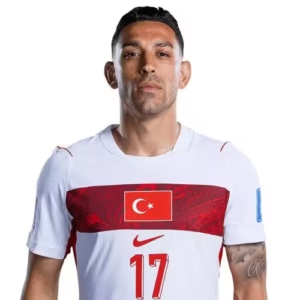
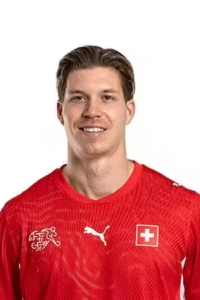
RB Leipzig enter 2026/27 under new management, with Martín Demichelis tasked with returning the club to Champions League contention after a one-season absence from European competition. The summer window delivered a club-record €125 million sale and a net transfer profit exceeding €100 million, but significant gaps remain in the squad — particularly on the right wing following Yan Diomande’s departure to Real Madrid. Three matches into the Bundesliga campaign, Leipzig sit fifth on six points with nine goals scored and three conceded.
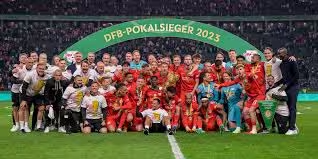
Technical Leadership & Coaching Profile
Manager: Martín Demichelis
Demichelis was appointed as RB Leipzig head coach on 22 June 2026, signing a contract until 30 June 2028. The 45-year-old Argentinian replaced Ole Werner, who was dismissed following the conclusion of the 2025/26 season.
Demichelis arrives with managerial experience across Spain, Mexico and Argentina, having most recently managed RCD Mallorca in La Liga. He began his coaching career as an assistant at Málaga CF and also worked with several FC Bayern München youth teams. As a player, he spent seven years at Bayern Munich, winning four Bundesliga titles and four DFB-Pokal trophies — experience that Managing Director for Sport Marcel Schäfer described as “an excellent fit for RB Leipzig and our global outlook”.
Demichelis outlined his tactical vision at his unveiling: “Intensity is an important part of Leipzig’s identity. For me, this includes passion, courageous and attacking football, but also aggression. We want to play aggressively going forward, defend bravely and be present in every situation”.
The early weeks have tested his squad management. Four first-team players — Christoph Baumgartner, Assan Ouédraogo, Rocco Reitz and Marc Guiu — have suffered injuries in the opening weeks of the season, forcing Demichelis to rotate heavily and defend his high-intensity approach. “We run the most sprints of any team in the league,” he said. “That is our idea and that is our risk. Players who never run much don’t get injured either”.
Tactical Philosophy
Demichelis has implemented an aggressive, high-pressing system built on intensity and verticality. The approach prioritises winning the ball back quickly in advanced areas and transitioning into attack before opponents can reorganise.
The 4-3-3 has been the base formation in the early weeks, with Demichelis fielding a midfield trio of Aynaoui, Banzuzi and Gruda behind an attacking line of Nkunku, Nusa and Rômulo in the recent 2-0 defeat at Bayer Leverkusen. The system places heavy physical demands on the squad, a factor that has contributed to the early-season injury crisis.
Offensively, Leipzig have shown potency in patches — the 5-0 victory over Hamburger SV demonstrated the team’s capacity for ruthless finishing, with Rômulo scoring on his league debut following his return from injury. However, the 3-1 defeat at Werder Bremen exposed defensive vulnerabilities and a lack of consistency that Demichelis has publicly acknowledged, warning his players that “we cannot be a team with two faces”.
Preferred Formations
4-3-3 (primary) / 4-2-3-1 (when adjusting midfield shape)
Strategic Transfer Activity
Leipzig’s summer window was defined by two contrasting dynamics: the record-shattering sale of Yan Diomande and the loan return of a club legend.
Diomande’s €125 million transfer to Real Madrid was the headline departure, generating a net transfer profit exceeding €100 million for the club. The 19-year-old Ivorian right winger had been one of the Bundesliga’s most exciting young talents, and his departure left a significant void on the right flank that the club has struggled to fill.
The response was a mix of opportunistic and necessity-driven moves. Christopher Nkunku returned on loan from AC Milan with a purchase option of approximately €28 million — a signing that Managing Director Schäfer hoped would restore the Frenchman’s “elegance, class and overview on the ball” to a squad that needed experienced quality in the final third. Marc Guiu arrived permanently from Chelsea for €17 million, a young Spanish striker with the physical profile to develop as a long-term No. 9. Maxime Estève was signed from Burnley for €25 million to provide competition in central defence, while Rocco Reitz arrived from Borussia Mönchengladbach for €20 million to strengthen the midfield following Xaver Schlager’s free-transfer departure.
The deal for Fisnik Asllani collapsed at an advanced stage of medical checks after knee problems were discovered, forcing a late pivot in the attacking plans.
Table A: Summer Major Transfer Influx
| Player | Position | Former Club | Fee Paid |
|---|---|---|---|
| Maxime Estève | Centre-Back | Burnley | €25m |
| Rocco Reitz | Midfielder | Borussia Mönchengladbach | €20m |
| Marc Guiu | Forward | Chelsea | €17m |
| Christopher Nkunku | Forward | AC Milan | Loan (€3m fee) |
| Neil El Aynaoui | Midfielder | AS Roma | Loan (€4m fee) |
| Örjan Nyland | Goalkeeper | Sevilla | Free |
| Sakuta Yamamoto | Midfielder | Kashiwa Reysol | €0.5m |
The First-Team Roster
Goalkeepers
Maarten Vandevoordt (#1): The Belgian goalkeeper remains Leipzig’s undisputed first choice, his shot-stopping and distribution having established him as one of the Bundesliga’s most reliable young custodians. He started the season as the clear No. 1.
Örjan Nyland (#31): The Norwegian international arrived from Sevilla on a free transfer to provide experienced competition and cover following Peter Gulácsi’s departure to Villarreal after eleven years at the club. At 35, Nyland brings World Cup experience with Norway and a professionalism suited to a backup role.
Leopold Zingerle (#21): The third-choice goalkeeper provides depth within the squad.
Defenders
Willi Orban (#4): The club captain and defensive cornerstone remains one of Leipzig’s most important players. His leadership and aerial dominance anchor the back line, and he has formed a formidable partnership with Castello Lukeba.
Castello Lukeba (#5): The French centre-back has developed into one of the Bundesliga’s finest young defenders, his recovery pace and composure on the ball ideally suited to Demichelis’s high defensive line. He has been managed carefully in the early weeks due to groin problems, but his return is imminent.
Maxime Estève (#23): The summer arrival from Burnley is a dominant aerial presence with excellent game-reading and calmness in possession. At 24, he represents a long-term investment and immediate competition for Orban and Lukeba.
Abdoul Koné (#24): The young French defender was signed permanently after his loan spell and is viewed as the long-term successor to Orban. The €21 million investment reflects the club’s confidence in his potential, though he is currently awaiting clearance.
David Raum (#22): The club captain and Germany international remains Leipzig’s first-choice left-back. Raum has expressed enthusiasm for Demichelis’s system, noting that his role “can be very, very fun and where I can add a few more goals and assists”.
Ridle Baku (#2): The right-back provides experience and attacking thrust on the right flank. His pace and delivery are important outlets in Demichelis’s system.
Benjamin Henrichs (#39): The German full-back offers versatility across the back line, capable of operating on either flank. His return from a serious Achilles injury is a significant boost to squad depth.
Max Finkgräfe (#44): The young left-back provides cover and competition for Raum.
El Chadaille Bitshiabu (#15): The young defender joined Galatasaray on loan with a purchase option, seeking regular first-team football.
Midfielders
Nicolas Seiwald (#27): The Austrian midfielder is the anchor of Leipzig’s midfield, his ball-winning and tactical discipline providing the platform for the team’s structure. With Xaver Schlager’s departure, Seiwald’s role has become even more important.
Neil El Aynaoui (#8): The Morocco international arrived on loan from AS Roma with a purchase option of €17 million. He provides physical presence and defensive coverage alongside Seiwald, having impressed at the World Cup.
Rocco Reitz (#14): The summer signing from Borussia Mönchengladbach impressed immediately, scoring on his debut against his former club. His energy and box-to-box running make him a key component of Demichelis’s midfield, though a muscle injury has interrupted his start.
Ezechiel Banzuzi (#16): The young midfielder has been entrusted with the No. 8 role in Ouédraogo’s absence, his physicality and work rate suited to Demichelis’s demanding system.
Assan Ouédraogo (#7): The 19-year-old is viewed as a key player in the “connector” role between midfield and attack, but a dislocated shoulder requiring surgery has ruled him out until the end of 2026. His return will provide a significant boost.
Christoph Baumgartner (#10): The Austrian international was Leipzig’s key player last season, delivering 17 goals in 37 appearances across all competitions. A tendon injury suffered before the World Cup has ruled him out until late October, and his absence has been keenly felt.
Sakuta Yamamoto (#28): The Japanese midfielder arrived from Kashiwa Reysol as a development project.
Kevin Kampl (#6): The experienced midfielder provides leadership and squad depth.
Forwards
Christopher Nkunku (#18): The returning Frenchman is the marquee addition of the summer window. During his first spell at Leipzig, Nkunku scored 70 goals and provided 56 assists in 172 appearances, finishing joint-top scorer in the Bundesliga with 16 strikes in his final campaign. Now 28, he offers versatility across the entire attacking line and the experience to deliver in big matches. His early performances have shown glimpses of his old self, including an assist for Reitz on his second debut.
Antonio Nusa (#11): The Norwegian winger is one of Leipzig’s most exciting young talents, his dribbling and unpredictability making him a constant threat. He has continued his development trajectory after helping Norway qualify for their first World Cup since 1998.
Brajan Gruda (#17): The attacking midfielder has flourished under Demichelis after struggling for consistency under the previous regime. His loan from Brighton was extended, with a purchase obligation that activates under certain conditions. His creativity between the lines is central to Leipzig’s attacking structure.
Tidiam Gomis (#19): The 20-year-old French winger has seized his opportunity in the early weeks, contributing one goal and two assists in just 229 Bundesliga minutes. His versatility across the front line and explosive pace have drawn comparisons to Nkunku’s profile, and his emergence has provided valuable depth following Diomande’s departure.
Rômulo (#9): The Brazilian forward returned from injury and scored immediately on his league debut against Hamburger SV. His physical presence provides a focal point in attack, though he faces competition from Nkunku and Guiu.
Marc Guiu (#29): The 20-year-old Spanish striker signed from Chelsea for €17 million, a long-term investment with the physical profile (1.87m) of a classic centre-forward. A muscle injury sustained in training has delayed his integration, but he is viewed as a potential long-term solution to the No. 9 position.
Conrad Harder (#20): The Danish forward joined Racing Strasbourg on loan after failing to establish himself under Demichelis.
Leadership Group & Squad Regulations
Club Captain: Willi Orban
The Hungarian centre-back remains the unequivocal leader of the squad, his experience and standards-setting influence anchoring a dressing room that has undergone significant transition. His partnership with Lukeba is one of the Bundesliga’s best, and his presence provides stability through the club’s evolutionary phase.
The Leadership Committee
David Raum serves as a senior voice alongside Orban, his experience of five years at the club providing continuity. Kevin Kampl and Nicolas Seiwald provide additional leadership within the midfield unit.
Homegrown Quota Check
Leipzig’s squad contains a mix of German talent and international recruits. Ridle Baku, Benjamin Henrichs, David Raum and Max Finkgräfe provide a German core, while the club’s academy continues to supply young talent. The club’s model relies on identifying and developing young players from across Europe rather than a traditional homegrown quota approach.
Financial & Contractual Health
Financial Balance Overview
Leipzig’s summer window generated a net transfer profit exceeding €100 million, the club’s total expenditure of €67.5 million offset by €173 million in sales. The €125 million received for Diomande, in particular, represents a transformational return on a player signed for a fraction of that fee. This financial flexibility positions Leipzig to invest in January or next summer without the constraints faced by many competitors.
Contract Red Alerts
Christopher Nkunku’s loan agreement includes a purchase option of approximately €28 million, a figure that could prove excellent value if he recaptures his best form. Brajan Gruda’s loan from Brighton contains a purchase obligation that activates under certain conditions, likely tied to appearances or performance milestones. Securing the long-term futures of Nusa and Gomis will be priorities if their development continues.
The Academy Pipeline & Loan Tracker
Breakout Talents to Watch
Tidiam Gomis has been the revelation of Leipzig’s early season, his goal contributions and versatility filling part of the void left by Diomande. The 20-year-old Frenchman has shown the explosiveness and technical quality that made him a highly-rated prospect at the time of his signing.
Ezechiel Banzuzi has been entrusted with significant responsibility in midfield following Ouédraogo’s injury, and his development in the “connector” role will be closely monitored.
Sakuta Yamamoto represents the club’s expanding international recruitment network.
Notable Out on Loan
El Chadaille Bitshiabu joined Galatasaray on loan with a purchase option, seeking regular first-team football. Conrad Harder joined Racing Strasbourg on loan after struggling for minutes, while Ayodele Thomas departed for Eindhoven. Joyeux Masanka Bungi joined VfB Stuttgart II on loan.
Set-Piece Specialists & FPL Cheat Sheet
Penalties: Christopher Nkunku (First Choice) / David Raum (Second Choice).
Direct Free-Kicks: David Raum / Antonio Nusa.
Corners & Crosses: David Raum / Brajan Gruda / Ridle Baku.
Final Outlook: Transition Tested by Injury Crisis
RB Leipzig’s 2026/27 season is a study in managed transition. The €125 million sale of Yan Diomande provided financial windfall but stripped the squad of its most explosive attacking talent. The return of Christopher Nkunku offers a proven solution, while the emergence of Tidiam Gomis has provided unexpected cover on the right flank.
The early weeks have exposed the fragility of the squad. Three matches have produced six points, nine goals scored and three conceded — a record that reflects both the attacking quality at Demichelis’s disposal and the defensive vulnerability that emerges when key players are unavailable. The injury list — Baumgartner, Ouédraogo, Reitz, Guiu, and Lukeba at various stages of absence — has forced Demichelis to improvise with a squad still adapting to his demanding system.
The Champions League represents both opportunity and risk. A league phase draw featuring Manchester City and Real Madrid at home, and trips to Manchester United and Feyenoord, offers the chance for statement performances. But the physical demands of competing in Europe with a squad already stretched by injuries may test Leipzig’s domestic consistency.
The margin between a return to the Champions League places and a transitional season is narrow. Demichelis’s system requires intensity and aggression that the squad is still learning to sustain across ninety minutes. The return of Baumgartner and Ouédraogo in late 2026 will provide a significant mid-season boost. But the right wing remains a question mark, the No. 9 position is unproven, and the defence lacks the depth to absorb multiple absences. Leipzig possess the financial resources and the technical leadership to address these gaps, but the season’s trajectory may be defined by whether the current squad can remain competitive until the January window opens.