After narrowly surviving a relegation nightmare last season, Werder Bremen opened 2026/27 with a structural rebuild of their squad. Daniel Thioune — the coach who took over in crisis and ultimately steered the club to safety — was given a full summer window to properly impose his identity. Yet the departure of several key players and the arrival of a batch of young signings have left the club on the Weser shrouded in uncertainty. A brutal 4-1 opening defeat away to Freiburg has already sounded the alarm for the season ahead.

Technical Leadership & Coaching Profile
Manager: Daniel Thioune
Thioune took charge of Werder Bremen midway through the 2025/26 season, when the club was mired in the relegation zone. He ultimately guided them to safety in the final rounds, but the process was “neither pretty nor remotely convincing.” The 52-year-old previously accumulated coaching experience at Fortuna Düsseldorf, and as a man with a background in education, his balance of “leadership and warmth” in crisis management has been recognised.
Thioune made clear before the season that the club could not repeat last season’s mistakes. “Our first goal must be to reach 40 points as quickly as possible,” he said in his season preview. “Then, depending on when we get there, we can see what else is possible. Staying grounded while having a clear target — that is the reasonable approach.” That pragmatism, bordering on conservatism, reflects the club’s clear-eyed assessment of its own situation.
Yet the 4-1 thrashing in Freiburg exposed systemic flaws at both ends. Thioune’s 4-2-3-1 proved fragile against the opponent’s quick transitions, trailing by two goals at half-time before conceding twice more within six minutes early in the second half.
Tactical Philosophy
Thioune’s tactical approach is built around compactness and quick transitions. Defensively, he demands his team maintain tight distances between the lines, using collective pressing in midfield to limit the opponent’s space to progress. In attack, Werder Bremen’s focus is undergoing a clear transformation.
With the departure of creative core Romano Schmid, Thioune and sporting director Peter Niemeyer have made explicit that the team’s attacking approach will be “fundamentally adjusted.” Niemeyer explained: “With Ahrens and Justin, we have extremely fast players whose strength lies in running into depth. Paul also gives us that special something.” This means Werder Bremen are moving away from relying on Schmid’s link play toward a more direct style built on speed and vertical thrust.
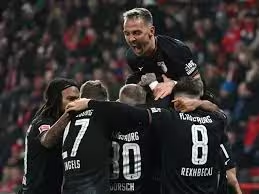
One notable tactical bright spot is set-pieces. Under assistant coach Christian Gross, set-pieces have been transformed from a weakness into a genuine weapon. In the first three competitive matches of the season (including the DFB-Pokal), Werder Bremen have already scored three goals from corners — Stage headed home in the cup, Starmach’s consolation in Freiburg came from a corner, and Füllkrug headed in Grüll’s corner at home to Leipzig. Captain Friedl said: “We put a lot into set-pieces. It shows our attitude and it shows the coaching staff, especially Gross’s work.”
Preferred Formations
4-2-3-1 / 4-4-2 (adjusted according to opponent and personnel).
Strategic Transfer Activity
Werder Bremen’s summer window followed a clear “youth plus experience” dual-track logic. With the club continuing to face financial constraints, sporting director Clemens Fritz had to operate within a limited budget. The departure of several loan players — including Sugawara, Milošević, Boniface and Wöber — further compressed squad depth.
In terms of incomings, the most eye-catching move was the signing of 33-year-old veteran Niclas Füllkrug. The German international striker returned to the Weser Stadium on loan from West Ham, beginning his third spell at the club. Füllkrug previously scored 49 goals in 124 appearances for Werder Bremen, helping the club return to the Bundesliga in 2022 and becoming joint-top scorer in the Bundesliga 12 months later. His return is both an injection of immediate quality up front and an investment in dressing-room leadership.
Other signings focused on young potential. The 22-year-old Spanish attacking midfielder Chuki arrived from Real Valladolid and has been described as “the most exciting young signing.” Twenty-year-olds Dariusz Starmach and Kenney Quettent, along with 19-year-old Darwin Soylu, will all be given opportunities. Swiss World Cup international striker Cedric Itten joined on a free transfer from Fortuna Düsseldorf, providing another option in attack.
In goal, Austrian World Cup goalkeeper Alexander Schlager arrived from Red Bull Salzburg, completing the goalkeeping department.
Summer Major Transfer Influx
| Player | Position | Former Club | Fee Paid |
|---|---|---|---|
| Niclas Füllkrug | Forward | West Ham United | Loan |
| Alexander Schlager | Goalkeeper | Red Bull Salzburg | Undisclosed |
| Chuki | Attacking Midfield | Real Valladolid | Undisclosed |
| Cedric Itten | Forward | Fortuna Düsseldorf | Free transfer |
| Ludovit Reis | Midfielder | Club Brugge | Undisclosed |
| Dariusz Starmach | Midfielder | — | Undisclosed |
The First-Team Roster
Goalkeepers
Alexander Schlager (#—) : The 30-year-old Austrian international arrived from Red Bull Salzburg after representing Austria at the World Cup. He is expected to bring immediate quality and experience to the goalkeeping position, though he will need time to adapt to the Bundesliga’s tempo.
Karl Hein (#—) : The Estonian goalkeeper started the opening fixture against Freiburg but conceded four. He missed the DFB-Pokal match against Lüneburg with a muscle issue, and Schlager’s arrival will provide direct competition.
Markus Kolke (#—) : The experienced backup plays a stabilising role in the dressing room.
Defenders
Marco Friedl (#—) : The Austrian centre-back is captain, defensive core and the club’s highest earner. His leadership and defensive stability are critical to Werder Bremen’s survival.
Amos Pieper (#—) : The German centre-back partners Friedl in the back four and started the opening fixture against Freiburg.
Niklas Stark (#—) : The experienced centre-back was troubled by hip problems in pre-season but returned to training before the season began.
Julian Malatini (#—) : The Argentine centre-back provides additional depth.
Mitchell Weiser (#—) : The German right-back has been out for over a year with an ACL injury but is nearing a return. He rejoined team training in late August, a significant boost to the right flank.
Olivier Deman (#—) : The Belgian left-back/wing-back, whose crossing quality was specifically highlighted by Niemeyer, is an important part of the team’s attacking organisation.
Felix Agu (#—) : The Nigerian-born left-back’s contract expires in 2027, and the club hopes to extend it, though his injury record remains a concern. He suffered a muscle issue before the DFB-Pokal and is still recovering.
Midfielders
Jens Stage (#—) : The Danish midfielder is one of Werder Bremen’s most important players. Last season he scored 10 goals in 29 league matches, making him one of the team’s top scorers. Hoffenheim attempted to sign him in the summer, but their offer fell short of Werder Bremen’s valuation and the deal collapsed. Stage has already scored in this season’s DFB-Pokal. His running power and late runs into the box are irreplaceable elements of Thioune’s system.
Senne Lynen (#—) : The Belgian midfielder partners Stage in midfield, responsible for screening the defence and transitioning play. He started against Freiburg but was substituted at half-time.
Ludovit Reis (#—) : The 26-year-old Dutch/Slovak midfielder arrived from Club Brugge and was described by Thioune as “hard-running, frequently winning the ball, and capable of threatening goal.” His technical ability and defensive midfield attributes give Thioune more options.
Chuki (#—) : The 22-year-old Spanish attacking midfielder arrived from Real Valladolid and is the most anticipated young signing of the summer. His technical profile and set-piece ability have drawn comparisons with the departed Schmid, though Niemeyer noted he “could equally be a substitute candidate.” Chuki started against Freiburg.
Dariusz Starmach (#—) : The 20-year-old Polish midfielder came off the bench against Freiburg and scored his first Bundesliga goal with a header. He suffered an acromioclavicular joint injury before the DFB-Pokal but has returned to training.
Forwards
Niclas Füllkrug (#—) : The 33-year-old German striker’s return to the Weser Stadium makes him the absolute focal point of Werder Bremen’s attack this season. He started against Freiburg and headed in Grüll’s corner at home to Leipzig, scoring his first competitive goal since returning. His aerial presence and finishing inside the box are the most reliable source of goals in Thioune’s system.
Cedric Itten (#—) : The 29-year-old Swiss World Cup international joined on a free transfer from Fortuna Düsseldorf, offering an alternative to Füllkrug. Thioune described him as “a tall, strong centre-forward who can hold the ball up and knows where the goal is.”
Justin Njinmah (#—) : The 25-year-old German forward is one of the team’s fastest attackers, with his strength lying in running into depth. He scored repeatedly in pre-season but was substituted after the Freiburg defeat.
Marco Grüll (#—) : The Austrian winger is Werder Bremen’s primary corner taker, his delivery quality specifically praised by Thioune as “very high.” He started against Freiburg.
Eren Dinkçi (#—) : The 24-year-old German attacker returned to Werder Bremen in the summer. He missed part of pre-season with a muscle issue but recovered in time for the season’s start. His speed and vertical running are viewed as key elements of the team’s attacking transition.
Leadership Group & Squad Regulations
Club Captain: Marco Friedl
The Austrian centre-back is the undisputed leader of Werder Bremen’s dressing room. He is not only the club’s highest earner but also the defensive core and the team’s spiritual anchor in difficult moments. Friedl also poses a threat from set-pieces, and his leadership proved vital in last season’s relegation battle.
The Leadership Committee
Jens Stage and Mitchell Weiser are important senior voices in the dressing room. Despite being among the lower earners in the squad, Stage has earned widespread respect through his performances and professionalism. Although Weiser has been absent long-term through injury, his experience has allowed him to influence the dressing room during his recovery.
Homegrown Quota Check
Werder Bremen’s squad construction shows a clear tilt toward the academy. The club has invested more than €40 million in upgrading its youth infrastructure, signalling a long-term strategic shift. In the first team, players such as Felix Agu, Niklas Stark and Justin Njinmah have direct links to the club’s academy or domestic development pathway. In addition, young forwards Salvatore Moussa and Paul Erefbenagi were given extensive opportunities in pre-season, with the latter viewed as a “shooting star.”
Financial & Contractual Health
Financial Balance Overview
Werder Bremen’s financial position is mid-to-lower tier in the Bundesliga, and the club’s reality of “chronic financial tightness” restricts the scale of its transfer operations. In terms of salary structure, Marco Friedl tops the squad at around €3 million per year, while Füllkrug is the highest earner at approximately €3.77 million. Jens Stage’s salary is just €320,000, a stark contrast to his on-pitch contribution — one of the reasons he sought a move in the summer.
Contract Red Alerts
Several key players’ contracts expire in the summer of 2027, including Felix Agu and Jens Stage. Agu’s renewal talks have begun but “have not yet produced substantive progress.” Stage’s situation is more urgent — he stayed after the Hoffenheim move collapsed, but if Werder Bremen cannot extend him during the season, he could leave on a free next summer, a major blow for the club.
In addition, sporting director Clemens Fritz’s contract also expires in 2027. Thioune stated explicitly at a mid-September press conference that he supports Fritz’s renewal: “For me, there is no doubt he is the right man. I know how difficult our transfer summer was — for him too. So I can promise I will only speak positively and hope to work with him for a long time yet.”
The Academy Pipeline & Loan Tracker
Breakout Talents to Watch
Salvatore Moussa is one of the most eye-catching young forwards in Werder Bremen’s academy. The 20-year-old, 1.98-metre centre-forward scored repeatedly in pre-season, showing potential to compete at senior level. His physical profile and instincts in the box evoke comparisons with Füllkrug’s eventual successor.
Paul Erefbenagi also impressed in pre-season, the young attacker scoring against Bochum and viewed by Niemeyer as one of the players who “gives us that special something.”
Loan Watch
Werder Bremen’s loan strategy this season has been constrained by squad depth, with large-scale loan operations less active than in previous years. The club prefers to keep young players in the U23 or on the fringes of the first team rather than loaning them to lower divisions.
Set-Piece Specialists & FPL Cheat Sheet
Penalties: Niclas Füllkrug (First Choice)
Direct Free-Kicks: Chuki / Marco Grüll
Corners & Crosses: Marco Grüll (primary corner taker, delivery quality very high) / Olivier Deman (high crossing quality)
Final Outlook: Navigating the Tactical Horizon
Werder Bremen enter 2026/27 in a state best described as a passive transformation under survival pressure. Last season’s 15th-place finish — just three points above relegated Wolfsburg — already indicated that the club’s competitiveness sits dangerously close to the edge. The 4-1 opening defeat in Freiburg further confirmed the pessimistic expectations of a fan survey that listed Werder Bremen as the second-favourite for relegation.
Thioune’s tactical transformation faces an inherent tension. Losing Schmid meant losing the creative core through whom “almost every attack passed last season,” while Füllkrug, though a reliable finisher, needs precise crossing rather than vertical through-balls. Chuki, Njinmah and Dinkçi are three different types of attacker, and Thioune must find a balance between direct play and the shortage of creativity.
Set-pieces are one of the few certainties this season. Gross’s work has produced immediate results, and if creativity in open play remains insufficient, corners and free-kicks will become Werder Bremen’s most reliable source of goals.
The health of the back line is another key variable. Weiser’s long-term absence has weakened the quality on the right, while Agu’s recurring injuries leave the left-back position without stability. If both full-backs can stay fit, Thioune’s defensive system will receive a significant boost.
Füllkrug’s physical condition may be the single most important factor determining the season’s direction. The 33-year-old German is the team’s only forward with a consistent Bundesliga goalscoring record, and if he is injured, Werder Bremen’s attack faces a “no striker available” scenario.
Thioune’s 40-point target is an honest and clear-eyed benchmark. If Werder Bremen can reach that mark by mid-season, they can turn their attention to higher goals; but if injuries and creativity problems persist, the relegation battle on the Weser will once again become the main theme. In an increasingly competitive Bundesliga, Werder Bremen’s path to survival may lie not in brilliance, but in pragmatism — and in Füllkrug’s head.