The Austria national football team, culturally and globally celebrated across the sporting landscape as Das Team (The Team) or Our Boys, represents the epicenter of modern high-intensity tactical architecture within the European continent. Once revered in the early 20th century as the “Wunderteam”—a legendary squad that dominated the globe with intricate, short-passing aesthetic symphonies—Austria has executed a comprehensive technical evolution. Under a highly systemic technical regime, the program has emerged as the definitive international blueprint for organized chaos, elite territorial choking, and lightning-fast vertical transitions.
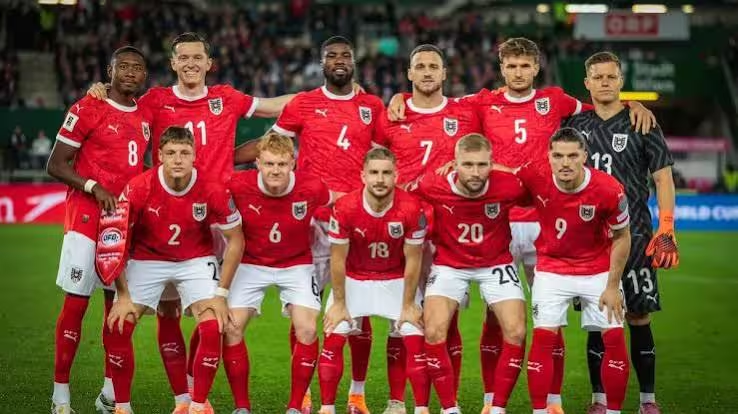
Following their highly successful multi-year campaigns, Austria enters the contemporary international landscape as one of Europe’s most feared tactical setups. Combining an experienced, multi-championship European first-division spine with a relentless wave of high-stamina central pivots, Austria stands as an incredibly complex structural challenge for global opponents. This comprehensive profile breaks down the architectural design of the active senior roster, foundational history, individual records, and up-to-date statistical performance data.
Brief History and Core Continental Achievements
The Austrian Football Association (ÖFB) was officially founded in 1904 and admitted to FIFA in 1905, later helping co-found UEFA in 1954. On their home continent, Austria’s historical pedigree bridges early global pioneering exploits with modern tactical comebacks, twice qualifying for the knockout tiers of the UEFA European Championship across recent campaigns to establish a highly respected baseline of regional elite status.
The Legend of the Wunderteam and the Global Podiums
Austria’s absolute statistical pinnacle on the global stage was achieved during the pre-war and early post-war eras. Spearheaded by the legendary Matthias Sindelar—globally revered as the “Paper Man” due to his slight frame and untouchable technical elegance—the 1930s “Wunderteam” completely transformed the tactical landscapes of international sports. This generation captured the silver medal at the 1936 Summer Olympics before the program reached its global tournament zenith at the 1954 FIFA World Cup in Switzerland. Putting on a high-scoring attacking masterclass, Austria marched dramatically to the global podium to secure the Bronze Medal, ranking as the nation’s finest sporting hour.
Technical Roster Breakdown
Under rigid, highly organized tactical management, the modern Austrian squad operates primarily within an ultra-aggressive, compact 4-2-2-2 or an asymmetric, transition-minded 4-2-3-1 matrix. The system places an absolute premium on a hyper-synchronized, high-line counter-press, intense physical trapping triggers in the middle third, and vertical slicing passing lines into the final third.
1. Goalkeepers
The Austrian goalmouth requires exceptional ball-playing sweeping traits to support a high defensive line, highly secure ball handling under heavy physical contact, and elite short-range reflex capabilities.
- Patrick Pentz (#1): The preferred first-choice starting goalkeeper. Pentz brings world-class positioning, exceptional composure under intense frontline pressing, and highly precise ball-playing distribution out of the back.
- Alexander Schlager (#12): A highly physical, authoritative shot-stopper who provides elite starting-caliber depth and vocal penalty-box collection metrics from the domestic Bundesliga.
- Niklas Hedl (#23): A sharp, high-reflex young backup keeper finalizing a secure and deeply knowledgeable goalkeeping department.
2. Defenders
The defensive line balances physically dominant, mobile center-backs who excel at distributing out of heavy pressure with high-stamina fullbacks built to execute intense recovery tracking.
- Kevin Danso (#4) & Philipp Lienhart (#2): The preferred central defensive starting pair, combining modern ground speed, high-volume clearance metrics, and exceptional reading of central progressive passing channels.
- Stefan Posch (#5): A world-class modern defender. Operating as a robust, heavy-tackling right fullback, Posch utilizes exceptional physical power, elite 1v1 wide containment traits, and immense tournament authority to protect the lateral flanks.
- Phillipp Mwene (#16) & Alexander Prass (#8): Exceptionally versatile wide options. Prass provides world-class left-footed progressive driving lines and midfielder-like press-resistance, while Mwene delivers strict structural containment on the flanks.
- Maximilian Wöber (#3) & Leopold Querfeld (#15): Physically robust central defenders deployed to provide structural depth and absorb heavy physical contact in tournament duels.
3. Midfielders
The midfield is the crown jewel and absolute tactical engine room of Das Team, combining unparalleled physical engines with press-resistant ball retention and ferocious ball-winning traps.
- Marcel Sabitzer (#9): The captain, superstar maestro, and undisputed emotional heartbeat of the team. Sabitzer utilizes world-class press-resistance, deep line-breaking passing vision, and a legendary long-range shooting threat to completely dominate team tempos from the middle third.
- Konrad Laimer (#6): The primary defensive shield, tactical general, and master of the press. Laimer excels at aggressively choking out opposition progressive paths, executing high-volume tackles, and triggering instant vertical counters.
- Nicolas Seiwald (#18) & Florian Grillitsch (#10): Metronomic central pivots possessing exceptional spatial intelligence, press-resistant ball recycling, and deep defensive screening to protect the center-backs.
- Christoph Baumgartner (#19): A world-class progressive advanced playmaker. Operating inside the advanced pockets or half-spaces, Baumgartner utilizes exceptional situational IQ, close-control dribbling, and a historic knack for scoring lightning-fast international goals.
- Patrick Wimmer (#11) & Romano Schmid (#17): High-energy, highly mobile attacking assets deployed to sustain intense pressing densities and inject unpredictable vertical speed wide late in matches.
4. Forwards
The frontline provides a highly flexible mixture of direct transitional speed, intense frontline defensive pressing traps, and clinical final-third execution.
- Michael Gregoritsch (#11): The premier central striker leading the line. Gregoritsch offers elite off-the-ball situational movement, exceptional physical hold-up metrics, and absolute aerial dominance inside the box to convert vertical crosses.
- Junior Adamu (#7) & Marko Arnautović (#13): Dynamic central forward variants chosen to alter attacking depths. The iconic veteran Arnautović continues to provide legendary locker-room authority and clinical edge, while Adamu injects high-intensity defensive pressing work rates.
- Andreas Weimann (#20): A vastly experienced, high-stamina forward variant utilized to run wide channels and stretch fatigued opposition backlines late in matches.
FIFA World Cup Performance Statistics
Austria’s statistical resume highlights an international program that stands as a model of historical elite achievement, amassing seven final tournament runs and a prestigious global podium finish.
World Cup Tournament History Dashboard
The table below logs Austria’s absolute performance metrics across their complete historical FIFA World Cup final appearances:
| World Cup Edition | Host Country / Nations | Overall Record (W-D-L) | Goals (GF-GA) | Final Tournament Milestones / Results |
|---|---|---|---|---|
| 1934 | Italy | 2-0-2 | 7-7 | Fourth-Place Finish (The Debut of the Wunderteam) |
| 1954 | Switzerland | 4-0-1 | 17-12 | Third-Place Finish (Bronze Medal – Highest Historic Mark) |
| 1958 | Sweden | 0-1-2 | 2-7 | Group Stage Exit |
| 1978–1982 | Argentina / Spain | 6-1-4 | 12-14 | 2x Consecutive Second Round Group Finishes (Finished 7th in 1978) |
| 1990–1998 | Italy / France | 1-2-3 | 5-9 | 2x Group Stage Exits |
| Historical Totals | 7 Tournaments Entered | 13-4-12 | 43-49 | Highest Achievement: World Cup Bronze Medal (1954) |
All-Time Cap and Scoring Leaderboards
The tables below document the historical all-time record holders for senior international appearances and goals scored for the Austrian men’s national team:
| Rank | Most Capped Players | Total International Caps | Career Era | Goals Scored |
|---|---|---|---|---|
| 1 | Marko Arnautović | 116 | 2008–Present | 37 |
| 2 | David Alaba | 105 | 2009–2024 | 15 |
| 3 | Andreas Herzog | 103 | 1988–2003 | 26 |
| 4 | Aleksandar Dragović | 100 | 2009–2022 | 2 |
| 5 | Toni Polster | 95 | 1982–2000 | 44 |
| Rank | All-Time Top Goalscorers | Goals Scored | Matches Played | World Cup Goals |
|---|---|---|---|---|
| 1 | Toni Polster | 44 | 95 | 3 |
| 2 | Hans Krankl | 34 | 69 | 4 (Scored Iconic 1978 Winner vs Germany) |
| 3 | Marko Arnautović | 37 | 116 | 0 (Highest Active Scorer) |
| 4 | Johann Horvath | 29 | 46 | 3 |
| 5 | Erich Probst | 17 | 19 | 6 (National World Cup Record) |
Elite Individual Benchmarks
- The Unrivaled Cap Monolith: Attacking icon Marko Arnautović stands entirely alone at the absolute apex of national sports history, amassing an extraordinary 116 international caps to sit comfortably as the most-capped player in the territory’s history while serving as the leading active goalscorer.
- The World Cup Marksman: Prolific forward Erich Probst holds the absolute independent record for the most goals scored at FIFA World Cup finals with 6 goals, single-handedly driving Austria’s historic 1954 Bronze Medal campaign by scoring in nearly every knockout sequence.
- The Historic World Record Strike: Advanced playmaker Christoph Baumgartner etched an immortal mark in global football history by scoring the fastest goal in international football history, hitting the back of the net just 6.3 seconds into the opening kickoff against Slovakia in a March 2024 showcase.
Tactical Identity: High-Line Gegenpressing and Vertical Transitions
The contemporary tactical blueprint of Das Team operates primarily out of a highly sophisticated, physically overwhelming 4-2-2-2 or 4-2-3-1 structural matrix heavily rooted in Red Bull-style system designs. The absolute cornerstone of the entire framework is spatial strangulation through collective synchronization. Austria completely avoids deep, passive low blocks, choosing instead to implement an intense, high-line counter-press that isolates the opposition’s deep pivots exactly as they look to turn.
Out of possession, Konrad Laimer leads hyper-aggressive trapping triggers to force the ball inward into congested central channels where physical pivots choke off passing lanes. Once a tactical turnover is ruthlessly forced, Austria completely bypasses slow, risk-heavy side possession build-ups. The metronomic distribution of Marcel Sabitzer instantly fires progressive line-breaking passes into advanced half-spaces, releasing the explosive vertical movements of Christoph Baumgartner to slice apart unseated backlines within a matter of single-digit seconds.
Conclusion
The Austria national football team stands as a magnificent testament to systematic structural planning, collective tactical discipline, and modern high-intensity football development. Their highly coordinated, high-speed transitional blueprint showcases an international program masterfully engineered to systematically neutralize, compress, and dismantle the possession models of global football giants. As Marcel Sabitzer orchestrates final-third execution with masterclass flair and Christoph Baumgartner injects unpredictable line-breaking speed into transitions, Das Team possesses every structural parameter necessary to maintain an elite historic legacy on the global stage.