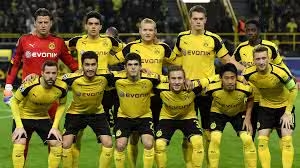
Following a summer of strategic reinvention under new sporting director Ole Book, Borussia Dortmund enter 2026/27 with a squad rebuilt around youth, hunger and a return to the club’s attacking traditions. Gone are the high-earning veterans of recent years; in their place, a collection of exciting young talents tasked with challenging Bayern Munich’s domestic dominance. Niko Kovač, the man who dragged Dortmund from crisis to Champions League qualification in 2025, now faces a different challenge: moulding potential into trophies.
Technical Leadership & Coaching Profile
Manager: Niko Kovač
Kovač took charge at Dortmund in January 2025 with the club in the wrong half of the Bundesliga table. He guided them to Champions League qualification, and last season delivered a second-place finish with 73 points — the fifth-best campaign in club history. His brother Robert serves as assistant, continuing a partnership that began during their playing days with Croatia.
Kovač’s reputation is built on defensive organisation and competitive resilience rather than aesthetic purism. He has openly questioned the primacy of “attractive football” in public discourse: “Who — apart from Bayern Munich — plays consistently attractive football in the Bundesliga? And is attractiveness more important than success?” His football demands discipline, hard work against the ball and a willingness to attack space directly. The early returns this season — four wins from four Bundesliga matches, three clean sheets, top of the table — suggest the message is landing.
Tactical Philosophy
Kovač’s Dortmund is built on defensive stability first. The back three, inherited from the previous regime and maintained through the summer, suits the physical profile of the defenders and provides the platform for everything else. Against the ball, Dortmund are compact, aggressive in duels and organised on set-pieces — qualities Book explicitly identified as non-negotiable foundations.
With the ball, Kovač wants verticality. His attacking players are instructed to repeatedly make runs into the space behind opposition defences, forcing the back line to turn and defend while retreating. This “fast and vertical into the back” approach was a key reason Dortmund pursued Said El Mala with a club-record offer exceeding €50 million, only to be rebuffed by Köln. The new attacking signings — Karetsas, Konstantelias, Nwaneri — offer creativity and dribbling in tight spaces rather than the direct running of El Mala, creating an intriguing tension between Kovač’s ideal and the tools at his disposal.
Preferred Formations
3-4-3 / 4-3-3 (situational variant).
Strategic Transfer Activity
Book’s first transfer window represented a decisive break from the Sebastian Kehl era. Where Kehl’s signings often failed to meet expectations across eight windows, Book targeted young, high-potential players with clear resale value and immediate first-team impact. More than €100 million was invested, financed through a combination of instalment-based payment structures and approximately €120 million in outstanding transfer receivables from previous sales, including Jude Bellingham, Jamie Gittens and Donyell Malen. Simultaneously, squad costs were reduced by €20 million through the departures of high earners like Niklas Süle and Julian Brandt.
Summer Major Transfer Influx
| Player | Position | Former Club | Fee Paid |
|---|---|---|---|
| Konstantinos Karetsas | Attacking Midfield | Genk | €30m + add-ons |
| Giannis Konstantelias | Winger | PAOK | €26m |
| Joey Veerman | Central Midfield | PSV Eindhoven | €22m |
| Joane Gadou | Centre-Back | Red Bull Salzburg | €19.5m |
| Ethan Nwaneri | Attacking Midfield | Arsenal | Loan |
The First-Team Roster
Goalkeepers
Gregor Kobel (#1) : The Swiss international remains Dortmund’s undisputed number one and one of the most valuable goalkeepers in world football. His shot-stopping and command of the penalty area were central to last season’s defensive record. Interest from elite clubs persists, but Dortmund have resisted.
Alexander Meyer (#33) : The experienced backup provides reliable coverage and a professional presence in the dressing room.
Defenders
Waldemar Anton (#2) : The German centre-back has become a leadership figure, captaining the side in the opening fixtures. His reading of the game and composure in possession suit Kovač’s back-three system.
Nico Schlotterbeck (#4) : The left-footed centre-back is Dortmund’s most valuable defensive asset and a Germany international. His passing range from deep positions initiates attacks, while his recovery pace covers for the aggressive positioning of the wing-backs.
Ramy Bensebaini (#5) : The Algerian offers physicality and aerial dominance on the left of the back three. He was suspended for the opening matches following a red card in the Supercup.
Joane Gadou (#22) : The 19-year-old French centre-back signed from Red Bull Salzburg for €19.5 million. At 1.95 metres, he combines exceptional physical presence with surprising mobility. His integration into the first team has been gradual but promising.
Julian Ryerson (#26) : The Norwegian’s versatility across the right flank is valued by Kovač. He can operate as a wing-back in the back three or as a traditional full-back if the system shifts.
Midfielders
Felix Nmecha (#8) : Book declared Nmecha “off-limits” for potential suitors, describing him as “one of the best midfielders in Germany.” The German international’s ball-carrying and physical presence make him central to Dortmund’s engine room.
Joey Veerman (#25) : The Dutch playmaker arrived from PSV Eindhoven for €22 million on a five-year deal. His exceptional passing range and ability to dictate tempo from central midfield provide the creative axis Dortmund lacked last season. Against Paderborn, his control of the game was evident.
Jobe Bellingham (#7) : Following in his brother’s footsteps, Jobe has carved his own reputation as a dynamic box-to-box midfielder. Only Bensebaini made more tackles for Dortmund in last season’s Champions League. “I feel most comfortable in the middle of the pitch, where everything happens around me,” he says.
Carney Chukwuemeka (#17) : The English midfielder offers athleticism and forward-running from deep positions, providing rotation options in a demanding season.
Marcel Sabitzer (#20) : The Austrian’s future remains uncertain, with Dortmund reportedly listening to offers around €10 million. His experience is valuable, but his consistency has not matched his Leipzig years.
Forwards
Serhou Guirassy (#9) : The Guinean striker is Dortmund’s attacking focal point. He scored 13 Champions League goals in 2024/25, finishing as joint-top scorer in the competition, and hit 22 in all competitions last season. His movement and finishing instincts make him indispensable when fit.
Konstantinos Karetsas (#19) : The 18-year-old Greek playmaker arrived from Genk for €30 million plus add-ons that could reach the club-record €35 million paid for Ousmane Dembélé. He needed less than nine minutes to make an impact on his Bundesliga debut, setting up Guirassy against Hamburg. An elite dribbler with exceptional vision in tight spaces, he is seen as Julian Brandt’s direct replacement.
Ethan Nwaneri (#18) : The Arsenal loanee arrived as a direct response to Konstantelias’s ACL injury. Still only 19, the left-footed attacker possesses exceptional technical quality and the ability to operate across the attacking line.
Giannis Konstantelias (#—) : The Greek winger’s season was derailed before it began. After an eye-catching cameo in the Supercup against Bayern, he scored on his Bundesliga debut against Hamburg — then suffered a torn ACL in the same match, ruling him out for several months.
Maximilian Beier (#—) : Primarily a centre-forward but capable of operating on the right wing, Beier offers a different profile to Guirassy with his preference for running into channels.
Fábio Silva (#21) : The Portuguese forward provides depth across the attacking line, though his minutes may be limited behind Guirassy and Beier.
Leadership Group & Squad Regulations
Club Captain: Waldemar Anton
The German centre-back has assumed the armband in the opening fixtures, a reflection of his seniority and composure within a young squad. His leadership extends beyond the pitch — as one of the few experienced heads in a dressing room stripped of its veteran core, his voice carries weight.
The Leadership Committee
Gregor Kobel and Felix Nmecha serve as senior voices alongside Anton. The departures of Süle, Brandt and Özcan made their leadership more important than ever.
Homegrown Quota Check
Dortmund’s squad continues to blend academy graduates with external signings. Kjell Wätjen and Tom Rothe represent the pathway from the youth setup, while the club’s emphasis on developing young talent remains central to its identity. The average squad age of 24.9 reflects Book’s deliberate pivot toward youth.
Financial & Contractual Health
Financial Balance Overview
Dortmund reported a net loss of €21.7 million for FY26, at the low end of management guidance, with revenue declining 12% to €460.5 million. The primary driver was a 26% fall in TV marketing revenue following the club’s Champions League knockout phase exit. Management has guided for a net profit of €0–10 million in FY27, with revenue projected at €485–495 million. This guidance assumes progression to the Champions League Round of 16 and a DFB-Pokal run.
The summer’s €100 million-plus investment was structured through instalment payments spread over three to four years, preserving short-term liquidity. Outstanding transfer receivables of approximately €120 million from previous sales provide additional financial flexibility, though open transfer liabilities stood at €123 million at the end of June.
Contract Red Alerts
Nico Schlotterbeck’s contract expires in 2027, and the centre-back has been the subject of persistent transfer speculation. Securing his future is a priority. Sabitzer’s situation also requires resolution — Dortmund are reportedly open to offers around €10 million, but finding a buyer for a 32-year-old on significant wages may prove difficult.
The Academy Pipeline & Loan Tracker
Breakout Talents to Watch
Samuele Inácio and Luca Reggiani broke into the first team during the latter stages of 2025/26 and are expected to feature more prominently this season. Justin Lerma, signed from Ecuador, has drawn comparisons to a young Mario Götze for his technical ability and creative vision. The 18-year-old made his professional debut at just 15. Takato Yamamoto, a two-footed Japanese midfielder, has impressed in pre-season and could earn first-team opportunities.
Notable Out on Loan
Diant Ramaj, on loan at Heidenheim, faces an uncertain future. The 24-year-old must decide whether to compete with Kobel, seek another loan, or be sold if a suitable offer arrives.
Set-Piece Specialists & FPL Cheat Sheet
Penalties: Serhou Guirassy (First Choice)
Direct Free-Kicks: Joey Veerman / Julian Brandt (departed)
Corners & Crosses: Joey Veerman / Julian Ryerson
Final Outlook: Navigating the Tactical Horizon
Dortmund enter 2026/27 in a state of calculated optimism. The four wins from four Bundesliga matches, the top-of-the-table position, and the clean sheets are objective evidence that Kovač’s fundamentals are working. The defensive structure that carried them to second place last season has been preserved, and the new signings have injected creativity and technical quality that was previously lacking.
Yet the margin for error remains thin. Bayern Munich’s domestic dominance is not easily challenged, and Dortmund’s title credentials will be tested by the grind of a Champions League campaign that demands progression to the Round of 16 for financial targets to be met. The ACL injuries to Konstantelias and Emre Can have already tested squad depth, and the January window may require further reinforcement if attacking options become stretched.
The central question is whether Kovač can extract consistent attacking output from a group built for potential rather than proven production. The departures of Brandt and Adeyemi removed goals that have not been directly replaced. Guirassy remains the only reliable finisher, and his fitness is paramount. If Karetsas and Nwaneri can contribute regularly, and if Veerman’s passing can unlock low blocks, Dortmund possess the tools to challenge. If not, the reliance on defensive solidity and individual moments may prove insufficient against elite opposition.
Book’s first window has been widely praised for its rigour and effectiveness, a sharp contrast to the Kehl era. But windows are judged over seasons, not weeks. The young talents must develop, the financial targets must be met, and the football must produce results. Dortmund’s path back to the summit is clear in design; whether it holds under pressure is the story of the season ahead.