Following a summer of profound institutional restructuring, OGC Nice enter 2026/27 with a new coach, a new sporting director, and a squad still bearing the scars of last season’s relegation play-off trauma. The departure of Franck Haise and the interim rescue mission of Claude Puel gave way to Olivier Pantaloni, a man returning to the club where he signed his first professional contract forty years ago. Roger Ricort replaced Geoffrey Moncada as sporting director. Yet the shadow of INEOS’s planned sale, a mandated €70 million in savings, and the crippling injuries to two key defenders have left Nice’s opening campaign teetering on the brink of another crisis.
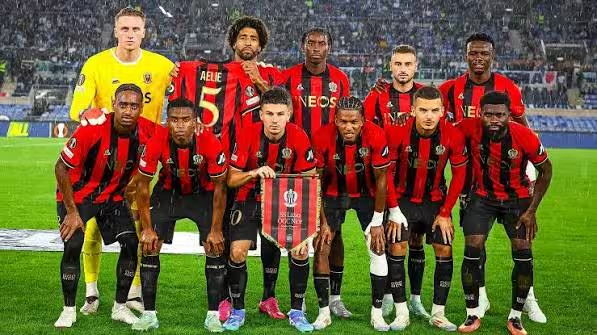
Technical Leadership & Coaching Profile
Manager: Olivier Pantaloni
Pantaloni was appointed on a two-year deal in June 2026, arriving from Lorient where he had built a reputation for pragmatic, organised football on a limited budget. His return to Nice carries symbolic weight — he began his playing career at the club as a trainee forty years ago.
His opening press conference struck a tone of cautious realism. “When you live through a season as difficult as that one, there is a rescue at the end. You have to congratulate the players,” he said, acknowledging the play-off survival against Saint-Étienne. But he made clear that avoiding a repeat was the priority: “My goal is clear: to install more stability and serenity as quickly as possible.”
Pantaloni’s staff was finalised at the start of July, with Frédéric Gioria, Erwann Le Postec, Cédric Varrault, Stéphane Cassard and Nicolas Dyon joining him. The continuity of Varrault and Cassard from Puel’s staff provided some institutional memory during a turbulent transition.
Tactical Philosophy
Pantaloni’s Nice has deployed a 3-4-3 in the opening matches of the season, a structure that appears designed to provide defensive solidity in front of a back line stripped of its most experienced figures. The system relies on wing-backs for width — Jonathan Clauss on the right, Niels Nkounkou or Ali Abdi on the left — with the front three tasked with generating whatever attacking threat the squad can muster.
The early data paints a grim picture. Across four matches, Nice have scored once and conceded five, taking just two points from a possible twelve. Possession numbers have been healthy — 70% at Auxerre, 60% against Lorient — but the ball has moved sideways more often than forward. Twenty-seven crosses at Auxerre yielded nothing. Twenty-six against Lorient yielded nothing. The 3-4-3 has provided structure without penetration.
Pantaloni’s task is to transform a squad constructed for survival into something more proactive, but the tools at his disposal are limited. The arrival of Mohammed Amoura and Niels Nkounkou in late August — both with purchase options — represents the sporting direction’s attempt to inject pace and directness into a side that has lacked both.
Preferred Formations
3-4-3.
Strategic Transfer Activity
Nice’s summer window was defined not by ambition but by obligation. INEOS, the club’s ownership, mandated €70 million in savings before the end of the market, with a minimum of €40 million in player sales required to fund any recruitment. The sporting director’s brief was brutal: sell before you can buy, and even then, buy only if the financial equation balanced.
The departures came in waves. Terem Moffi’s loan to Porto was made permanent in all but name, the purchase option unexercised but the player’s salary off the books. Sofiane Diop — earning €4.2 million annually, a figure incompatible with Nice’s new reality — remained, an administrative error having prevented his winter departure. Hicham Boudaoui and Morgan Sanson were both touted to suitors, their contracts expiring in 2027 and their salaries representing exactly the kind of expenditure the club needed to eliminate.
The arrivals, when they came, were late and pragmatic. Mohammed Amoura joined on loan from Wolfsburg on 30 August, bringing pace, work rate, and a respectable goalscoring record in Belgium and Germany. Niels Nkounkou followed on 31 August, the 25-year-old left-back arriving from Eintracht Frankfurt on a similar loan-with-option arrangement. Alidu Seidu’s loan from Rennes in mid-September was less a tactical choice than an emergency response to the devastating injuries suffered by Antoine Mendy and Moïse Bombito.
Summer Major Transfer Influx
| Player | Position | Former Club | Fee Paid |
|---|---|---|---|
| Mohammed Amoura | Forward | Wolfsburg | Loan (with option) |
| Niels Nkounkou | Left-Back | Eintracht Frankfurt | Loan (with option) |
| Alidu Seidu | Defender | Rennes | Loan |
| Laurent Abergel | Midfielder | Lorient | Free |
| Gauthier Hein | Midfielder | Metz | Undisclosed |
The First-Team Roster
Goalkeepers
Yéhvann Diouf (#23) : The 27-year-old has been entrusted with the number one jersey following the departures of Marcin Bułka and the retirements of previous incumbents. His shot-stopping has been adequate, but the defensive chaos in front of him has exposed the limits of his command.
Teddy Boulhendi (#77) : The academy graduate provides backup, though his minutes will be limited unless Diouf falters.
Martin Ponsot (#—) : The 17-year-old has been the surprise of pre-season, his performances against Marseille drawing comparisons with a young Hugo Lloris. Originally third in the hierarchy, he could challenge for a more prominent role as the season progresses.
Defenders
Jonathan Clauss (#92) : The 34-year-old captain has worn the armband in every league match this season, his experience and crossing ability making him a rare source of quality in a struggling side.
Youssouf Ndayishimiye (#55) : The Burundian has been deployed at the heart of the back three, his physicality and reading of the game providing the closest thing Nice have to defensive stability.
Moïse Bombito (#64) : The Canadian suffered a serious injury in the opening weeks, a devastating blow given his importance to Pantaloni’s structure.
Antoine Mendy (#33) : The young defender’s injury compounded Nice’s defensive crisis, forcing the club into the emergency loan for Seidu.
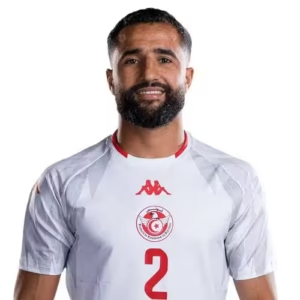
Ali Abdi (#—) : The Tunisian international offers cover on the left, though his minutes have been limited by Nkounkou’s arrival.
Niels Nkounkou (#—) : The loan signing from Eintracht Frankfurt brings athleticism and attacking thrust to the left flank, reuniting him with his friend Elye Wahi.
Alidu Seidu (#—) : The Ghanaian international arrived from Rennes on loan after Mendy and Bombito’s injuries, bringing 106 matches of Ligue 1 experience and two World Cup appearances.
Hamza Koutoune (#84) : The 19-year-old has impressed in pre-season, establishing himself as a reliable alternative to Clauss at right wing-back. Pantaloni is convinced he can give the young defender meaningful minutes this season.
Midfielders
Hicham Boudaoui (#—) : The Algerian international remains a key figure in the engine room, his energy and ball-carrying ability central to Nice’s transition play. His contract expires in 2027, and his future remains uncertain.
Morgan Sanson (#—) : The 32-year-old is among the club’s highest earners at €5.09 million annually, a salary that has made him a priority to move on. His experience is valuable, but the economics dictate his departure.
Laurent Abergel (#19) : The 33-year-old arrived on a free transfer from Lorient, bringing the kind of experienced, disciplined midfield presence Pantaloni values.
Axel Witsel (#28) : The veteran Belgian offers calmness and positional intelligence in midfield, though his legs are no longer those of his Dortmund prime.
Gauthier Hein (#—) : The 30-year-old signed from Metz, his creativity and set-piece delivery offering a different dimension to Nice’s midfield.
Issiaga Camara (#22) : The young Guinean provides depth and athleticism in central areas.
Djibril Coulibaly (#39) : The 18-year-old has impressed with his technical serenity and presence in midfield, earning the trust of the coaching staff.
Junior Mandza (#35) : The 17-year-old signed his first professional contract in July after growing up at the club since the age of six. A left-footed midfielder with personality and intensity, he has been tested in a deeper left-sided role during pre-season and could provide cover in defence.
Forwards
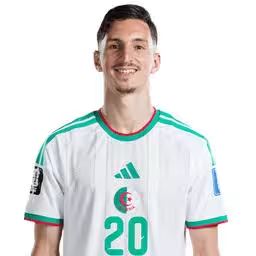
Mohammed Amoura (#—) : The 26-year-old Algerian international arrived on loan from Wolfsburg, bringing pace, acceleration, and a proven goalscoring record in Belgium and Germany. He scored on his home debut against Lille, a rare bright spot in a difficult start.
Elye Wahi (#11) : The French forward returned to Nice after his loan spell, tasked with leading the line. His talent is undeniable, but his consistency remains the question.
Sofiane Diop (#—) : The 26-year-old remains at the club despite his €4.2 million salary making him a financial burden. His ten goals and three assists last season demonstrated his quality, but his future lies elsewhere if a buyer can be found.
Salis Abdul Samed (#99) : The Ghanaian midfielder provides physical presence and defensive coverage, though his role in the attacking third is limited.
Isak Jansson (#21) : The Swedish forward offers depth across the attacking line.
Nathan Ngoumou (#29) : The French winger’s pace and directness provide a different option in wide areas.
Zoumana Diallo (#44) : The 21-year-old hopes to establish himself as a credible alternative in attack, though the competition for places is fierce.
Leadership Group & Squad Regulations
Club Captain: Jonathan Clauss
The 34-year-old right wing-back has worn the armband in every league match this season, a reflection of his seniority and the vacuum left by Dante’s departure. Clauss brings 15 years of professional experience and a professionalism that Pantaloni has leaned on heavily during a turbulent start.
The Leadership Committee
Youssouf Ndayishimiye and Hicham Boudaoui serve as senior voices alongside Clauss, their combined experience providing essential guidance through a challenging campaign.
Homegrown Quota Check
Nice’s academy is not merely a philosophical commitment but an economic necessity. Junior Mandza, Martin Ponsot, Hamza Koutoune, Djibril Coulibaly and Zoumana Diallo have all been integrated into the professional squad this season, a direct consequence of the club’s financial constraints and its stated commitment to “trusting our youth academy.” The academy’s director, Julien Sablé, has overseen a period of significant results: U13 national champions, U14 champions, Gambardella quarter-finalists for the second consecutive season. The pipeline is functioning; the question is whether the first team can survive long enough to benefit from it.
Financial & Contractual Health
Financial Balance Overview
Nice’s financial situation is the defining context of the season. INEOS, the club’s ownership, has mandated €70 million in savings before the end of the summer market, with €40 million in player sales required as a minimum. The wage bill stands at approximately €37.2 million annually, representing 89% of estimated revenue — a ratio that is unsustainable under any reasonable financial model.
Morgan Sanson’s €5.09 million salary and Jonathan Clauss’s €4.55 million package illustrate the structural imbalance. Mohammed Amoura’s arrival on comparable terms — €4.55 million annually — suggests the club is still operating at the edge of its means, even as it attempts to shed costs elsewhere.
Contract Red Alerts
The futures of several key players require urgent attention. Hicham Boudaoui and Morgan Sanson both see their contracts expire in June 2027, making January the final opportunity to generate transfer fees. Sofiane Diop, whose salary remains the club’s most significant individual burden, has one year remaining and no obvious suitor. The failure to resolve these situations will leave Nice facing another summer of forced sales and diminished squad depth.
The Academy Pipeline & Loan Tracker
Breakout Talents to Watch
Martin Ponsot is the most compelling story of Nice’s pre-season. The 17-year-old goalkeeper, signed from Olympique de Valence in 2024, has risen from third in the hierarchy to challenge Yéhvann Diouf for the number one spot. His performance against Marseille drew comparisons with Hugo Lloris, and his maturity has impressed the coaching staff.
Junior Mandza signed his first professional contract in July after fifteen years at the club. A left-footed midfielder with “a modern playing style and outstanding natural talents,” he has been tested in a deeper defensive role and could provide cover for the injury crisis.
Djibril Coulibaly’s “serenity in the engine room” has marked him as one of the academy’s most promising midfielders, while Hamza Koutoune has established himself as a credible backup to Clauss.
Notable Out on Loan
Victor Orakpo’s failure to learn French since his arrival has been noted as a concern, his integration into the squad hindered by the language barrier. His future appears increasingly uncertain.
Set-Piece Specialists & FPL Cheat Sheet
Penalties: TBD (no fixed taker established early in the season)
Direct Free-Kicks: Gauthier Hein / Sofiane Diop
Corners & Crosses: Jonathan Clauss / Gauthier Hein
Final Outlook: Navigating the Tactical Horizon
Nice enter 2026/27 in a state of managed decline. The play-off survival against Saint-Étienne was celebrated as an achievement, but it merely postponed the reckoning. The financial constraints imposed by INEOS, the ownership’s apparent desire to sell, and the structural imbalance of the wage bill have combined to create a squad that is thinner, younger, and less experienced than the one that nearly fell through the trapdoor.
Two points from four matches, one goal scored, and a defence that has already lost two key figures to serious injury tell their own story. The 3-4-3 has provided a framework, but frameworks alone do not win matches. Mohammed Amoura’s goal against Lille offered a glimpse of the pace and directness the attack has lacked, but one moment does not constitute a pattern.
The academy is the club’s lifeline. Ponsot, Mandza, Coulibaly, Koutoune — these are names that will define Nice’s season, for better or worse. If they rise to the challenge, Pantaloni’s side might find the energy and hunger that a squad of expensive, disillusioned veterans cannot provide. If they falter, the weight of responsibility may crush them.
The January window will be critical, but the €70 million savings mandate means any reinforcement must be preceded by sales. The futures of Sanson, Boudaoui, and Diop remain unresolved, their salaries a constant drain on resources that could be redirected toward the playing staff.
Pantaloni’s return to the club where it all began is a romantic narrative, but romance offers no points. His task is to keep Nice competitive long enough for the academy to bear fruit, and to prevent the financial reckoning from becoming a sporting catastrophe. The margin for error is thin, and the opening weeks have already exposed the fragility of the project. Survival, once again, must be the priority.