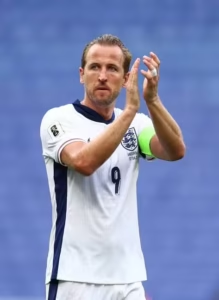
PLAYER SNAPSHOT: At a Glance
| Category | Details |
|---|---|
| Full Name | Neymar da Silva Santos Júnior |
| Date of Birth | 05/02/1992 (Age: 34) |
| Place of Birth | Mogi das Cruzes, Brazil |
| Nationality | Brazilian |
| Height | 5 ft 9 in / 175 cm |
| Position | Forward / Attacking Midfielder |
| Squad Number | #10 |
| Current Club | Santos FC |
| Previous Clubs | Santos, Barcelona, Paris Saint-Germain, Al Hilal |
| International Caps | 130 caps / 80 goals for Brazil |
| World Cup Appearances | 2014, 2018, 2022, 2026 |
| Contract Until | 2026 |
| Market Value | — |
The Frozen Moment
The tears said everything that words could not.
At MetLife Stadium in New Jersey, the same venue where he had made his senior debut for Brazil sixteen years earlier, Neymar Jr. walked off the pitch for the final time. The scoreboard read 2-1 to Norway. Brazil, the five-time world champions, were out of the World Cup in the round of 16 for the first time since 1990. Erling Haaland’s late brace had ended their dreams.
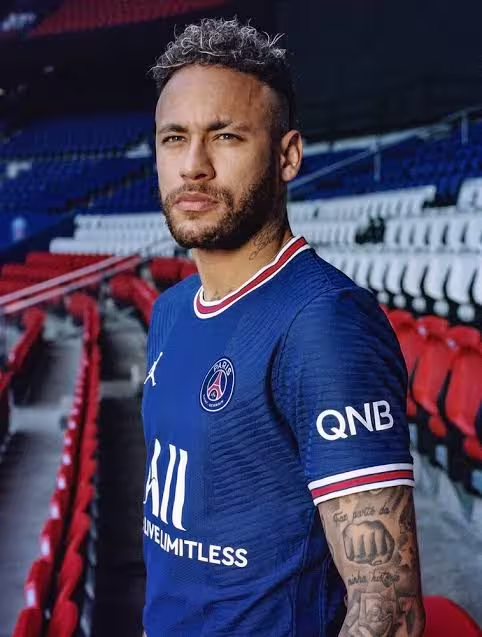
Neymar had scored a stoppage-time penalty—his first goal of the tournament and his ninth in World Cups overall. It was a goal that mattered only to history, not to the result. He had become only the second Brazilian, after Pelé, to score in four different World Cups. But the achievement felt hollow. The trophy he had chased for nearly sixteen years remained out of reach.
“I tried, I tried. Now it’s over,” he told Globo after the game. “I started here; I finished here.”
The image of Neymar in tears, surrounded by teammates trying to console him, will linger long after the statistics fade. Raphinha, Vinicius Junior, and the others embraced him, but the consolation was meaningless. Brazil’s wait for a sixth World Cup title would stretch beyond a quarter of a century. And Neymar’s wait—the wait of a nation that had anointed him as Pelé’s heir—had ended without the crown.
Origins
To understand Neymar, you must understand that he was born in Mogi das Cruzes, São Paulo, on February 5, 1992. His father, Neymar Santos Sr., was a former footballer who became his son’s manager and confidant. From the earliest age, the trajectory was clear: this boy would play football, and he would be great.
He joined Santos FC’s youth academy at 11. The club, where Pelé had made his name, was the perfect stage. Neymar’s talent was undeniable. By 17, he had made his senior debut. By 18, he was being compared to the greatest Brazilian players of all time. He won the Copa do Brasil, the Campeonato Paulista, and the Copa Libertadores. He scored goals that defied belief. The “Next Pelé” label was impossible to escape.
Neymar made his senior debut for Brazil on August 10, 2010, in a friendly against the United States at MetLife Stadium. He scored on that night. Sixteen years later, at the same stadium, he scored his final goal for Brazil. The symmetry was poetic, even if the ending was not.
The European Forge
In 2013, Neymar made the move that would define the next chapter of his career: Barcelona. He joined Lionel Messi and Luis Suárez to form the legendary “MSN” attacking trio. The chemistry was instant. They won the treble in 2014-15—La Liga, the Copa del Rey, and the Champions League—with Neymar scoring in the final.
In 123 appearances for Barcelona, he scored 68 goals. He was a star, but he was also in Messi’s shadow. The world-record transfer to Paris Saint-Germain in 2017, for €222 million, was his attempt to step into the light.
At PSG, he won five Ligue 1 titles. He scored 82 goals in 112 league appearances and led the club to the Champions League final in 2020. But the trophy eluded him. The injuries began to mount. The consistency was gone. The joy of playing—the thing that had always defined him—seemed to fade.
In 2023, he moved to Al Hilal in Saudi Arabia, but the spell was injury-plagued. He played just seven times. The cruciate ligament injury he suffered while playing for Brazil in 2023 kept him on the sidelines for a year. His career appeared to be slipping away.
The Return
In January 2025, Neymar made the decision that surprised the football world: he returned to Santos FC, the club where it all began. The move was framed as a bid to rediscover joy and fitness, with the 2026 World Cup as the ultimate goal.
“You know, Neymar was born again. Football is born again,” Santos teammate Diego Pituca said of his return.
But the reunion was far from smooth. Muscular injuries repeatedly interrupted his season, costing him chances to return to the national team. Then-Brazil coach Dorival Junior recalled him, only for Neymar to withdraw because of discomfort.
When Carlo Ancelotti took charge of Brazil in May 2025, Neymar’s international return remained uncertain. The tension between player and coach was visible. Ancelotti repeatedly left him out of squads, citing concerns about his fitness and intensity.
“Everyone knows my style,” Neymar said after one omission. “I’m available, I’m an athlete, and I still feel good. I don’t need to prove anything to anyone.”
Ancelotti was more cautious: “I’m not going to take a player who lacks intensity for the entire World Cup. Neymar doesn’t need to prove his quality. The issue is physical condition.”
The turning point came when Santos drifted dangerously close to relegation. Neymar delivered: five goals and one assist across four decisive matches, inspiring Santos’ survival push and helping secure qualification for the Copa Sudamericana. He renewed his contract and underwent further treatment on his troublesome knee.
When Brazil unveiled their 26-man World Cup squad, Neymar’s name was included. “We evaluated Neymar throughout the year,” Ancelotti explained. “He played consistently and is in good physical condition. He’s an important player for this World Cup.”
The Anatomy of His Game
Neymar was never just a goal-scorer. He was a creator, a showman, and a symbol of Brazilian joy on the pitch.
In possession, his dribbling was unparalleled. His low centre of gravity, combined with explosive acceleration and impeccable balance, made him one of the most difficult players in history to dispossess. His trademark move—the “Neymar stepover”—was a combination of deception and speed that left defenders helpless. His vision and passing range made him as much a playmaker as a finisher.
Out of possession, Neymar was less impactful. He was not a relentless presser. He conserved energy for the moments when he could change the game. But when he was engaged, his tackling and interception instincts were underrated.
His physical attributes were remarkable. He was not the tallest, but his low centre of gravity made him impossible to knock off balance. His acceleration over five yards was elite. His stamina, though often questioned, was sufficient when he was fully fit.
And yet, his greatest weakness was his durability. Injuries defined his career—a fractured vertebra in 2014, countless hamstring issues, the cruciate ligament tear in 2023. The body that had given so much had taken so much. By 34, Neymar had played through pain that would have ended lesser careers.
The Numbers Game
Despite not winning many silverwares in his career, Neymar has achieved extraordinary individual success. His real achievement, though will be ultimately be defined by what he could not win.
TABLE A: The Data Snapshot (Career Overview)
| Season | Club | League | Apps | Goals | Assists | Minutes Played |
|---|---|---|---|---|---|---|
| 2009-2013 | Santos | Brasileirão | 225 | 136 | — | — |
| 2013-2017 | Barcelona | La Liga | 186 | 105 | — | — |
| 2017-2023 | PSG | Ligue 1 | 173 | 118 | — | — |
| 2023-2025 | Al Hilal | Saudi Pro League | 7 | — | — | — |
| 2025-2026 | Santos | Brasileirão | — | — | — | — |
| 2010-2026 | Brazil | International | 130 | 80 | 59 | — |
TABLE B: Performance Metrics (2026 World Cup)
| Metric | Neymar (2026) | Tournament Average | Percentile Rank |
|---|---|---|---|
| Goals | 1 | — | — |
| Assists | 0 | — | — |
| Pass Completion % | — | — | — |
| Shots per Game | — | — | — |
| Rating | — | — | — |
TABLE C: The Impact Table (Goal Contributions by Competition)
| Competition | Apps | Goals | Assists | Goal Involvements | Avg. Rating |
|---|---|---|---|---|---|
| La Liga (Barcelona) | 123 | 68 | — | — | — |
| Ligue 1 (PSG) | 112 | 82 | — | — | — |
| Champions League | — | 43 | — | — | — |
| International (Excl. World Cup) | — | — | — | — | — |
| World Cup | 15 | 9 | 4 | 13 | — |
| TOTAL | — | — | — | — | — |
TABLE D: Heatmap / Positional Activity
Neymar operates primarily on the left wing or centrally, cutting inside to create and finish chances.
                         ATTACKING THIRD
                   ┌─────────────────────────┐
                   │     LW     ST     RW     │
                   │    [40%]   [30%]   [15%]  │
                   ├─────────────────────────┤
                   │     LCM    CAM    RCM    │
                   │    [10%]   [20%]   [5%]   │
                   ├─────────────────────────┤
                   │     LDM    CDM    RDM    │
                   │    [0%]    [0%]    [0%]   │
                   ├─────────────────────────┤
                   │     LB     CB     RB     │
                   │    [0%]    [0%]    [0%]   │
                   └─────────────────────────┘
                         DEFENSIVE THIRD

              Neymar Jr.'s Average Touch Map
                    (Higher % = More Activity)
TABLE E: Career Milestones
| Year | Achievement | Details |
|---|---|---|
| 2009 | Professional Debut | Made debut for Santos at 17 |
| 2010 | International Debut | Debut for Brazil vs USA |
| 2011 | Puskás Award | Won FIFA Puskás Award for solo goal vs Flamengo |
| 2013 | Confederations Cup | Won with Brazil |
| 2013 | Move to Barcelona | Signed for €57 million |
| 2015 | Champions League Winner | Won UCL with Barcelona |
| 2015 | World Record Transfer | Signed for PSG for €222 million |
| 2016 | Olympic Gold | Won Olympic gold with Brazil |
| 2019 | Copa América | Brazil won without Neymar (injury) |
| 2023 | All-Time Top Scorer | Surpassed Pelé’s 77 goals |
| 2026 | World Cup Record | Scored in 4 different World Cups (Pelé achievement) |
| 2026 | International Retirement | Retired after Norway defeat |
TABLE F: Comparison with Peers
| Player | Goals (Brazil) | Caps | Goals per Game | World Cup Goals | World Cups Won |
|---|---|---|---|---|---|
| Neymar Jr. | 80 | 130 | 0.62 | 9 | 0 |
| Pelé | 77 | 92 | 0.84 | 12 | 3 |
| Ronaldo Nazário | 62 | 98 | 0.63 | 15 | 2 |
| Romário | 55 | 70 | 0.79 | 5 | 1 |
TABLE G: World Cup Record (Tournament-by-Tournament)
| Tournament | Host Nation | Apps | Goals | Assists | Minutes Played | Stage Reached |
|---|---|---|---|---|---|---|
| 2014 | Brazil | 5 | 4 | 0 | — | Semi-Finals (4th) |
| 2018 | Russia | 5 | 2 | 1 | — | Quarter-Finals |
| 2022 | Qatar | 3 | 2 | 1 | — | Quarter-Finals |
| 2026 | USA/Canada/Mexico | 2 | 1 | 0 | — | Round of 16 |
| TOTAL | — | 15 | 9 | 2 | — | — |
TABLE H: World Cup Knockout Stage Performance
| Round | Year | Opponent | Result | Goals | Assists | Rating |
|---|---|---|---|---|---|---|
| Quarter-Final | 2014 | Colombia | W 2-1 | 0 | 0 | — |
| Semi-Final | 2014 | Germany | L 7-1 | 0 | 0 | — |
| Round of 16 | 2018 | Mexico | W 2-0 | 1 | 1 | — |
| Quarter-Final | 2018 | Belgium | L 2-1 | 0 | 1 | — |
| Quarter-Final | 2022 | Croatia | L 4-2 (pens) | 1 | 0 | — |
| Round of 16 | 2026 | Norway | L 2-1 | 1 | 0 | — |
| TOTAL | — | — | 2W-4L | 3 | 2 | — |
What these figures reveal is a player of extraordinary individual achievement—80 goals for Brazil, surpassing Pelé; nine World Cup goals, joining the exclusive four-tournament club; a world-record transfer; and countless moments of individual brilliance. But they also reveal a painful truth: Neymar never won the World Cup, and Brazil’s wait for a sixth title extended beyond a quarter of a century.
The Present Tense
The 2026 World Cup was supposed to be Neymar’s redemption. Instead, it became his final act of heartbreak.
His participation had been uncertain until the final stages of squad selection because of a recurring right calf problem. Ancelotti included him in Brazil’s 26-man squad, hoping his experience would inspire another deep run in the tournament. But Neymar was limited to just two appearances, both as a substitute, against Scotland and Norway.
Brazil’s campaign ended in dramatic fashion. Norway, appearing in the knockout stages with growing confidence, absorbed sustained Brazilian pressure before Haaland broke the deadlock in the 79th minute with a towering header. The Manchester City striker then sealed a famous victory moments later, firing home his second goal to put Norway 2-0 ahead.
Neymar reduced the deficit from the penalty spot deep into stoppage time—his first goal of the tournament—but Brazil were unable to mount a comeback.
After the match, Neymar was inconsolable. “I tried, I tried. Now it’s over,” he told Globo. The announcement of his international retirement followed moments later. He finished his career with 80 goals in 130 appearances for Brazil, the all-time leading scorer.
Beyond the Touchline
Neymar is a man of contradictions. On the pitch, he was flamboyant, theatrical, and often controversial. Off it, he was a devoted father, a philanthropist, and a cultural icon.
His charity work in Brazil was significant. He established the Instituto Neymar Jr., a social project that provides education and sports opportunities for children in Praia Grande, São Paulo. He has donated millions to Brazilian causes. He remains deeply connected to his roots.
The injuries, the constant pressure, the weight of comparison to Pelé—it all took a toll. “I suffered every day I was off the pitch,” Neymar said after his ACL recovery. He played through pain for years. He fought through ridicule and criticism. And in the end, he delivered numbers that will stand the test of time.
“He can no longer play at the level we are used to,” his Al Hilal coach Jorge Jesus said before his return to Santos. The words stung, but they were not entirely wrong. The body that had given so much had reached its limit.
The Verdict from the Camp
Carlo Ancelotti, Brazil head coach:
“I don’t think this is the end. I think this is the start of a new cycle. I think with the squad they have, Brazil could have competed right to the end of this World Cup, even considering what happened in today’s game.”
Neymar Jr., after Brazil’s World Cup exit:
“I tried, I tried. Now it’s over. I started here; I finished here.”
Diego Pituca, Santos teammate:
“You know, Neymar was born again. Football is born again.”
Where Next?
Neymar retired from international football with 80 goals in 130 appearances, Brazil’s all-time leading scorer. He joined Pelé as the only two Brazilian men to score in four different World Cups. He won the 2013 Confederations Cup and Olympic gold at Rio 2016. But the World Cup—the trophy that defined Brazilian football—eluded him.
The comparison with Pelé will always haunt him. Pelé won three World Cups. Neymar never won one. Pelé scored 12 World Cup goals. Neymar scored nine. Pelé was the greatest Brazilian of all time. Neymar, despite the numbers, will always be second best.
He continues his club career with Santos, evaluating his future season by season. But the international chapter is closed. The tears at MetLife Stadium will linger. The “Next Pelé” label will remain unfulfilled.
And yet, Neymar’s significance extends beyond the goals he scored or the trophies he lifted. He emerged from humble beginnings to become one of the world’s most recognizable athletes. As a Brazilian, he challenged perceptions of who could occupy football’s biggest stages. His flair, his joy, his passion—these were the things that made him special. The goals were just the byproduct. The wait for Brazil’s sixth World Cup title will continue. The wait for a new hero will continue. Neymar’s journey is over. But his legacy is eternal.