The Sweden national football team, culturally and universally heralded across the sporting landscape as the Blågult (The Blue and Yellow), represents one of Europe’s most historically successful, structurally disciplined, and physically resilient football programs. Long renowned for an international identity rooted in collective unity, rigorous tactical organization, and uncompromising physical power, Swedish football has consistently punched well above its demographic weight class on the global stage.
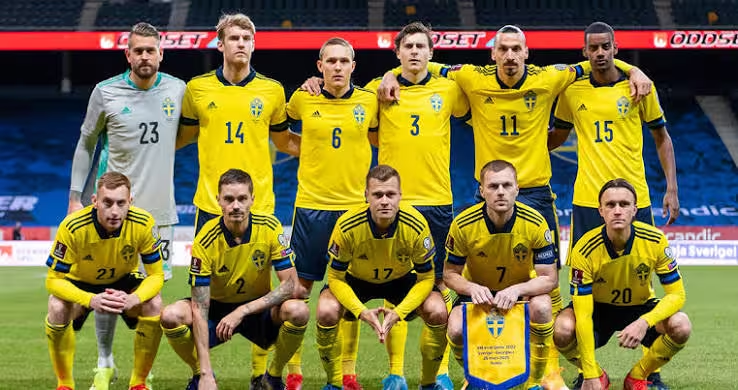
Following a highly focused technical transition away from rigid classical systems, the Blågult enter the modern international landscape as a highly dynamic, attack-minded competitor. Blending an elite wave of explosive, world-class young forwards lighting up Europe’s major domestic leagues with a rebuilt, highly technical midfield structure, Sweden stands as a complex and demanding challenge for global opponents. This comprehensive profile breaks down the structural design of the active senior roster, foundational history, individual records, and up-to-date statistical performance data.
Brief History and Core Continental Achievements
The Swedish Football Association (SvFF) was founded in 1904 and helped co-found FIFA the same year, later joining UEFA in 1954. On their home continent, Sweden has maintained a highly respected competitive pedigree, famously marching to the Semi-finals of UEFA Euro 1992 on home soil and consistently qualifying for the knockout tiers of European football across subsequent decades.
Global Pioneers and the Silver Standard
Sweden’s historical legacy at the FIFA World Cup bridges early global pioneering exploits with modern tournament consistency, amassing 12 total appearances and four top-four finishes. Their crowning milestone on the international stage arrived during the 1958 FIFA World Cup on home soil, where a legendary team featuring Gunnar Nordahl, Nils Liedholm, and Kurt Hamrin marched spectacularly to the Final before earning the Silver Medal against Pelé’s iconic Brazil. They backed up this historic elite status decades later at the 1994 FIFA World Cup in the United States, putting on a high-scoring attacking masterclass to capture a historic Bronze Medal.
Technical Roster Breakdown (2026 Campaign)
The modern Swedish squad operates primarily within a highly fluid, modern 3-4-1-2 or an aggressive, attack-heavy 4-2-3-1 formation. Departing from the defensive low-blocks of the previous decade, the current system places an absolute premium on high-volume progressive passing channels, intense front-line vertical pressing, and isolating world-class central forwards in 1v1 final-third situations.
1. Goalkeepers
The Swedish goalmouth requires exceptional close-range reflex capabilities, highly secure ball handling under heavy physical pressure, and comfortable distribution metrics.
- Robin Olsen (#1): The veteran first-choice starting goalkeeper and long-serving protector of the national team. Olsen brings world-class positioning, extensive top-flight European league experience, and immense vocal organizational leadership.
- Viktor Johansson (#12): A highly agile, modern reflex shot-stopper who provides elite starting-caliber depth and robust shot-stopping metrics.
- Kristoffer Nordfeldt (#23): A vastly experienced, dependable veteran keeper finalizing a highly secure and deeply knowledgeable goalkeeping department.
2. Defenders
The backline balances physically dominant, towering central markers who excel at aerial containment with mobile center-backs built to pass out of heavy pressure.
- Isak Hien (#3): The preferred central defensive anchor. Combining exceptional recovery speed with robust physical tackling power, Hien excels at neutralising elite central forwards in open space.
- Victor Lindelöf (#2): The active captain and structural leader. Lindelöf utilizes world-class tactical anticipation, calm ball-carrying traits, and organizational authority to direct transitions directly out of the back.
- Carl Starfelt (#4) & Filip Helander (#5): Physically robust, heavy-tackling central defensive enforcers deployed to protect the penalty box and handle physical tournament battles.
- Linus Wahlqvist (#6) & Emil Krafth (#16): Highly disciplined, tactically sound right-backs responsible for shutting down wing isolation attempts and executing recovery tracking.
- Gabriel Gudmundsson (#13) & Ludwig Augustinsson (#5): High-stamina wide fullbacks responsible for providing vertical width, tracking lateral channels, and delivering high-volume crosses.
3. Midfielders
The midfield functions as a tireless, technically secure engine room, meticulously balancing deep possession orchestration with intense mid-block pressing traps.
- Dejan Kulusevski (#21): The creative centerpiece and dynamic fluid playmaker. Operating as an advanced attacking midfielder or an inverted wide option, Kulusevski utilizes world-class press-resistance, powerful close-control driving lines, and elite vision to slice open opposition lines.
- Hugo Larsson (#8): The premier young midfield maestro. Larsson provides world-class press-resistance, metronomic passing range, and positional intelligence to comfortably recycle possession out of high-pressure zones.
- Jens Cajuste (#14) & Anton Salétros (#6): Robust, tireless central anchors responsible for executing high-volume tackles, clogging progressive lanes, and protecting the defensive lines.
- Mattias Svanberg (#11) & Yasin Ayari (#18): High-energy box-to-box assets who provide intense physical tracking and execute rapid vertical transitions through the half-spaces.
4. Forwards
The frontline features one of the most explosive, devastatingly clinical attacking duos in modern European international football.
- Viktor Gyökeres (#9): The premier central striker leading the line. Gyökeres offers world-class physical hold-up capabilities, brute upper-body strength, relentless off-the-ball channel running, and a highly clinical scoring record at the absolute highest tiers of European club football.
- Alexander Isak (#11): A world-class superstar forward and global icon. Operating as a fluid inside-forward or a strike partner, Isak utilizes exceptional spatial intelligence, electric close-control dribbling, change-of-pace acceleration, and world-class final-third execution.
- Anthony Elanga (#17) & Gustaf Nilsson (#19): Blistering, exceptionally fast attacking variants utilized to stretch fatigued opposition backlines and inject rapid vertical speed late in matches.
FIFA World Cup Performance Statistics
Sweden’s statistical resume at the FIFA World Cup highlights an international program that stands as a model of historical elite achievement, amassing 12 final tournament runs and four separate podium finishes.
World Cup Tournament History Dashboard
The table below logs Sweden’s absolute performance metrics across their complete historical FIFA World Cup final appearances:
| World Cup Era | Final Tournaments | Overall Record (W-D-L) | Goals (GF-GA) | Final Tournament Milestones / Results |
|---|---|---|---|---|
| 1934–1950 | 3 | 4-1-4 | 26-22 | Third Place (1950), Fourth Place (1938) |
| 1958 | 1 | 4-1-1 | 12-7 | Runners-up (Silver Medal – Highest Mark) |
| 1970–1978 | 3 | 2-4-3 | 7-10 | Highest Finish: Second Group Stage (1974) |
| 1990–1994 | 2 | 5-2-3 | 17-15 | Third Place (Bronze Medal – 1994), 1x Group Exit |
| 2002–2006 | 2 | 2-4-2 | 9-9 | 2x Consecutive Round of 16 Exits |
| 2018 | 1 | 3-0-2 | 6-4 | Quarter-finals Exit (Finished 7th Overall) |
| Historical Totals | 12 Tournaments | 20-12-15 | 77-67 | 1x Silver Medal, 2x Bronze Medals |
Legendary Individual Records and Milestones
The history of the Blågult is built upon pioneering global goalscorers and dedicated international centurions who set the absolute highest standards for Scandinavian sports.
All-Time Cap and Scoring Leaderboards
The tables below document the historical all-time record holders for senior international appearances and goals scored for the Swedish men’s national team:
| Rank | Most Capped Players | Total International Caps | Career Era | Goals Scored |
|---|---|---|---|---|
| 1 | Anders Svensson | 148 | 1999–2013 | 21 |
| 2 | Thomas Ravelli | 143 | 1981–1997 | 0 |
| 3 | Andreas Isaksson | 133 | 2002–2016 | 0 |
| 4 | Kim Källström | 131 | 2001–2016 | 16 |
| 5 | Zlatan Ibrahimović | 122 | 2001–2023 | 62 |
| Rank | All-Time Top Goalscorers | Goals Scored | Matches Played | World Cup Goals |
|---|---|---|---|---|
| 1 | Zlatan Ibrahimović | 62 | 122 | 0 |
| 2 | Sven Rydell | 49 | 43 | 0 (Highest Goal Ratio: 1.14) |
| 3 | Gunnar Nordahl | 43 | 33 | 0 (Olympic Gold Winner) |
| 4 | Henrik Larsson | 37 | 106 | 5 (National World Cup Record) |
| 5 | Gunnar Gren | 32 | 57 | 1 |
Elite Individual Benchmarks
- The Unrivaled Ibrahimović Era: Attacking icon Zlatan Ibrahimović stands entirely alone at the apex of Swedish goalscoring history, netting an extraordinary 62 international goals to sit comfortably as the country’s all-time top scorer.
- The World Cup Marksman: Legendary striker Henrik Larsson holds the absolute national record for the most goals scored at FIFA World Cup finals with 5 goals, hitting clinical strikes across three separate tournaments (1994, 2002, and 2006).
- The Midfield Monolith: Metronomic playmaker Anders Svensson remains the undisputed most-capped player in Swedish history with 148 caps, anchored by a historic international career spanning over a decade of elite competition.
Tactical Identity: High-Intensity Pressing and Central Slicing
The contemporary tactical blueprint of the Blågult operates primarily out of a highly sophisticated, attack-minded 3-4-1-2 structural matrix. The core philosophy centers on immediate territorial unbalancing through central channels. Rather than indulging in prolonged, slow lateral possession build-ups in their own defensive half, Sweden utilizes the digital metronomic distribution of Hugo Larsson to quickly find playmakers in advanced half-spaces.
This movement triggers immediate vertical exploitation lines. Dejan Kulusevski drops deep into pocket zones to pull opposing defensive midfielders out of position, creating massive vertical passing lanes. Deep anchors then immediately fire line-breaking balls directly into the sprinting paths of Viktor Gyökeres and Alexander Isak. Out of possession, Sweden completely avoids passive low blocks, deploying an intense, synchronized front-line press designed to suffocate opposition distribution routes and create quick final-third turnovers.
Conclusion
The Sweden national football team stands as a magnificent testament to systematic long-term planning, elite individual development, and modern tactical maturity. Their highly coordinated, high-speed attacking style highlights an international program masterfully engineered to systematically exploit and break down the defensive frameworks of global football giants. As Dejan Kulusevski orchestrates final-third transitions and the lethal strike partnership of Alexander Isak and Viktor Gyökeres clinicalizes half-chances under intense global expectation, the Blågult possess every structural asset necessary to claim a historic legacy on the international stage.