The Jordan national football team, known culturally and globally as Al-Nashama (The Chivalrous), represents one of the most rapidly ascending, tactically disciplined, and fiercely competitive football programs in modern Asian football. Long operating as a respected regional competitor within West Asia, Jordan has systematically engineered a historic structural modernization to transform its international identity into a perennially feared continental powerhouse.

Following their historic, paradigm-shifting performance at the AFC Asian Cup, Al-Nashama continue to establish themselves as a lethal, elite transitional threat. Combining a physically dominant, highly synchronized core playing across elite Arab and regional domestic club structures with an explosive wave of fast, technically brilliant forwards, Jordan stands as a demanding, rugged challenge for global opponents. This comprehensive profile breaks down the architectural design of the active senior roster, foundational history, individual records, and up-to-date tournament performance metrics.
Brief History and Core Continental Achievements
The Jordan Football Association (JFA) was officially founded in 1949 and admitted to FIFA in 1956, later joining the Asian Football Confederation (AFC) in 1970. For decades, Jordan established a highly competitive baseline within regional tournaments, capturing two Pan Arab Games gold medals (1997 and 1999). However, the 21st century sparked an international revolution that completely altered the trajectory of the sport within the Hashemite Kingdom.
The Historic Miracle of the 2023 Asian Cup
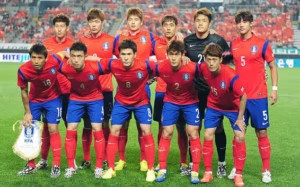
Jordan’s ultimate sporting pinnacle and historical benchmark of footballing excellence arrived during the 2023 AFC Asian Cup (hosted in early 2024). Putting on a breathtaking display of high-speed transitional football and tactical masterclasses under expert technical engineering, Al-Nashama shocked the planet. By orchestrating legendary knockout triumphs over heavyweights—including a stunning 2-0 execution against regional superpower South Korea—Jordan marched spectacularly into their first-ever AFC Asian Cup Final, capturing the Silver Medal and transforming their program into an undisputed continental giant.
Technical Roster Breakdown
Under highly rigid, sophisticated technical direction, the modern Jordanian squad operates primarily within a structurally dense, compact 3-4-2-1 matrix or a fluid, high-pressing 4-3-3 template. The system places an absolute premium on low-block defensive synchronization, heavy spatial compression in the middle third, and lightning-fast vertical wide distribution to unleash explosive inside forwards.
1. Goalkeepers
The Jordanian goalmouth requires exceptional close-range reflex capabilities, highly secure handling under intense aerial set-piece pressure, and commanding box communication.
- Yazeed Abulaila (#1): The undisputed first-choice starting goalkeeper and long-serving protector. Abulaila brings world-class positioning, incredible physical frame command, and an exceptional history of clutch, acrobatic saving masterclasses in major international tournaments.
- Abdallah Al-Fakhouri (#12): A highly talented, agile young shot-stopper who provides elite starting-caliber backup depth and robust domestic league pedigree.
- Ahmad Al-Juaidi (#23): A sharp, high-reflex backup goalkeeper finalizing a highly secure and deeply experienced goalkeeping department.
2. Defenders
The defensive line focuses on rigid positional discipline, absolute aerial dominance inside the six-yard box, and fullbacks built to provide high-stamina recovery tracking.
- Yazan Al-Arab (#5): The central defensive anchor, enforcer, and emotional heartbeat of the backline. Al-Arab provides world-class aerial power, ferocious tackling metrics, and immense physical intensity inside the penalty box.
- Abdallah Nasib (#3) & Salem Al-Ajalin (#2): Highly experienced, physically imposing central defenders who partner Al-Arab to form an impenetrable structural shield, providing an exceptional mixture of physical height and ground pace.
- Ehsan Haddad (#23): The highly disciplined veteran captain and right fullback. Haddad utilizes world-class 1v1 containment traits, immense big-game experience, and elite tracking capabilities to lock down the lateral flank.
- Mohammad Abu Hasheesh (#16) & Feras Shelbaieh (#13): Relentless, high-stamina wide fullbacks responsible for providing technical wide width in transition and executing quick recovery tracking.
- Bara’ Marei (#4) & Saad Al-Rousan (#14): Physically robust defenders deployed to provide structural depth across both three-man and four-man backlines.
3. Midfielders
The midfield functions as a tireless, hard-pressing engine room, meticulously balancing deep possession orchestration with intense mid-block pressing traps.
- Nizar Al-Rashdan (#14) & Noor Al-Rawabdeh (#8): The core starting central midfield axis. Al-Rawabdeh provides a tireless, physical box-to-box engine to disrupt opposition lines, while Al-Rashdan excels at intercepting passing channels and recycling possession out of pressure.
- Raja’i Ayed (#6) & Ibrahim Sadeh (#15): Robust, tireless central anchors deployed to plug central progressive lanes and sustain central pressing densities in the middle third.
- Mahmoud Al-Mardi (#11): A highly versatile, creative wide playmaker. Operating across the midfield axis or advanced wide channels, Al-Mardi utilizes press-resistance, close-control ball retention, and a dangerous long-range shooting threat.
- Saleh Rateb (#10) & Yousef Abu Jalboush (#18): High-IQ progressive midfielders possessing excellent technical ball retention and transition vision out of high-pressure zones.
4. Forwards
The frontline features a devastating combination of world-class explosive transitional speed, direct 1v1 wing isolation dominance, and clinical final-third execution.
- Mousa Al-Tamari (#10): The undisputed superstar icon, global phenomenon, and talismanic leader. Operating at the highest elite European first-division tier, Al-Tamari utilizes world-class explosive acceleration, direct 1v1 touchline dribbling flair, and a lethal inside-cutting left-footed shooting threat to completely unbalance opposition backlines.
- Yazan Al-Naimat (#11): The premier advanced central striker leading the line. Al-Naimat offers an exceptional combination of explosive ground pace, brute upper-body strength, tireless channel running, and highly clinical finishing execution under immense tournament pressure.
- Ali Olwan (#9): A world-class inside-forward. Operating from the wide flanks, Olwan utilizes electric pace, exceptional physical hold-up metrics, and a relentless frontline defensive pressing work rate to stretch opposing systems.
- Anas Al-Awadat (#7) & Hamza Al-Dardour (#20): High-intensity wide forwards deployed to stretch tired defenses, with the iconic veteran Al-Dardour injecting legendary locker-room authority and big-game edge late in matches.
World Cup Tournament History Dashboard
The table below logs Jordan’s absolute independent performance metrics across their qualification history:
| World Cup Era | Final Tournament Appearances | Overall Qualification Record | Milestone Achievements / Results |
|---|---|---|---|
| 1950–1982 | 0 | Did Not Enter | Final Tournament Preliminary Phases |
| 1986–2010 | 0 | Group Preliminary Formats | Advanced to AFC Second and Third Rounds |
| 2014 | 0 | Reached Intercontinental Play-off | Highest Historic Qualification Mark (Lost to Uruguay) |
| 2018–2022 | 0 | Group Elimination Phases | Finished Narrowly Outside Advanced Pools |
| Historical Totals | 0 Finals Appearances | Highly Regular AFC Contender | Highest Continental Mark: 2023 AFC Asian Cup Silver Medal |
All-Time Cap and Scoring Leaderboards
The tables below document the historical all-time record holders for senior international appearances and goals scored for the Jordanian men’s national team:
| Rank | Most Capped Players | Total International Caps | Career Era | Goals Scored |
|---|---|---|---|---|
| 1 | Amer Shafi | 176 | 2002–2020 | 1 |
| 2 | Baha’ Abdel-Rahman | 144 | 2007–2022 | 6 |
| 3 | Amer Deeb | 130 | 2002–2014 | 20 |
| 4 | Hatem Aqel | 111 | 1998–2014 | 9 |
| 5 | Hamza Al-Dardour | 110 | 2011–Present | 35 |
| Rank | All-Time Top Goalscorers | Goals Scored | Matches Played | Career Goal Ratio |
|---|---|---|---|---|
| 1 | Hamza Al-Dardour | 35 | 110 | 0.32 (All-Time National Record) |
| 2 | Abdullah Deeb | 25 | 102 | 0.25 |
| 3 | Badran Al-Shagran | 21 | 48 | 0.44 |
| 4 | Mahmoud Shelbaieh | 21 | 79 | 0.27 |
| 5 | Amer Deeb | 20 | 130 | 0.15 |
Elite Individual Benchmarks
- The Sovereign King of Goals: Veteran forward Hamza Al-Dardour stands entirely unrivaled at the absolute apex of national goalscoring history, amassing an extraordinary 35 international goals to sit comfortably clear as the country’s all-time top scorer.
- The Legend of the Whale: Iconic goalkeeper Amer Shafi stands in an elite tier of global football history, amassing a staggering 176 international caps to sit comfortably as one of the most capped male shot-stoppers of all time, famously scoring a direct goal from his own box against India in 2018.
- The Modern European Standard: Winger Mousa Al-Tamari enters active international cycles as the premier global icon of modern Jordanian sport, representing the baseline for elite technical development within the Hashemite Kingdom.
Tactical Identity: Low-Block Synchronization and Direct Transitions
The contemporary tactical blueprint of Al-Nashama operates primarily out of a highly sophisticated, structurally rigid 3-4-2-1 matrix that seamlessly compresses space out of possession. The cornerstone of the entire system is spatial denial through an impenetrable low-to-mid block shape. Jordan willingly surrenders high-volume ball possession to elite global opponents, choosing to form a highly synchronized defensive shield led by Yazan Al-Arab that completely suffocates central progressive corridors.
Out of possession, Noor Al-Rawabdeh and Nizar Al-Rashdan screen the central defensive zone with clinical discipline, forcing opposition combinations outward toward the lateral touchlines where physical fullbacks execute hard tackles. Once an aggressive turnover is secured, Jordan completely avoids slow possession build-ups inside their own half. Deep anchors immediately trigger direct linear transitions, firing direct vertical balls into advanced channels to utilize the world-class explosive acceleration and direct 1v1 touchline dribbling flair of Mousa Al-Tamari and Yazan Al-Naimat, transforming deep defensive containment into clean final-third goals within a matter of single-digit seconds.
Conclusion
The Jordan national football team stands as a magnificent testament to structural organization, tactical discipline, and immense group ethics. Their highly synchronized, defensive counter-attacking framework highlights an international program masterfully engineered to systematically neutralize and pick apart the progressive systems of global football giants on the grandest stage. As Mousa Al-Tamari injects clinical world-class execution into final-third sequences and Yazan Al-Arab anchors the backline under intense national expectation, Al-Nashama possess every structural parameter necessary to claim a historic legacy.