The Morocco national football team, culturally and globally heralded as the Atlas Lions, represents the absolute vanguard of modern African and Arab footballing excellence. Known for a rich sporting heritage that historically blended exquisite individual skill with tactical discipline, Morocco has systematically transformed into a highly disciplined, defensively impenetrable global superpower.
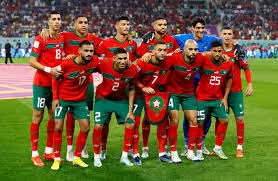
Following a period of unprecedented international success, the Atlas Lions enter the current footballing landscape as a respected giant. Combining an elite core of stars playing at the absolute highest levels of European club football with a meticulous structural defensive model, Morocco stands as a premier tactical obstacle for global opponents. This comprehensive profile breaks down the structural design of the active senior roster, foundational history, individual records, and updated statistical performance data.
Brief History and Core Continental Achievements
The Royal Moroccan Football Federation was founded in 1955 and became an official member of FIFA in 1960. On their home continent, Morocco captured their maiden Africa Cup of Nations (AFCON) title in 1976, establishing an early legacy of competitive excellence within African sports.
The World Cup Pioneers and the 2022 Miracle
Morocco has consistently operated as a primary historical trailblazer for African football on the global stage. At the 1986 FIFA World Cup in West Germany, they shocked the sporting world by becoming the first-ever African and Arab nation to finish top of a World Cup group and advance to the knockout stages.
Thirty-six years later, they rewrote the history books entirely. At the 2022 FIFA World Cup in Qatar, under the visionary leadership of head coach Walid Regragui, the Atlas Lions executed an unforgettable campaign. By dismantling traditional European football powerhouses Belgium, Spain, and Portugal, Morocco became the first African and Arab nation in human history to reach a FIFA World Cup Semi-final, finishing fourth overall and permanently shattering global sports hierarchies.
Technical Roster Breakdown
The modern Moroccan squad operates primarily out of a highly structured, compact 4-1-4-1 or a fluid, transitional 4-3-3 formation. The system places a supreme premium on absolute defensive synchronization, a tireless mid-block press, and explosive vertical wide counters triggered by world-class fullbacks.
1. Goalkeepers
The Moroccan goalmouth is anchored by a world-class, physically imposing shot-stopper who serves as a vital symbol of national tournament resilience.
- Yassine Bounou “Bono” (#1): The undisputed first-choice starting goalkeeper. Bono brings world-class positioning, elite penalty-saving capabilities, and immense mental composure under high-stakes pressure.
- Munir Mohamedi (#12): A vastly experienced veteran shot-stopper providing elite, highly reliable starting-caliber backup depth from the bench.
- Mehdi Benabid (#22): A sharp, agile domestic goalkeeper finalizing a highly secure goalkeeping department.
2. Defenders
The backline balances world-class, attack-minded fullbacks who dictate width with physically dominant central defenders who prioritize strict spatial containment.
- Achraf Hakimi (#2): The active vice-captain and a world-class right-back. Hakimi provides blistering vertical recovery speed, elite 1v1 wide isolation dribbling, and precise crossing metrics.
- Nayef Aguerd (#5): The preferred central defensive anchor, offering exceptional physical height, high-volume clearances, and comfortable left-footed passing distribution out of the backline.
- Romain Saïss (#6): The legendary veteran captain and structural leader, providing immense organizational authority and aerial dominance.
- Noussair Mazraoui (#3): A tactically sophisticated left-back who frequently tucks inside to act as an inverted playmaker during possession phases.
- Abdel Abqar (#4) & Chadi Riad (#15): High-speed, modern young center-backs deployed to provide robust central depth.
- Yahia Attiyat Allah (#25): An energetic, defensive-minded left-back who provides exceptional positional cover.
3. Midfielders
The midfield functions as a relentless, hard-pressing unit engineered to choke out central progressive lanes before releasing immediate wide counters.
- Sofyan Amrabat (#4): The primary defensive shield and tactical engine room. Amrabat excels at aggressively breaking up opposition transitions, covering lateral space, and recycling possession safely.
- Azzedine Ounahi (#8): A highly technical, elegant central midfielder possessing world-class press-resistance, close-control dribbling, and progressive driving lines.
- Bilal El Khannouss (#23): The prodigiously talented young creative playmaker tasked with operating between lines to unlock deep defensive structures.
- Selim Amallah (#15) & Amir Richardson (#18): Robust, high-stamina box-to-box assets who provide physical tracking and sustain central pressing densities.
- Ismael Saibari (#10): A dynamic, physical attacking midfielder who injects sudden vertical power into final-third sequences.
4. Forwards
The frontline provides an aggressive mixture of direct transitional speed, intricate inside-cutting wing movements, and elite clinical finishing execution.
- Hakim Ziyech (#7): The creative centerpiece and talismanic winger. Operating from the right flank, Ziyech utilizes world-class vision, defense-splitting passing arcs, and lethal long-range shooting threat.
- Youssef En-Nesyri (#19): The premier central striker leading the attack. En-Nesyri offers world-class aerial power, an elite defensive pressing work rate, and an iconic history of clutch international goals.
- Amine Adli (#21) & Brahim Díaz (#10): Exceptionally fast, technically gifted inside-forwards who thrive when isolating fullbacks to create shooting angles.
- Soufiane Rahimi (#9) & Ayoub El Kaabi (#20): High-intensity, clinical attacking variants deployed to stretch tired opposition backlines late in matches.
FIFA World Cup Performance Statistics
Morocco's statistical resume at the FIFA World Cup highlights an international program that systematically elevated its trailblazing history into absolute global elite execution.
World Cup Tournament History Dashboard
The table below logs Morocco’s absolute statistical metrics across their complete historical FIFA World Cup final appearances:
| World Cup Edition | Overall Record (W-D-L) | Goals (GF-GA) | Final Tournament Milestone / Result |
|---|---|---|---|
| 1970 | 0-1-2 | 2-6 | Group Stage Exit (World Cup Debut) |
| 1986 | 1-2-1 | 3-2 | Round of 16 (First African Group Winners) |
| 1994–1998 | 1-1-4 | 9-10 | 2x Consecutive Group Stage Exits |
| 2018 | 0-1-2 | 2-4 | Group Stage Exit |
| 2022 | 3-2-2 | 6-5 | Fourth-Place Finish (Semi-finals) |
| Historical Totals | 5-7-11 | 22-27 | Highest Finish by an African/Arab Nation |
Legendary Individual Records and Milestones
The history of the Atlas Lions is written by modern pioneers and dedicated tournament icons who have established the absolute highest standards for African international sports.
All-Time Cap and Scoring Leaderboards
The tables below document the historical all-time record holders for senior international appearances and goals scored for the Moroccan men’s national team:
| Rank | Most Capped Players | Total International Caps | Career Era | Goals Scored |
|---|---|---|---|---|
| 1 | Noureddine Naybet | 115 | 1990–2006 | 4 |
| 2 | Ahmed Faras | 94 | 1965–1979 | 36 |
| 3 | Romain Saïss | 83 | 2012–Present | 3 |
| 4 | Achraf Hakimi | 81 | 2016–Present | 9 |
| 5 | Youssef Chippo | 80 | 1996–2006 | 9 |
| Rank | All-Time Top Goalscorers | Goals Scored | Matches Played | World Cup Goals |
|---|---|---|---|---|
| 1 | Ahmed Faras | 36 | 94 | 0 |
| 2 | Salaheddine Bassir | 27 | 59 | 2 |
| 3 | Youssef En-Nesyri | 23 | 77 | 3 (National Record) |
| 4 | Marouane Chamakh | 18 | 65 | 0 |
| 5 | Abdeljalil Hadda | 17 | 43 | 2 |
Elite Individual Benchmarks
- The World Cup Scoring Peak: Forward Youssef En-Nesyri holds the absolute national record for the most goals scored at FIFA World Cup finals with 3 goals, including his legendary, gravity-defying header against Portugal in the 2022 Quarter-finals.
- The Clean Sheet Benchmarks: During their historic 2022 campaign, goalkeeper Bono became the first African shot-stopper to record three clean sheets at a single World Cup tournament, navigating the group stage and Round of 16 without conceding a goal to an opposition player.
Tactical Identity: The Defensively Rigid Matrix
The contemporary tactical blueprint of the Atlas Lions operates primarily out of a highly structured, ultra-compact 4-1-4-1 matrix under Walid Regragui. The hallmark of the entire system is spatial denial. Morocco willingly surrenders high-volume ball possession to elite opponents, choosing to form a synchronized, impenetrable low-to-mid block that suffocates central passing lanes.
Out of possession, Sofyan Amrabat screens the central space with clinical discipline, forcing opposition sequences outward toward the touchlines. Once a turnover is aggressively secured, Morocco transitions with blistering vertical speed. Achraf Hakimi and Noussair Mazraoui operate as primary transitional triggers, using world-class acceleration to overlap wide channels while Hakim Ziyech delivers line-breaking horizontal balls, transforming deep defensive block containment into surgical final-third execution.
Conclusion
The Morocco national football team stands as a supreme monumental pillar of modern footballing development, blending tactical structural perfection, elite European club pedigree, and immense national pride. Their historic statistics confirm an international program engineered to dismantle traditional sporting hierarchies on the global stage. As Achraf Hakimi orchestrates wide transitions and a disciplined defensive low block neutralizes opposition systems under immense global expectation, the Atlas Lions possess every structural asset necessary to maintain their position among the elite of international football.