The Qatar national football team, culturally and globally known as Al-Annabi (The Maroon), represents one of the most structurally unique and rapidly evolving stories in modern Asian football history. Historically regarded as a minor competitive entity within the Gulf region, Qatar has utilized visionary long-term infrastructural investment and systemic tactical continuity to transform into a major continental force.
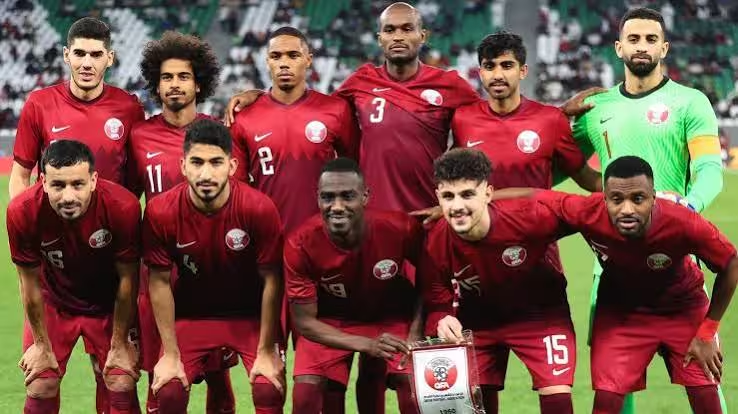
Following a highly successful era marked by back-to-back continental championships, Qatar enters the 2026 FIFA World Cup as an incredibly sophisticated, highly technical international competitor. Combining an unmatched level of internal team chemistry with an explosive, high-speed attacking style, the Maroon stands as a complex tactical challenge for global opponents. This comprehensive profile breaks down the structural design of the active senior roster, foundational history, individual records, and up-to-date statistical performance data.
Brief History and Core Continental Achievements
The Qatar Football Association was founded in 1960 and admitted to FIFA in 1972. For decades, the nation focused on establishing regional consistency within the Gulf Cup, but the launch of the world-renowned Aspire Academy in the early 2000s completely revolutionized the trajectory of the sport within the country.
Back-to-Back Asian Dominance
Qatar’s structural investments yielded historic results during the 2019 AFC Asian Cup in the United Arab Emirates. Putting on a flawless tactical masterclass, the Maroon marched to their maiden continental title, winning all seven matches and famously conceding only one single goal throughout the entire tournament. Proving this historic breakthrough was a permanent asset, Qatar successfully defended their crown on home soil during the 2023 AFC Asian Cup, capturing a historic back-to-back continental double to firmly establish themselves among the absolute elite of Asian football history.
Technical Roster Breakdown (2026 Campaign)
Under highly structured tactical management, the modern Qatari squad operates primarily out of a fluid 3-5-2 or a compact, counter-attacking 5-3-2 formation. The system places a supreme premium on extreme positional telepathy, deep defensive low-blocks, and lightning-fast vertical transitions spearheaded by an iconic strike partnership.
1. Goalkeepers
The Qatari goalmouth requires exceptional aerial control, high-volume reflex saving, and comfortable short-passing distribution to help bypass opposition presses.
- Meshaal Barsham (#22): The undisputed first-choice starting goalkeeper. Barsham brings world-class reflexes, immense composure under heavy tournament pressure, and an iconic reputation for penalty-saving heroics.
- Saad Al-Sheeb (#1): A legendary veteran shot-stopper and long-serving protector of the national team, providing elite starting-caliber depth and leadership from the bench.
- Salah Zakaria (#21): A sharp, highly agile young backup keeper finalizing a secure and deeply experienced goalkeeping department.
2. Defenders
The backline focuses on rigid defensive synchronization, deep spatial containment, and fullbacks capable of covering immense ground to act as primary wide triggers in transition.
- Lucas Mendes (#3) & Boualem Khoukhi (#16): The preferred central defensive axis, offering an exceptional mixture of physical aerial presence, clean tackling metrics, and precise line-breaking passing range out of the back.
- Al-Mahdi Ali Mukhtar (#5): A highly disciplined, tactically sound center-back who completes the preferred three-man defensive shield.
- Pedro Miguel “Ró-Ró” (#2): A robust, physically dominant right-back providing exceptional 1v1 defensive isolation skills and robust recovery tracking.
- Homam Ahmed (#14): An energetic, attack-minded left-back responsible for stretching opposing structures and delivering high-volume crosses.
- Tarek Salman (#15) & Sultan Al-Brake (#12): Tactically flexible wide and central defensive depth options built to enforce strict structural containment.
3. Midfielders
The midfield functions as a tireless, hard-pressing unit engineered to choke out central progressive lanes before rapidly unlocking forward transitions.
- Jassem Gaber (#20): The primary defensive anchor and structural shield. Gaber excels at breaking up opposition counter-attacks and recycling possession efficiently.
- Ahmed Fathy (#6): A robust, aggressive central midfielder responsible for covering extensive lateral space to protect the back three.
- Hassan Al-Haydos (#10): The legendary former captain and timeless playmaker who continues to provide elite technical vision, spatial management, and creative leadership between the lines.
- Abdulaziz Hatem (#11) & Mohammed Waad (#4): Dynamic box-to-box assets who provide intense physical tracking and sustain central pressing densities.
- Mostafa Meshaal (#18): A highly energetic young technical progressive option representing the future of the Qatari midfield core.
4. Forwards
The frontline features one of the most synchronized, devastatingly clinical attacking duos in modern international football.
- Akram Afif (#11): The undisputed superstar playmaker and reigning Asian Footballer of the Year. Operating as a fluid inside-forward, Afif utilizes world-class dribbling flair, masterclass vision, and clinical execution to completely unbalance opposing backlines.
- Almoez Ali (#19): The premier central striker leading the line. Ali offers an elite work rate, exceptional off-the-ball movement, and a historic record for converting half-chances inside the penalty area.
- Yusuf Abdurisag (#7) & Ahmed Alaaeldin (#9): Direct attacking variants deployed to stretch tired defenses and inject rapid vertical speed late in matches.
FIFA World Cup Performance Statistics
The statistical resume of Qatar at the FIFA World Cup bridges their historic hosting debut with their ongoing efforts to establish competitive longevity on the global stage.
World Cup Tournament History Dashboard
The table below logs Qatar’s absolute performance metrics across their historical FIFA World Cup final appearances:
| World Cup Edition | Host Country | Overall Record (W-D-L) | Goals (GF-GA) | Final Tournament Milestone / Result |
|---|---|---|---|---|
| 2022 | Qatar | 0-0-3 | 1-7 | Group Stage Exit (World Cup Debut as Hosts) |
| Historical Totals | 1 Tournament | 0-0-3 | 1-7 | First Historical Goal Scored by Mohammed Muntari |
Legendary Individual Records and Milestones
The history of Qatari football is defined by modern icons who broke institutional boundaries to set elite individual benchmarks for Asian sports.
All-Time Cap and Scoring Leaderboards
The tables below document the historical all-time record holders for senior international appearances and goals scored for the Qatari men’s national team:
| Rank | Most Capped Players | Total International Caps | Career Era | Goals Scored |
|---|---|---|---|---|
| 1 | Hassan Al-Haydos | 185 | 2008–Present | 41 |
| 2 | Abdelkarim Hassan | 133 | 2010–2022 | 15 |
| 3 | Almoez Ali | 116 | 2016–Present | 54 |
| 4 | Boualem Khoukhi | 115 | 2013–Present | 21 |
| 5 | Bilal Mohammed | 114 | 2003–2014 | 7 |
| Rank | All-Time Top Goalscorers | Goals Scored | Matches Played | Career Goal Ratio |
|---|---|---|---|---|
| 1 | Almoez Ali | 54 | 116 | 0.47 |
| 2 | Mansoor Muftah | 42 | 81 | 0.52 |
| 3 | Hassan Al-Haydos | 41 | 185 | 0.22 |
| 4 | Mubarak Mustafa | 41 | 85 | 0.48 |
| 5 | Akram Afif | 38 | 112 | 0.34 |
Elite Individual Records
- The Golden Boot King: Striker Almoez Ali holds an immortal position in continental sports folklore, setting the absolute record for the most goals scored in a single Asian Cup tournament, netting 9 goals in 2019 to shatter previous records.
- The International Appearance Peak: Playmaker Hassan Al-Haydos stands in an elite tier of global football history, amassing an extraordinary 185 international caps to sit comfortably among the most capped male footballers of all time.
- The Asian Cup Final Masterclass: In the 2023 Asian Cup Final, Akram Afif made history by becoming the first player to score a hat-trick of penalties in a major continental final, finishing the tournament as top scorer and MVP.
Tactical Identity: The Surgical Transition Template
The modern tactical blueprint of Al-Annabi operates primarily out of a highly structural 3-5-2 system that seamlessly shifts into a low-block 5-3-2 out of possession. The defining competitive advantage of this team is structural synergy; because the vast majority of the core roster has spent over a decade developing side-by-side inside the Aspire Academy and domestic powerhouse Al-Sadd, their spatial coverage is execution-perfect.
out of possession, Qatar willingly surrenders territory, forming a compact, impenetrable defensive block designed to choke central spaces. Once a turnover is forced, the team completely bypasses slow possession build-ups. Deep pivots immediately fire vertical, line-breaking passes into Akram Afif. Afif utilizes his world-class vision and technical dribbling to hold up play just long enough to slide diagnostic balls through to the sprinting Almoez Ali, transforming deep defensive containment into clean final-third goals within a matter of mere seconds.
Conclusion
The Qatar national football team stands as a powerful testament to structural planning, academy synchronization, and modern tactical discipline. Their historic back-to-back Asian Cup triumphs highlight an international program engineered to execute surgical game plans capable of neutralizing traditional footballing hierarchies. As Almoez Ali continues to extend his legendary scoring benchmarks and Akram Afif orchestrates rapid transitions, the Maroon possesses the tactical identity and technical parameters necessary to carve out a lasting, highly competitive legacy on the international stage.