The Curaçao national football team, culturally and universally heralded across the sporting landscape as the Blue Wave or La Familia Azul, represents one of the most structurally fascinating, rapidly ascending football programs in the CONCACAF region. Following a monumental restructuring of the Curaçao Football Federation at the turn of the century, this Caribbean island territory has transformed its international identity from a regional underdog into a highly dangerous, technically sophisticated competitor.
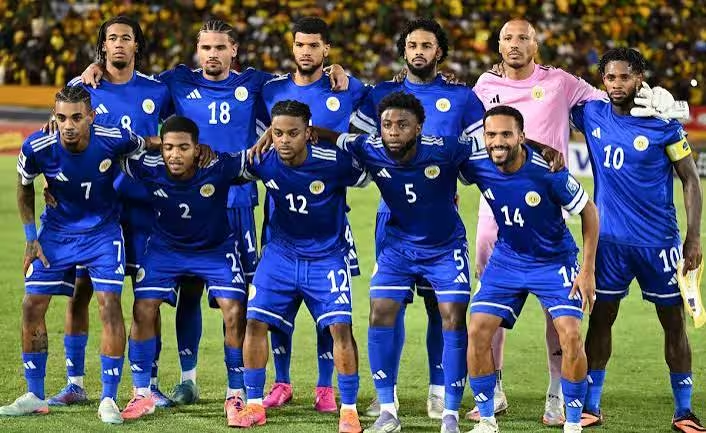
By leveraging its deep dual-citizenship network and structural integration with Dutch footballing institutions, Curaçao stands as a demanding, modern tactical puzzle for global opponents. This comprehensive profile breaks down the structural design of the active senior roster, foundational history, individual records, and up-to-date statistical performance data.
Brief History and Core Continental Achievements
The Curaçao Football Federation was originally founded in 1921 and admitted to FIFA in 1932. Between 1958 and 2010, the island competed under the banner of the Netherlands Antilles national football team, twice securing third-place podium finishes at the CONCACAF Championship.
The Caribbean Peak and Gold Cup Regulars
Following the constitutional dissolution of the Netherlands Antilles in 2010, Curaçao re-entered official FIFA competition under its independent name. The modern era sparked an immediate revolution. Curaçao captured a historic Caribbean Cup title in 2017, defeating Jamaica in the final to seal their status as the kings of the region. This success translated into continuous continental progression, as the Blue Wave qualified for three consecutive CONCACAF Gold Cups, highlighted by a historic march into the Quarter-finals of the 2019 Gold Cup, where they pushed eventual finalists United States to a tight 1-0 competitive limit.
Technical Roster Breakdown (2026 Campaign)
The modern Curaçaoan squad operates primarily within a highly disciplined 4-3-3 or a fluid, possession-oriented 4-2-3-1 formation. Heavily influenced by the classical Dutch school of tactical spacing, the system places an absolute premium on fluid short-passing from deep channels, press-resistant possession recycling, and quick vertical runs from explosive wingers.
1. Goalkeepers
The Curaçaoan goalmouth requires exceptional aerial command, commanding penalty box organization, and elite ball-playing sweeping traits to launch deep build-ups.
- Eloy Room (#1): The legendary veteran captain and long-serving protector of the national team. Room brings world-class close-range reflexes, extensive Major League Soccer and Eredivisie experience, and immense vocal organizational leadership.
- Trevor Doornbusch (#12): A highly agile, modern ball-playing goalkeeper who provides elite starting-caliber depth from the Dutch professional tiers.
- Tyrick Bodak (#23): A sharp, high-reflex young backup goalkeeper finalizing a secure and deeply experienced goalkeeping department.
2. Defenders
The defensive line balances physically dominant central markers with rapid fullbacks who push high up the pitch to support possession overloads.
- Riechedly Bazoer (#4): The central defensive anchor and global icon. Operating at the elite European first-division level, Bazoer provides world-class recovery speed, robust physical tackling power, and midfielder-like distribution metrics out of the backline.
- Cuco Martina (#2): The veteran fullback and iconic leader, providing immense organizational authority, defensive containment, and tactical versatility.
- Jurien Gaari (#3) & Sherel Floranus (#15): Highly aggressive, modern wide fullbacks responsible for providing vertical width, overlapping crossing runs, and quick recovery tracking.
- Justin Ogenia (#5) & Leandro Bacuna (#7): Highly adaptable tactical pieces capable of shifting across full-back and midfield roles to enforce positional containment.
3. Midfielders
The midfield functions as the absolute tactical engine room, meticulously balancing intense possession orchestration with high-intensity pressing triggers.
- Vurnon Anita (#10): The primary deep-lying pivot and midfield anchor. Anita utilizes world-class press-resistance, positional discipline, and metronomic passing lines to comfortably recycle possession out of tight zones.
- Juninho Bacuna (#8): A highly dynamic, powerhouse box-to-box maestro. Bacuna provides a blend of explosive physical driving lines, line-breaking passing vision, and a dangerous long-range shooting threat.
- Gervane Kastaneer (#14) & Godfried Roemeratoe (#6): Robust, tireless central assets deployed to choke out opposition central passing channels and protect the central defenders.
- Rangelo Janga (#9): A towering, physical advanced option who frequently drops deep into midfield pockets to hold up long distributions.
4. Forwards
The frontline provides a devastating mixture of direct transitional speed, intricate inside-cutting wide movements, and clinical penalty box execution.
- Jearl Margaritha (#11): An exceptionally fast, technically brilliant winger. Operating from the flanks, Margaritha thrives when aggressively isolating fullbacks in 1v1 touchline scenarios to cut inside and create shooting angles.
- Kenji Gorré (#7) & Brandley Kuwas (#17): Creative inside-forwards who operate from wide spaces to generate final-third overloads or deliver cross-field distributions.
- Jürgen Locadia (#19): The premier central striker leading the line. Locadia offers elite physical hold-up capabilities, immense box presence, and a proven history of high-volume scoring across Europe’s top divisions.
- Anthony van den Hurk (#20): A physically robust central forward wildcard utilized to wear down opposition center-backs late in matches.
FIFA World Cup Performance Statistics
Curaçao's statistical resume highlights an international program rapidly translating its structural technical modernization into historic preliminary campaigns on the global stage.
World Cup Tournament History Dashboard
The table below logs Curaçao’s absolute performance metrics across their independent history:
| World Cup Era | Final Tournament Appearances | Overall Record (W-D-L) | Goals (GF-GA) | Milestone Achievements / Results |
|---|---|---|---|---|
| 1930–2010 | 0 | 0-0-0 | 0-0 | Competed as Netherlands Antilles |
| 2014–2022 | 0 | 0-0-0 | 0-0 | Reached CONCACAF Third Round Preliminaries |
| 2026 | 0 (Active) | 0-0-0 | 0-0 | Competing in active CONCACAF Qualifying Rounds |
| Historical Totals | 0 Finals Appearances | 0-0-0 | 0-0 | Highest Continental Mark: 2019 Gold Cup QF |
Legendary Individual Records and Milestones
The history of the Blue Wave is written by modern trailblazers who successfully established the absolute highest standards for Curaçaoan international sports.
All-Time Cap and Scoring Leaderboards
The tables below document the historical independent all-time record holders for senior international appearances and goals scored for the Curaçao men’s national team:
| Rank | Most Capped Players | Total International Caps | Career Era | Goals Scored |
|---|---|---|---|---|
| 1 | Cuco Martina | 63 | 2011–Present | 1 |
| 2 | Eloy Room | 58 | 2015–Present | 0 |
| 3 | Leandro Bacuna | 54 | 2016–Present | 14 |
| 4 | Gevaro Nepomuceno | 51 | 2014–Present | 8 |
| 5 | Jurien Gaari | 42 | 2016–Present | 1 |
| Rank | All-Time Top Goalscorers | Goals Scored | Matches Played | Career Goal Ratio |
|---|---|---|---|---|
| 1 | Rangelo Janga | 21 | 40 | 0.52 |
| 2 | Leandro Bacuna | 14 | 54 | 0.26 |
| 3 | Gevaro Nepomuceno | 8 | 51 | 0.16 |
| 4 | Felitciano Zschusschen | 7 | 14 | 0.50 |
| 5 | Gino van Kessel | 7 | 30 | 0.23 |
Elite Individual Benchmarks
- The Unrivaled Cap Leader: Veteran defender Cuco Martina stands as the undisputed most-capped player in independent national history with 63 caps, representing the very bridge into the territory’s modern era of football.
- The Goalscoring Apex: Striker Rangelo Janga occupies an immortal position at the top of the nation’s scoring records, accumulating a world-class 21 international goals to sit comfortably as the most efficient marksman in country history.
Tactical Identity: The Dutch-Infused Spacing Template
The contemporary tactical blueprint of the Blue Wave operates primarily out of a highly structural 4-3-3 matrix. The cornerstone of the entire system is positional control through structured triangles. Curaçao utilizes the technical press-resistance of Vurnon Anita to comfortably recycle possession deep in the defensive third, methodically drawing out opposition presses before releasing vertical transitions.
Out of possession, Curaçao abandons uncoordinated, high-risk high pressing, choosing instead to form a synchronized, compact mid-block shape. Central defensive lines prioritize rigid spatial containment, forcing opposition combinations outward toward the lateral touchlines where fullbacks execute hard tackles. Once possession is secured, the team switches with rapid precision, utilizing the spatial vision of Juninho Bacuna to slice balls out to explosive wide wingers, transforming defensive containment into surgical final-third execution.
Conclusion
The Curaçao national football team stands as a magnificent testament to long-term structural planning, academy synchronization, and modern tactical discipline. Their highly organized, possession-oriented style highlights an international program masterfully engineered to systematically neutralize and exploit the defensive frameworks of regional giants. As Eloy Room coordinates the backline from his box and Rangelo Janga extends modern scoring benchmarks under intense tournament expectation, the Blue Wave possesses every structural asset necessary to carve out a lasting, highly competitive legacy on the international stage.