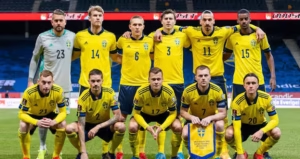
The Bosnia and Herzegovina national football team, known on the global stage as the Zmajevi (The Dragons) or Ljiljani (The Lilies), occupies a highly resonant, emotionally profound position in modern footballing history. Emerging from the geopolitical fragmentation of Yugoslavia in the early 1990s, the nation has methodically forged a reputation for technical sophistication, physical resilience, and producing world-class individual attacking talents.
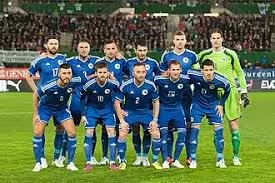
Following a period of generational transition, Bosnia and Herzegovina has entered a phase of structural tactical reconstruction. The Zmajevi rely on an absolute blend of veteran locker-room leadership and an exciting wave of young talent developed inside the top tiers of European club football. This comprehensive profile breaks down the structural design of the active senior roster, foundational history, individual records, and up-to-date statistical performance data.
Brief History and Core International Achievements
The Football Association of Bosnia and Herzegovina was officially admitted to FIFA in 1996 and UEFA in 1998. The national team initially earned a reputation as the ultimate “near-miss” side of European football, narrowly missing out on tournament qualifications in dramatic playoff defeats during the 2010 World Cup and Euro 2012 cycles.
The Historic Breakthrough of 2014
The ultimate crowning achievement of the Zmajevi arrived during the 2014 FIFA World Cup qualification cycle. Led by an unstoppable attacking partnership of Edin Džeko and Vedad Ibišević, Bosnia and Herzegovina topped their qualification group to book a historic ticket to the final tournament in Brazil. On the grandest global stage, they delivered highly competitive displays, recording a memorable victory over Iran. In subsequent years, the nation proved its tactical potential by securing promotion to the elite tier of European football, competing in League A of the UEFA Nations League, which laid the structural blueprint for their modern developmental setups.
Technical Roster Breakdown
The modern Bosnian squad sets up primarily inside a highly structured, defensively sound 3-5-2 or a compact, possession-oriented 4-2-3-1 formation. The system places a major tactical premium on spatial control, structural discipline in a mid-block, and utilizing a towering central target man to bring dynamic wingers and late-arriving midfielders into play.
1. Goalkeepers
The Bosnian goal area relies on extensive physical height, commanding box organization during set-piece phases, and exceptional shot-stopping reflexes.
- Nikola Vasilj (#1): The preferred first-choice starting goalkeeper. Vasilj brings excellent positioning, robust physical presence in the six-yard box, and strong distribution mechanics forged in the German Bundesliga.
- Kenan Pirić (#12): A vastly experienced, highly agile keeper providing premium starting-caliber depth from the bench.
- Osman Hadžikić (#22): A sharp backup shot-stopper finalizing a secure and physically imposing goalkeeping department.
2. Defenders
The defensive line focuses on absolute physical dominance, aerial containment, and utilizing ball-playing center-backs capable of launching vertical transitions.
- Sead Kolašinac (#3): The veteran defensive enforcer. Operating as a left-sided center-back or an overlapping wing-back, Kolašinac brings world-class physical toughness, immense European experience, and robust tracking capabilities.
- Anel Ahmedhodžić (#15) & Dennis Hadžikadunić (#6): The core central defensive axis, offering an exceptional mixture of physical height, high clearance numbers, and comfortable short-passing distribution.
- Nusmir Hajradinović (#2): A tactically intelligent, versatile wide defender responsible for maintaining defensive containment and execution on lateral crosses.
- Jusuf Gazibegović (#4) & Amar Dedić (#5): Highly dynamic, modern young fullbacks who provide electric recovery speed, vertical width in attack, and intense 1v1 defensive isolation traits.
- Nikola Katić (#13) & Nihad Mujakić (#14): Physically dominant, rugged backup defensive pieces built for intense tournament battles.
3. Midfielders
The midfield functions as a hard-pressing, technically secure engine room designed to choke out opposition central passing channels.
- Benjamin Tahirović (#8): The premier young deep-lying playmaker. Tahirović possesses exceptional press-resistance, elite technical vision, and an innate ability to recycle possession safely out of high-pressure zones.
- Rade Krunić (#10): The primary tactical engine. Krunić utilizes superb positional awareness and an intense work rate to intercept opposition transitions and drive vertical box-to-box runs.
- Denis Huseinbašić (#6) & Armin Gigović (#18): Highly energetic, modern central midfielders deployed to provide lateral coverage and sustain pressing densities in the middle third.
- Ivan Bašić (#20) & Dal Varešanović (#17): Creative young progressive outlets tasked with finding pockets of space between opposition lines.
4. Forwards
The frontline balances legendary, world-class scoring experience with blistering vertical speed to exploit space on the counter-attack.
- Edin Džeko (#11): The captain, greatest national icon, and undisputed talisman. Even in the twilight of his historic career, Džeko remains a lethal, world-class target forward, offering unparalleled aerial power, elite hold-up metrics, and clinical finishing inside the box.
- Ermedin Demirović (#9): A highly dynamic, physically robust forward who provides an aggressive frontline press, tireless channel running, and excellent scoring instincts.
- Haris Tabaković (#19): A towering, old-school central target striker utilized to offer absolute physical aerial presence late in games.
- Kenan Kodro (#7) & Said Hamulić (#21): Direct attacking variants chosen to wear down opposition central defenders and run channels.
FIFA World Cup Performance Statistics
The statistical logs of Bosnia and Herzegovina at the FIFA World Cup center on their historic, debut performance in South America, illustrating an international program with a proven pedigree for competing at the highest level.
World Cup Tournament History Dashboard
The table below logs Bosnia and Herzegovina’s absolute performance metrics across their historical FIFA World Cup final appearances:
| World Cup Edition | Host Country | Overall Record (W-D-L) | Goals (GF-GA) | Final Tournament Milestone / Result |
|---|---|---|---|---|
| 2014 | Brazil | 1-0-2 | 4-4 | Group Stage Exit (Finished 3rd in Group F) |
| Historical Totals | 1 Tournament | 1-0-2 | 4-4 | First World Cup Point and Win Secured vs Iran |
Legendary Individual Records and Milestones
The history of Bosnian football is defined by iconic superstars who broke structural barriers to establish the nation as a premier talent factory in European sports.
All-Time Cap and Scoring Leaderboards
The tables below document the historical all-time record holders for senior international appearances and goals scored for the Bosnia and Herzegovina men’s national team:
| Rank | Most Capped Players | Total International Caps | Career Era | Goals Scored |
|---|---|---|---|---|
| 1 | Edin Džeko | 138 | 2007–Present | 67 |
| 2 | Miralem Pjanić | 115 | 2008–2024 | 17 |
| 3 | Emir Spahić | 94 | 2003–2018 | 6 |
| 4 | Zvjezdan Misimović | 84 | 2004–2014 | 25 |
| 5 | Vedad Ibišević | 83 | 2007–2018 | 28 |
| Rank | All-Time Top Goalscorers | Goals Scored | Matches Played | World Cup Goals |
|---|---|---|---|---|
| 1 | Edin Džeko | 67 | 138 | 1 |
| 2 | Vedad Ibišević | 28 | 83 | 1 (First-Ever World Cup Goal) |
| 3 | Zvjezdan Misimović | 25 | 84 | 0 |
| 4 | Elvir Bolić | 22 | 51 | 0 |
| 5 | Sergej Barbarez | 17 | 47 | 0 |
Elite Individual Records
- The Historic First Goal: Forward Vedad Ibišević earned permanent immortality in national sports folklore by scoring Bosnia and Herzegovina’s first-ever FIFA World Cup goal during their opening match against Argentina at the iconic Maracanã Stadium in 2014.
- The Undisputed King of Goals: Captain Edin Džeko stands in an elite, world-class tier of international football history, amassing an extraordinary 67 international goals to sit completely unrivaled at the top of the nation’s appearance and scoring charts.
Tactical Identity: The Positional Control Template
The modern tactical blueprint of the Zmajevi functions primarily within a compact 3-5-2 or 4-2-3-1 structural grid. The cornerstone of the entire system is territorial control inside a highly synchronized mid-block. Rather than engaging in frantic, uncoordinated high presses, Bosnia and Herzegovina seeks to choke central passing lanes via Rade Krunić, forcing opposition sequences outward toward the touchlines.
When transitioning to attack, the team bypasses slow possession build-ups in the defensive third, looking to feed central vertical distributions directly into captain Edin Džeko. Džeko utilizes his elite hold-up play to shield the ball, allowing modern fullbacks like Amar Dedić and Jusuf Gazibegović to make aggressive, high-speed overlapping runs into the final third. This strategic wing overload model, paired with a highly physical aerial presence on offensive set-pieces, turns Bosnia and Herzegovina into an incredibly direct, dangerous threat in the opposition box.
Conclusion
The Bosnia and Herzegovina national football team represents a magnificent blend of historic technical flair, immense physical toughness, and an evolving modern tactical template. Their disciplined structures and elite historical records showcase an international program capable of engineering highly complex, tactical game plans to challenge the established global elite. As Edin Džeko continues to extend his legendary scoring benchmarks and a technical wave of young pivots organize the midfield, the Zmajevi possess the foundation necessary to build a lasting, highly competitive era on the international stage.