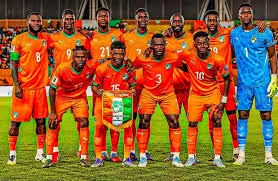
The Senegal national football team, culturally and universally heralded across the sporting landscape as the Lions of Teranga, represents the modern structural locomotive, athletic standard, and premier competitive force within sub-Saharan African football. Operating as an undisputed institutional giant within the Confederation of African Football (CAF), Senegal has built a formidable global reputation centered on tactical organization, immense physical power, and an exceptional tournament pedigree.
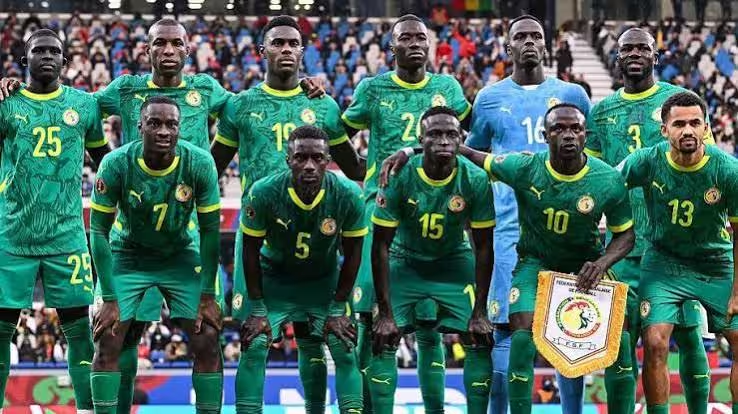
Following a highly successful modern technical reconstruction under centralized engineering, the Lions continue to emerge as an elite continental contender. Combining an experienced, multi-championship European and Middle Eastern club core with an incredibly dynamic, explosive wave of young academy-produced talent, Senegal stands as a complex and highly demanding structural puzzle for global opponents. This comprehensive profile breaks down the architectural design of the active senior roster, foundational history, individual records, and up-to-date statistical performance data.
Brief History and Core Continental Achievements
The Senegalese Football Federation (FSF) was officially founded in 1960 and admitted to FIFA in 1962, later joining CAF in 1964. On their home continent, Senegal’s ultimate crowning historic milestone arrived when they captured the 2021 Africa Cup of Nations (AFCON) title in Cameroon, putting on a structural masterclass to defeat Egypt in a high-stakes penalty shootout. They have also finished as continental runners-up twice (2002 and 2019) alongside winning the African Nations Championship (CHAN) in 2022, establishing a permanent baseline of regional elite status.
Global Trailblazers and World Cup Heroics
Senegal occupies an immortal position in global sports folklore as one of Africa’s most iconic World Cup trailblazers. On their final tournament debut at the 2002 FIFA World Cup in South Korea and Japan, the Lions stunned the international community by defeating reigning world champions France 1-0 in the opening match, before marching dramatically into the Quarter-finals to equal the highest tournament placement ever achieved by an African nation. Across three completed final tournament appearances (2002, 2018, and 2022), they have consistently delivered highly competitive spectacles, highlighted by their modern march into the Round of 16 at the 2022 World Cup in Qatar.
Technical Roster Breakdown for the 2026 World Cup Campaign
The modern Senegalese squad operates primarily within a highly disciplined, compact 4-3-3 or a fluid, transition-minded 3-4-2-1 archetype. The tactical template places an absolute premium on low-block defensive synchronization, heavy spatial compression in the middle third, and lightning-fast vertical distributions out wide to unleash explosive inside forwards.
1. Goalkeepers
The Senegalese goalmouth requires world-class close-range reflex capabilities, highly secure handling under intense aerial pressure, and commanding box communication.
- Édouard Mendy (#1): The preferred first-choice starting goalkeeper and iconic defensive anchor. Mendy brings world-class positioning, exceptional penalty-saving instincts, and a historic pedigree as an elite continental and global champion.
- Seny Dieng (#12): A highly commanding, athletic shot-stopper who provides elite starting-caliber backup depth and robust English league experience.
- Mory Diaw (#23): A sharp, vastly experienced backup goalkeeper finalizing an exceptionally secure goalkeeping department.
2. Defenders
The defensive backline is engineered for absolute physical dominance, strict spatial containment inside the penalty box, and fullbacks built for high-stamina recovery tracking.
- Kalidou Koulibaly (#3): The captain, undisputed defensive general, and emotional heartbeat of the team. Koulibaly utilizes world-class aerial power, immense physical strength, and a decade of elite top-flight experience to direct the entire backline.
- Abdou Diallo (#22) & Formose Mendy (#4): Physically robust central defensive enforcers who form an impenetrable structural shield inside the box alongside Koulibaly, with Diallo providing excellent left-footed balance.
- Ismail Jakobs (#14) & Fodé Ballo-Touré (#12): Highly dynamic, attack-minded left-backs responsible for providing vertical progressive width in transition and executing quick recovery tracking.
- Krépin Diatta (#15): A highly versatile wide option who operates seamlessly as an attack-minded, physically dominant right fullback or wing-back.
- Seydou Sano (#5) & Abdoulaye Seck (#2): Rugged central defensive depth options built for heavy physical contact in international tournament battles.
3. Midfielders
The midfield functions as a tireless, technically secure engine room, meticulously balancing deep possession orchestration with intense mid-block pressing traps.
- Idrissa Gana Gueye (#5): The legendary veteran general. Operating across the midfield axis, Gueye brings world-class press-resistance, high-intensity tracking, and invaluable tournament experience.
- Pape Matar Sarr (#17): The premier young midfield maestro. Sarr provides world-class progressive ball-carrying lines, exceptional line-breaking passing range through the half-spaces, and a dangerous long-range shooting threat.
- Nampalys Mendy (#6) & Pathé Ciss (#11): Robust, tireless central anchors responsible for executing high-volume tackles, clogging central passing channels, and protecting the central defenders out of possession.
- Lamine Camara (#25): The prodigiously gifted rising young star playmaker. Operating between lines, Camara possesses exceptional spatial intelligence, press-resistant ball retention, and visionary passing to unlock deep blocks.
4. Forwards
The frontline provides a devastating combination of world-class explosive transitional speed, direct 1v1 wing isolation dominance, and clinical final-third execution.
- Sadio Mané (#10): The undisputed superstar icon, global phenomenon, and talismanic leader. Operating from the inverted left flank or as a fluid central forward, Mané utilizes world-class acceleration, devastating technical dribbling skills, and clinical final-third execution to completely dismantle opposition backlines.
- Ismaïla Sarr (#18): A world-class wide weapon. Operating from the right flank, Sarr possesses blistering acceleration, devastating 1v1 touchline dribbling skills, and unpredictable transitional flair to stretch opposing systems.
- Nicolas Jackson (#7): The premier central striker leading the line. Jackson offers an exceptional combination of explosive ground pace, brute upper-body strength, tireless channel running, and clinical finishing execution inside the penalty box.
- Habib Diallo (#20) & Iliman Ndiaye (#13): Highly dynamic attacking options chosen to lead the front-line press, provide penalty box target depth, and execute intricate link-play late in matches.
World Cup Performance Statistics
Senegal’s statistical resume highlights an international program that stands as one of Africa’s most consistent and highly regular knockout-stage competitors, amassing three completed tournament appearances.
World Cup Tournament History Dashboard
The table below logs Senegal’s absolute performance metrics across their historical FIFA World Cup final appearances:
| World Cup Edition | Host Country / Nations | Overall Record (W-D-L) | Goals (GF-GA) | Final Tournament Milestone / Result |
|---|---|---|---|---|
| 2002 | South Korea / Japan | 2-2-1 | 7-6 | Quarter-finals Exit (Highest African Placement Mark) |
| 2018 | Russia | 1-1-1 | 4-4 | Group Stage Exit (Eliminated via Unique Fair Play Metric) |
| 2022 | Qatar | 2-0-2 | 5-7 | Round of 16 Exit (Defeated Qatar and Ecuador) |
| Historical Totals | 3 Tournaments Entered | 5-3-4 | 16-17 | 2x Knockout Stage Appearances (QF, R16) |
All-Time Cap and Scoring Leaderboards
The tables below document the historical all-time record holders for senior international appearances and goals scored for the Senegalese men’s national team:
| Rank | Most Capped Players | Total International Caps | Career Era | Goals Scored |
|---|---|---|---|---|
| 1 | Idrissa Gana Gueye | 111 | 2011–Present | 7 |
| 2 | Sadio Mané | 107 | 2012–Present | 43 |
| 3 | Henri Camara | 99 | 1999–2008 | 29 |
| 4 | Kalidou Koulibaly | 83 | 2015–Present | 3 |
| 5 | Roger Mendy | 87 | 1979–1995 | 3 |
| Rank | All-Time Top Goalscorers | Goals Scored | Matches Played | World Cup Goals |
|---|---|---|---|---|
| 1 | Sadio Mané | 43 | 107 | 2 (Joint National Record) |
| 2 | Henri Camara | 29 | 99 | 2 (Scored Iconic 2002 Golden Goal) |
| 3 | El Hadji Diouf | 24 | 70 | 0 |
| 4 | Mamadou Niang | 20 | 54 | 0 |
| 5 | Jules Bocandé | 20 | 73 | 0 |
Elite Individual Benchmarks
- The Sovereign King of Goals: Talismanic forward Sadio Mané stands entirely unrivaled at the absolute apex of national sports history, amassing an extraordinary 43 international goals to sit comfortably as the country’s all-time top goalscorer.
- The Midfield Appearance Peak: Defensively rigid midfield general Idrissa Gana Gueye remains the undisputed most-capped player in Senegalese history with 111 caps, anchoring the central axis over more than a decade of elite competition.
- The Ballon d’Or Standard: Forward Sadio Mané achieved an extraordinary individual record for African sports by finishing as the runner-up for the prestigious Ballon d’oR award in 2022, mirroring his historic continental dominance.
Tactical Identity: Mid-Block Suffocation and Wide Inversion
The contemporary tactical blueprint of the Lions of Teranga operates primarily out of a highly structural, balanced 4-3-3 matrix. The defining cornerstone of the entire system is spatial manipulation through an ultra-compact mid-block. Senegal willingly surrenders high-volume ball possession to elite opponents, choosing to form a highly synchronized defensive shield led by Kalidou Koulibaly that completely suffocates central progressive lanes.
When a tactical turnover is ruthlessly triggered, the Lions transition with terrifying vertical speed. Rather than engaging in slow, risk-heavy ball-handling loops inside their own half, deep pivots immediately fire line-breaking progressive distributions outward into open wide channels. This movement unleashes the world-class explosive acceleration of Sadio Mané and Ismaïla Sarr to aggressively isolate fullbacks in 1v1 situations, transforming deep defensive containment into clean final-third goals within a matter of single-digit seconds.
Conclusion
The Senegal national football team stands as a magnificent testament to systematic long-term planning, academy synchronization, and modern tactical discipline. Their highly organized, high-speed transitional blueprint showcases an international program masterfully engineered to systematically control, pick apart, and neutralize opposition systems on the grandest global stage. As Sadio Mané injects clinical world-class ruthlessness into final-third distributions and Pape Matar Sarr orchestrates midfield tempos from the center circle, the Lions possess every structural parameter necessary to maintain their prestigious standing at the absolute apex of international football.