The Germany national football team, culturally and universally heralded across the sporting landscape as the Nationalelf (The National Eleven) or Die Mannschaft, represents the definitive blueprint of competitive efficiency, tactical structural perfection, and athletic durability in football history. Renowned for an international identity that combines cold-blooded tournament execution with meticulous positional discipline, Germany has permanently occupied the absolute upper tier of the global game across multiple generations.
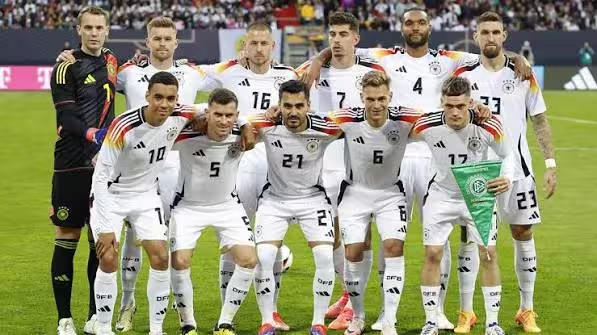
Following a highly successful modern reconstruction under a unified technical regime, the Nationalelf enters the current international landscape as a terrifyingly complete unit. Blending a world-class, multi-championship veteran core with an incredibly dynamic, explosive wave of young playmaker talent based at Europe’s absolute elite domestic clubs, Germany stands as a monumental tactical puzzle for global opponents. This comprehensive profile breaks down the structural design of the active senior roster, foundational history, individual records, and up-to-date tournament performance data.
Brief History and Core Continental Achievements
The German Football Association was founded in 1900 and helped co-found UEFA in 1954. On their home continent, Germany stands as the most consistently successful nation in European history, capturing a record three UEFA European Championships (1972, 1980, and 1996) alongside finishing as continental runners-up three times, establishing an unmatched baseline of regional supremacy.
The Ultimate Tournament Powerhouse
Germany’s statistical resume at the FIFA World Cup is a monument to absolute sporting dominance, holding the record for the most top-four finishes in history and capturing four World Cup titles (1954, 1974, 1990, and 2014). From the “Miracle of Bern” in 1954 to the iconic Franz Beckenbauer-led 1974 squad, the ruthless efficiency of the 1990 team, and the breathtaking 7-1 demolition of Brazil en route to their 2014 triumph, Germany’s legacy is defined by a unique ability to peak exactly when the global spotlight is brightest.
Technical Roster Breakdown (2026 Campaign)
The modern German squad functions inside a highly sophisticated 4-2-3-1 or a possession-oriented, fluid 4-3-3 archetype. The system places an absolute premium on high-volume progressive passing lines through the half-spaces, complete territorial dominance via press-resistant deep pivots, and utilizing fluid inside playmakers to slice open deep blocks.
1. Goalkeepers
The German goalkeeping department remains an elite institution, globally renowned for pioneering modern sweeping capabilities, world-class 1v1 positioning, and accurate distribution metrics.
- Marc-André ter Stegen (#1): The active first-choice starting goalkeeper. Ter Stegen brings world-class, short-range reflex stopping, unparalleled composure under heavy pressure, and midfielder-like passing distribution.
- Alexander Nübel (#12): A highly commanding, athletic shot-stopper who provides elite starting-caliber backup depth from the German Bundesliga.
- Oliver Baumann (#23): A vastly experienced, highly dependable veteran keeper finalizing a highly secure goalkeeping department.
2. Defenders
The backline balances physically dominant, world-class central markers with high-stamina fullbacks who provide tactical width and rapid recovery tracking.
- Antonio Rüdiger (#2): The defensive anchor, vice-captain, and undisputed leader of the backline. Rüdiger provides world-class recovery speed, intimidating physical power, and elite tactical positioning.
- Jonathan Tah (#4) & Nico Schlotterbeck (#15): Physically robust central defenders who partner Rüdiger to form an impenetrable structural shield, with Schlotterbeck providing excellent left-footed ball-carrying attributes.
- Joshua Kimmich (#6): The elite, multi-functional right-back. Operating as a hybrid inverted fullback, Kimmich utilizes world-class tactical IQ, press-resistance, and defense-splitting crossing metrics to dictate transitions from the wide areas.
- David Raum (#3) & Benjamin Henrichs (#16): Highly dynamic, attack-minded fullbacks responsible for providing width and delivering high-volume crosses.
- Waldemar Anton (#5) & Maximilian Mittelstädt (#22): Disciplined, tactically sound defensive depth options built for rugged tournament battles.
3. Midfielders
The midfield is the absolute crown jewel and tactical engine room of the Nationalelf, combining unparalleled spatial awareness with press-resistant ball retention.
- Pascal Groß (#5) & Robert Andrich (#4): The preferred central defensive pivots. Andrich provides the aggressive, hard-tackling structural shield, while Groß operates as the metronomic distributor recycling possession safely out of pressure.
- Florian Wirtz (#17): A world-class superstar advanced playmaker. Wirtz utilizes exceptional spatial intelligence, intricate close-control dribbling, and defense-splitting vision to unlock elite backlines from the half-spaces.
- Jamal Musiala (#10): The creative centerpiece. Blessed with world-class press-resistance, generational 1v1 dribbling inside tight pockets, and lethal final-third execution, Musiala can completely dismantle defensive blocks single-handedly.
- Aleksandar Pavlović (#16) & Angelo Stiller (#8): The highly energetic new wave of technical young pivots deployed to maintain possession tempos.
- İlkay Gündoğan (#21): The veteran maestro who continues to provide elite tactical vision, spatial management, and creative locker-room leadership.
4. Forwards
The frontline provides a highly flexible mixture of direct transitional speed, intense front-line defensive pressing, and dynamic attacking versatility.
- Kai Havertz (#7): The premier hybrid central forward leading the line. Havertz operates as a fluid “nine-and-a-half,” offering elite off-the-ball movement, exceptional aerial link-play, and a knack for scoring clinical tournament goals.
- Niclas Füllkrug (#9): A physically imposing, old-school central target striker chosen for his absolute aerial power, clinical penalty box presence, and world-class strike rate off the bench.
- Leroy Sané (#19) & Maximilian Beier (#14): Blistering, exceptionally fast wide forwards deployed to stretch opposing fullbacks and inject explosive vertical speed into transitions.
- Chris Führich (#11) & Thomas Müller (#13): High-IQ attacking variants utilized to alter forward depths and inject relentless structural intelligence into final-third sequences.
FIFA World Cup Performance Statistics
Germany’s statistical resume at the FIFA World Cup represents the global benchmark for ultimate tournament consistency, amassing the most games played and the most top-four finishes in international sports history.
World Cup Tournament History Dashboard
The table below logs Germany’s absolute statistical metrics across their complete historical FIFA World Cup final appearances:
| World Cup Era | Tournaments | Overall Record (W-D-L) | Goals (GF-GA) | Final Tournament Milestones / Titles |
|---|---|---|---|---|
| 1934–1938 | 2 | 3-1-2 | 14-13 | Third Place (1934) |
| 1954–1974 | 6 | 27-5-5 | 105-55 | 2x World Cup Champions (1954, 1974), 1x Runner-up, 2x Third |
| 1978–1990 | 4 | 15-6-5 | 45-29 | 1x World Cup Champion (1990), 2x Runners-up (1982, 1986) |
| 1994–2014 | 6 | 29-6-6 | 95-40 | 1x World Cup Champion (2014), 1x Runner-up, 2x Third |
| 2018–2022 | 2 | 2-1-3 | 8-9 | 2x Group Stage Exits |
| Historical Totals | 20 Tournaments | 76-19-21 | 232-146 | 4x World Cup Titles (12x Total Podiums) |
Legendary Individual Records and Milestones
The narrative of the Nationalelf is written by pioneering global legends and modern centurions who established the absolute technical standards of international football.
All-Time Cap and Scoring Leaderboards
The tables below document the historical all-time record holders for senior international appearances and goals scored for the German men’s national team:
| Rank | Most Capped Players | Total International Caps | Career Era | Goals Scored |
|---|---|---|---|---|
| 1 | Lothar Matthäus | 150 | 1980–2000 | 23 |
| 2 | Miroslav Klose | 137 | 2001–2014 | 71 |
| 3 | Thomas Müller | 131 | 2010–2024 | 45 |
| 4 | Lukas Podolski | 130 | 2004–2016 | 49 |
| 5 | Manuel Neuer | 124 | 2009–2024 | 0 |
| Rank | All-Time Top Goalscorers | Goals Scored | Matches Played | World Cup Goals |
|---|---|---|---|---|
| 1 | Miroslav Klose | 71 | 137 | 16 (All-Time Global Record) |
| 2 | Gerd Müller | 68 | 62 | 14 (Highest Goal Ratio: 1.10) |
| 3 | Lukas Podolski | 49 | 130 | 5 |
| 4 | Rudi Völler | 47 | 90 | 8 |
| 5 | Jürgen Klinsmann | 47 | 108 | 11 |
Elite Individual Benchmarks
- The Ultimate Global Record: Striker Miroslav Klose holds the absolute, immortal FIFA world record for the most goals scored in World Cup history with 16 goals, netting across four consecutive tournaments (2002 to 2014) to eclipse Brazil’s Ronaldo.
- The Unrivaled Cap Century: Midfield legend Lothar Matthäus stands entirely alone at the apex of German sports history, amassing an extraordinary 150 international caps across five distinct World Cup final campaigns.
- The Gerd Müller Efficiency: “Der Bomber” Gerd Müller holds an untouchable modern scoring efficiency mark, netting a staggering 68 goals in just 62 caps, including the historic tournament winner in the 1974 World Cup Final.
Tactical Identity: The Positional Hegemony Machine
The contemporary tactical blueprint of the Nationalelf operates primarily out of a highly sophisticated, dominant 4-2-3-1 matrix. The core philosophy centers on total territorial suffocation through possession. Rather than engaging in chaotic transitions, Germany utilizes the calculated deep circulation of Pascal Groß to systematically push the opposition’s entire defensive defensive line into their own final third.
This technical compression triggers immediate overload strategies inside the half-spaces. Inverted left-backs or hybrid pivots shift horizontally, creating structural pockets that allow the generational creative genius of Florian Wirtz and Jamal Musiala to operate between opposition lines. Out of possession, Germany implements an intense, highly synchronized counter-press led by Kai Havertz, smothering central progressive escape lanes to instantly regain the ball and launch direct, surgical attacking sequences inside a matter of single-digit seconds.
Conclusion
The Germany national football team stands as a monumental pillar of global sports history, blending unmatched technical heritage, unparalleled tournament efficiency, and modern tactical sophistication. Their legendary statistics confirm an international program masterfully engineered to systematically control, pick apart, and neutralize opposition systems on the grandest global stage. As Jamal Musiala injects unpredictable creative genius into final-third sequences and a physically dominant backline locks down opposition systems under intense global expectation, the Nationalelf possesses every structural asset necessary to sustain their position at the absolute mountaintop of international football.