The Turkey national football team, culturally and universally heralded across the sporting landscape as Bizim Çocuklar (Our Boys) or the Crescent-Stars, represents one of Europe’s most passionate, technically gifted, and structurally unpredictable footballing programs. Operating as a geopolitical and athletic bridge between Europe and Asia, Turkish football is historically celebrated for producing players with immense individual flair, emotional intensity, and a fierce competitive spirit capable of orchestrating historic tournament comebacks.
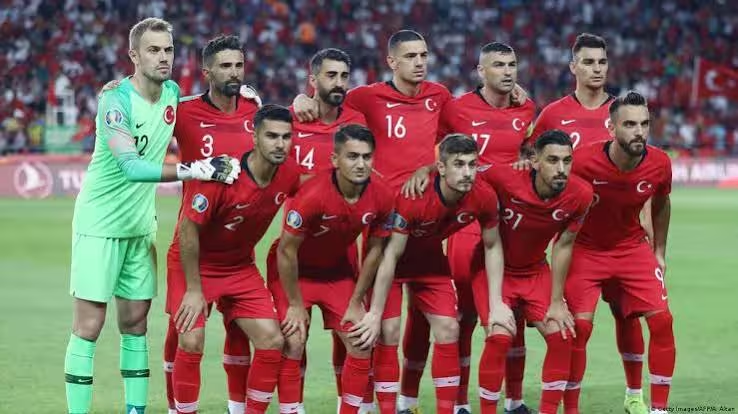
Following a highly competitive qualification cycle under experienced technical management, Turkey enters the 2026 FIFA World Cup as a highly dynamic, dangerous international competitor. Blending a world-class, experienced defensive spine with an incredibly creative wave of young playmaker talent lighting up Europe’s elite domestic clubs, the Crescent-Stars stand as a complex tactical challenge for global opponents. This comprehensive profile breaks down the structural design of the active senior roster, foundational history, individual records, and up-to-date statistical performance data.
Brief History and Core Continental Achievements
The Turkish Football Federation was founded in 1923 and admitted to FIFA the same year, later joining UEFA in 1962. Turkey’s international legacy is defined by brief but incredibly high-impact golden eras where they established themselves among the absolute elite of the global game.
The Historic Dual Bronze Eras
Turkey’s absolute pinnacle on the global stage arrived during the 2002 FIFA World Cup in South Korea and Japan. Led by a legendary generation featuring Hakan Şükür, Hasan Şaş, and Rüştü Reçber, Turkey put on a majestic display of high-tempo football, marching dramatically into the Semi-finals before capturing the Bronze Medal in a thrilling third-place play-off. They proved this elite tournament pedigree was a permanent asset six years later at UEFA Euro 2008 in Austria and Switzerland, executing an extraordinary series of last-minute knockout comebacks to secure another historic third-place finish, cementing their reputation as one of the most resilient tournament teams in modern sports history.
Technical Roster Breakdown (2026 Campaign)
The modern Turkish squad operates primarily within a fluid 4-2-3-1 or a highly technical, possession-oriented 4-3-3 formation. The system places a supreme premium on fluid positional rotations in the half-spaces, deep build-ups through press-resistant defensive pivots, and generating wide overloads to unleash creative inside forwards.
1. Goalkeepers
The Turkish goalmouth requires exceptional close-range reflex capabilities, commanding box organization during corner routines, and comfortable ball-playing distribution metrics.
- Mert Günok (#1): The preferred first-choice starting goalkeeper. Günok brings immense veteran calmness, world-class positioning, and an exceptional history of clutch, acrobatic tournament saves.
- Uğurcan Çakır (#12): A highly physical, authoritative shot-stopper who provides elite starting-caliber depth and locker-room leadership from the bench.
- Altay Bayındır (#23): A sharp, highly agile European-based backup keeper finalizing a secure and deeply experienced goalkeeping department.
2. Defenders
The backline balances physically robust, ball-carrying center-backs who excel at distributing out of heavy pressure with fast fullbacks who provide vertical width.
- Merih Demiral (#3) & Abdülkerim Bardakcı (#14): The preferred starting central defensive partnership, offering optical physical strength, high-volume clearance metrics, and excellent left-right passing symmetry out of the backline.
- Samet Akaydin (#4) & Çağlar Söyüncü (#5): Aggressive, rugged central defensive enforcers deployed to absorb quick counter-attacks and maintain strict spatial containment inside the penalty box.
- Ferdi Kadıoğlu (#20): A world-class, highly versatile wide defender. Operating primarily as an inverted left-back, Kadıoğlu utilizes exceptional press-resistance, close-control dribbling, and midfielder-like vision to dictate transitions.
- Zeki Çelik (#2) & Mert Müldür (#18): Highly disciplined, tactically sound right-backs responsible for shutting down wing isolation attempts and executing recovery tracking.
3. Midfielders
The midfield is the crown jewel and absolute tactical engine room of the Crescent-Stars, combining unparalleled technical IQ with press-resistant ball retention.
- Hakan Çalhanoğlu (#10): The captain, all-time icon, and undisputed heartbeat of the team. Operating as a deep-lying playmaker, Çalhanoğlu utilizes world-class press-resistance, visionary passing range, and legendary dead-ball execution to orchestrate team tempos.
- Ismail Yüksek (#16) & Salih Özcan (#15): Robust, tireless central anchors responsible for executing high-volume tackles, clogging central passing channels, and protecting the central defenders.
- Arda Güler (#8): The prodigiously gifted young superstar playmaker. Operating between lines or as an inverted winger, Güler possesses world-class close-control dribbling, extraordinary vision, and a lethal left-footed shooting threat inside the final third.
- Orkun Kökçü (#6) & Kerem Aktürkoğlu (#7): Dynamic box-to-box assets who provide a blend of technical line-breaking passes and rapid vertical acceleration out wide.
4. Forwards
The frontline provides a highly flexible mixture of direct transitional speed, inside-cutting wide combinations, and intense front-line defensive pressing.
- Kenan Yıldız (#19): An exceptionally fast, technically brilliant inside-forward. Operating from the left flank, Yıldız thrives when aggressively isolating defenders in 1v1 situations and cutting inside to hit powerful strikes.
- Barış Alper Yılmaz (#21): A highly dynamic, physically robust forward whose tireless running lines and versatile physical hold-up capabilities wear down opposition structures.
- Cenk Tosun (#9) & Semih Kılıçsoy (#24): Clinical central forwards chosen to lead the front-line press, provide penalty box presence, and convert crosses.
- İrfan Can Kahveci (#11) & Yusuf Yazıcı (#17): High-IQ attacking variants utilized to alter forward depths and inject unpredictable technical flair late in matches.
FIFA World Cup Performance Statistics
Turkey’s statistical resume at the FIFA World Cup represents one of the most efficient medal-to-appearance ratios in modern football history, capturing a Bronze Medal during their primary modern appearance.
World Cup Tournament History Dashboard
The table below logs Turkey’s absolute performance metrics across their historical FIFA World Cup final appearances:
| World Cup Edition | Overall Record (W-D-L) | Goals (GF-GA) | Final Tournament Milestone / Result |
|---|---|---|---|
| 1954 | 1-0-2 | 10-11 | Group Stage Exit (World Cup Debut) |
| 2002 | 4-1-2 | 13-8 | Third-Place Finish (Bronze Medal) |
| 2026 | 1-1-0 (Active) | 3-1 | Group Stage Performance (Tournament Active) |
| Historical Totals | 6-2-4 | 26-20 | Highest Placement: 3rd Place (2002) |
The Active 2026 World Cup Campaign
Turkey successfully navigated a grueling European qualification cycle to earn their place at the expanded finals in North America. Competing in the active group stage, the Crescent-Stars have displayed typical technical resilience.
- The Group Opener: Turkey kicked off their tournament campaign in clinical fashion, utilizing a majestic long-range strike from Arda Güler to secure a high-stakes 2-1 victory, banking an ideal three points.
- The Second Matchday: In their second group stage fixture, the squad displayed intense tactical discipline, grinding through a highly physical 1-1 draw to keep their knockout qualification targets entirely in their own hands.
Legendary Individual Records and Milestones
The history of Turkish football is built upon pioneering global icons and dedicated tournament veterans who established elite individual benchmarks.
All-Time Cap and Scoring Leaderboards
The tables below document the historical all-time record holders for senior international appearances and goals scored for the Turkish men’s national team:
| Rank | Most Capped Players | Total International Caps | Career Era | Goals Scored |
|---|---|---|---|---|
| 1 | Rüştü Reçber | 120 | 1994–2012 | 0 |
| 2 | Hakan Şükür | 112 | 1992–2007 | 51 |
| 3 | Bülent Korkmaz | 102 | 1990–2005 | 3 |
| 4 | Hakan Çalhanoğlu | 96 | 2013–Present | 20 |
| 5 | Emre Belözoğlu | 101 | 2000–2019 | 9 |
| Rank | All-Time Top Goalscorers | Goals Scored | Matches Played | World Cup Goals |
|---|---|---|---|---|
| 1 | Hakan Şükür | 51 | 112 | 1 (Fastest World Cup Goal) |
| 2 | Burak Yılmaz | 31 | 77 | 0 |
| 3 | Tuncay Şanlı | 22 | 80 | 0 |
| 4 | Lefter Küçükandonyadis | 21 | 46 | 2 |
| 5 | Nihat Kahveci | 19 | 68 | 0 |
Elite Individual Benchmarks
- The World Record Goal: Striker Hakan Şükür holds an immortal, official FIFA world record, scoring the fastest goal in World Cup history by netting just 10.8 seconds into the opening kickoff against South Korea in the 2002 third-place play-off.
- The Cap Century Target: Current captain Hakan Çalhanoğlu enters the 2026 matches rapidly approaching the legendary 100-cap milestone, positioning himself to become only the fifth player in national history to enter the centurion club.
Tactical Identity: Fluid Inversion and Half-Space Overloads
The contemporary tactical blueprint of Bizim Çocuklar operates primarily out of a highly sophisticated 4-2-3-1 structure. The core philosophy centers on spatial manipulation through the central channels. Rather than indulging in static, safe lateral possession, Turkey utilizes the world-class deep orchestration of Hakan Çalhanoğlu to feed line-breaking passes directly into the half-spaces.
This tactical movement triggers immediate inside rotation. Left-back Ferdi Kadıoğlu pushes inside to act as an auxiliary central playmaker, freeing up advanced assets like Arda Güler and Kenan Yıldız to cut inside onto their dominant feet, unbalancing the opposition backline. Out of possession, Turkey utilizes an intense, highly aggressive counter-press, compressing central shapes through central anchors to force quick turnovers and launch direct, surgical final-third sequences.
Conclusion
The Turkey national football team represents a magnificent blend of historic technical brilliance, tactical sophistication, and unyielding team ethics. Their coordinated, fluid attacking style highlights an international program masterfully engineered to systematically exploit and break down the defensive frameworks of global football giants. As Hakan Çalhanoğlu dictates midfield tempos from the center circle and Arda Güler injects unpredictable creative genius into final-third sequences under immense national expectation, the Crescent-Stars possess every structural parameter necessary to claim a historic legacy on the global stage.