The South Korea national football team, officially recognized across the global sporting landscape as the Taegeuk Warriors, represents the undisputed historical power of East Asian football. Renowned for an international identity combining relentless physical endurance, highly disciplined tactical execution, and explosive transitional speed, South Korea has built a legacy of unparalleled consistency within the Asian Football Confederation (AFC).
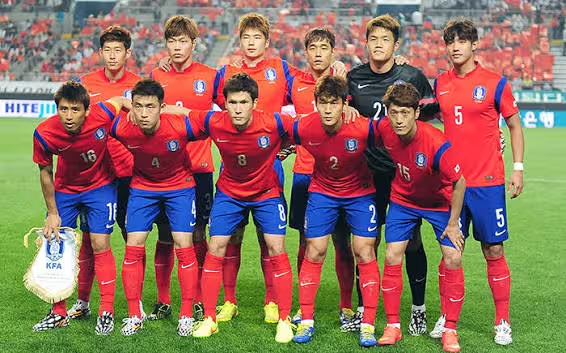
Following a successful qualification cycle, the Taegeuk Warriors have entered the 2026 FIFA World Cup as a highly respected, dangerous competitor capable of matching the tactical structures of the world’s elite. Blending iconic, world-class European superstars with an incredibly technical wave of young playmaker talent, South Korea stands as a formidable challenge for global opponents. This comprehensive review breaks down the structural design of the active 2026 roster, historical milestones, individual records, and up-to-date tournament data.
Brief History and Core Asian Achievements
While the Korea Football Association was founded in 1928, the nation truly established its regional footprint by winning the first two iterations of the AFC Asian Cup in 1956 and 1960. They have also finished as continental runners-up four times, building an institutional legacy that commands immense respect across Asian sports.
The World Cup Pedigree and the 2002 Miracle
South Korea holds the absolute record for the most FIFA World Cup appearances by an Asian nation, qualifying for 11 consecutive editions from 1986 through to 2026. Their crowning historical achievement came on home soil during the 2002 FIFA World Cup, which they co-hosted with Japan. Under the visionary guidance of Guus Hiddink, the Taegeuk Warriors stunned the global football community by defeating traditional powerhouses Italy and Spain to march into the Semi-finals, finishing fourth overall—the highest tournament placement ever achieved by an Asian, North American, or African nation in World Cup history.
Technical Roster Breakdown (2026 Campaign)
The modern South Korean squad utilizes a fluid 4-2-3-1 or 4-3-3 shape. The system relies heavily on a solid defensive block, quick short-passing sequences through the central channels, and explosive vertical runs from inside forwards.
1. Goalkeepers
The South Korean goal area requires exceptional positioning, clean ball handling, and rapid sweeping capabilities out of the penalty box.
- Jo Hyeon-woo (#21): The starting goalkeeper at the 2026 finals. Jo brings world-class reflexes, immense composure, and a legendary history of clutch tournament saves.
- Song Bum-keun (#1): A highly physical, commanding shot-stopper who provides elite backup coverage.
- Hwang In-jae (#12): A sharp, high-reflex backup keeper finalizing the squad’s deep goalkeeping reserves.
2. Defenders
The defensive line balances physical aerial dominance with ball-carrying fullbacks who look to trigger rapid wide distribution.
- Kim Min-jae (#4): The defensive anchor, vice-captain, and undisputed leader of the backline. Operating at the highest European club level, Kim provides world-class recovery speed, robust tackling power, and elite physical dominance.
- Cho Yu-min (#3) & Kwon Kyung-won (#14): Capable, highly disciplined central defenders favored to partner Kim in central defense.
- Seol Young-woo (#22) & Hwang Mun-ki (#2): Dynamic, energetic fullbacks responsible for shutting down wing isolation attempts and executing recovery tracking.
- Lee Myung-jae (#13) & Kim Moon-hwan (#15): Vastly experienced wide defenders providing tactical depth across both lateral flanks.
- Lee Han-beom (#5): A highly talented young central option built for modern structural distribution out of the back.
3. Midfielders
The midfield functions as the tactical engine room, meticulously balancing intense pressing phases with creative, line-breaking passing.
- Hwang In-beom (#6): The primary deep pivot and midfield maestro. Hwang acts as the vital link, dictating possession tempo and executing vertical transitions.
- Park Yong-woo (#5) & Paik Seung-ho (#8): Robust, ball-winning engine rooms who provide relentless lateral coverage to choke opposition passing lines.
- Lee Kang-in (#10): The creative centerpiece. Blessed with world-class press-resistance, vision, and dead-ball delivery, Lee operates between lines to unlock deep defensive structures.
- Lee Jae-sung (#7) & Hong Hyun-seok (#17): Tactically intelligent playmakers tasked with finding space, pressing high, and executing final-third combinations.
- Bae Jun-ho (#16) & Jeong Woo-yeong (#11): Highly energetic, technical young midfielders deployed to sustain attacking intensity.
4. Forwards
The frontline provides a devastating mixture of elite target presence, intricate inside-cutting movements, and world-class clinical finishing.
- Son Heung-min (#7): The captain, all-time icon, and talismanic leader. Son operates from the left flank or as a central forward, utilizing blistering speed, two-footed shooting threat, and world-class final-third execution.
- Hwang Hee-chan (#11): An explosive, physically robust inside-forward who thrives when aggressively isolating fullbacks in wide spaces.
- Oh Se-hun (#9) & Joo Min-kyu (#18): Physically imposing, classic target strikers chosen to lead the front-line press and convert aerial crosses.
- Oh Hyeong-gyu (#19) & Yang Min-hyuk (#20): Fast, direct young forwards utilized to inject unpredictable transitional flair late in matches.
FIFA World Cup Performance Statistics
South Korea’s statistical resume ranks them as the most consistent and regular Asian representative in FIFA World Cup history, amassing 12 total appearances.
World Cup Tournament History Dashboard
The table below logs South Korea’s absolute performance metrics across their completed and active FIFA World Cup final appearances:
| World Cup Edition | Host Country / Nations | Overall Record (W-D-L) | Goals (GF-GA) | Final Tournament Milestone / Result |
|---|---|---|---|---|
| 1954 | Switzerland | 0-0-2 | 0-16 | Group Stage Exit (World Cup Debut) |
| 1986–1998 | Various Countries | 0-4-8 | 11-27 | 4x Consecutive Group Stage Exits |
| 2002 | South Korea / Japan | 3-2-2 | 8-6 | Fourth-Place Finish (Semi-finals) |
| 2006 | Germany | 1-1-1 | 3-4 | Group Stage Exit |
| 2010 | South Africa | 1-1-2 | 6-8 | Round of 16 |
| 2014–2018 | Brazil / Russia | 1-1-4 | 6-9 | Group Stage Exit (Defeated Germany in 2018) |
| 2022 | Qatar | 1-1-2 | 5-8 | Round of 16 |
| 2026 | USA, Canada, Mexico | 1-1-0 (Active) | 2-1 | Group Stage Performance |
| Historical Totals | 12 Tournaments Entered | 8-11-22 | 41-79 | Highest Placement: 4th Place (2002) |
The Active 2026 World Cup Campaign
South Korea dominated their AFC qualification groups, executing a flawless defensive cycle to secure their twelfth ticket to the World Cup finals. Competing in a deeply tactical Group Stage in North America, the Taegeuk Warriors have displayed immense resilience.
- The Group Opener: South Korea kicked off their tournament campaign with a commanding 1-0 victory, grinding down a stubborn opponent to establish an ideal start.
- The Second Matchday: In their second group fixture, South Korea engaged in a highly technical midfield battle, playing out a tense 1-1 draw to keep their progression paths entirely in their own hands.
With 4 points accumulated, South Korea sits in prime position to safely book passage into the expanded Round of 32 knockout stages ahead of their final group encounter.
Legendary Individual Records and Milestones
The history of South Korean football is built upon iconic global superstars and dedicated veterans who established elite individual benchmarks.
All-Time Cap and Scoring Leaderboards
The tables below document the historical all-time record holders for senior international appearances and goals scored for the South Korean men’s national team:
| Rank | Most Capped Players | Total International Caps | Career Era | Goals Scored |
|---|---|---|---|---|
| 1 | Cha Bum-kun | 136 | 1972–1986 | 58 |
| 2 | Hong Myung-bo | 136 | 1990–2002 | 10 |
| 3 | Lee Woon-jae | 133 | 1994–2010 | 0 |
| 4 | Son Heung-min | 132 | 2010–Present | 50 |
| 5 | Lee Young-pyo | 127 | 1999–2011 | 5 |
| Rank | All-Time Top Goalscorers | Goals Scored | Matches Played | World Cup Goals |
|---|---|---|---|---|
| 1 | Cha Bum-kun | 58 | 136 | 0 |
| 2 | Hwang Sun-hong | 50 | 103 | 2 |
| 3 | Son Heung-min | 50 | 132 | 3 (Joint National Record) |
| 4 | Park Lee-chun | 36 | 89 | 0 |
| 5 | Kim Jae-han | 33 | 57 | 0 |
Elite Individual Records
- The World Cup Scoring Record: Captain Son Heung-min, Park Ji-sung, and Ahn Jung-hwan share the national record for the most goals scored at World Cup final tournaments, netting 3 goals each.
- The 50-Goal Milestone: With his recent international exploits, Son Heung-min reached 50 international goals, tying Hwang Sun-hong for second place on the nation’s all-time scoring chart and leaving him just eight goals behind the legendary Cha Bum-kun.
Tactical Identity: The Modern Korean System
The tactical blueprint of the Taegeuk Warriors revolves around a high-tempo, heavy-pressing philosophy operating out of a fluid 4-2-3-1 structure. The foundational system aims to compress the pitch out of possession, using the central anchoring properties of Hwang In-beom and the physical intervention speed of Kim Min-jae to force turnovers in the middle third.
When transitioning to attack, South Korea avoids slow possession sequences, looking to feed the ball wide as quickly as possible. Fullbacks overlap to drag opposing defenders out of position, leaving space for inverted wingers like Lee Kang-in to cut inside and combine with Son Heung-min. This intensive wing overload strategy, combined with the technical vision of their creative midfield core, turns South Korea into a highly direct and dynamic threat in the final third.
Conclusion
The South Korea national football team represents a magnificent blend of historic continental prestige, technical brilliance, and unyielding team ethics. Their disciplined performances at the 2026 World Cup showcase a team engineered to navigate the intense requirements of global tournament football. As Son Heung-min continues to chase legendary goalscoring records under immense national expectation, the Taegeuk Warriors possess all the structural attributes necessary to challenge the world’s best on the global stage.