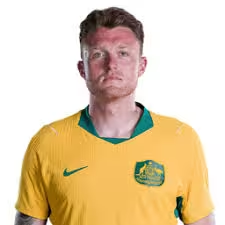
Following an eighth-place finish last season and a summer of unprecedented transformation, Strasbourg enters 2026/27 under new manager Hugo Oliveira with a completely rebuilt squad, record transfer income exceeding €200 million, and the challenge of replacing the goals that powered last season’s European push. This is the definitive guide to the current Le Racing squad.

Technical Leadership & Coaching Profile
Manager: Hugo Oliveira
Oliveira arrives at the Stade de la Meinau after a remarkable period of managerial turnover that saw Liam Rosenior depart for Chelsea in January 2026, Gary O’Neil take over briefly before leaving for Ipswich Town, and the Portuguese coach finally entrusted with the project. The 43-year-old made his name at Famalicão in the Portuguese league, guiding the club to fifth place with a young squad sprinkled with veterans. He inherits one of the youngest squads in Ligue 1, with an average age of just 22.
Tactical Philosophy
Oliveira has been explicit about his footballing principles: “I really like the 4-3-3. The goalkeeper will be capital in our game, he’s truly an eleventh outfield player. He is the first attacker and our attacker is also the first defender.” The Portuguese coach demands dominance: “The objective is to constantly dominate the game. Tactics must allow us to control our emotions. We must recover the ball as quickly as possible. Transitions are the most important phases in modern football.” The early-season evidence suggests the implementation remains a work in progress, with Strasbourg’s 4-0 opening defeat to Marseille exposing the gap between intention and execution.
Preferred Formations
4-3-3 in possession.
Strategic Transfer Activity
Strasbourg’s summer window was one of the most dramatic in Ligue 1 history. The club completed 17 departures and 17 arrivals, generating nearly €200 million in sales while reinvesting almost €100 million. The departures included Emanuel Emegha (Chelsea, €25m), Diego Moreira (AC Milan, €50m — a club-record sale), Julio Enciso and Abdoul Ouattara (Ipswich, €30.5m and €20m), Valentín Barco (Chelsea, €40m), and Guéla Doué (Bayer Leverkusen, €30m).
Table A: Summer Major Transfer Influx
| Player | Position | Former Club | Fee Paid |
|---|---|---|---|
| Karim Coulibaly | Center-Back | Werder Bremen | €20m |
| Jacobo Ortega | Striker | Real Madrid | €10m |
| Diogo Sousa | Central Midfielder | Vitória Guimarães | €10m |
| Jeyland Mitchell | Center-Back | Sturm Graz | €8m |
| Fabio Baldé | Winger | — | €7m |
| Omari Kellyman | Forward | Chelsea | €6m |
| Giovanni Reyna | Attacking Midfielder | Borussia Dortmund | €3m |
| Mateo Del Blanco | Left-Back | Unión Santa Fe | €2.5m |
| Conrad Harder | Striker | RB Leipzig | Loan |
| Filip Jörgensen | Goalkeeper | Chelsea | Loan |
| Genesis Antwi | Right-Back | Chelsea | Loan |
The First-Team Roster
Goalkeepers
Filip Jörgensen (#1): The Danish goalkeeper arrived on loan from Chelsea, continuing the pipeline of Blues goalkeepers at the Meinau following Mike Penders and Đorđe Petrović. At 24, Jörgensen’s distribution is central to Oliveira’s philosophy, though the coach was forced to abandon the build-from-the-back approach during the opening defeat to Marseille.
Miłosz Piekutowski (#12): The Polish goalkeeper arrived from Jagiellonia Białystok as a long-term investment, providing competition and depth.
Karl-Johan Johnsson (#21): The veteran Swedish goalkeeper offers experienced cover, his professionalism valued within the goalkeeping group.
Defenders
Karim Coulibaly (#5): The most expensive signing of Strasbourg’s window, arriving from Werder Bremen for €20 million. The 19-year-old German defender played 27 matches last season to help Bremen stay in the Bundesliga, and his physical profile and composure make him a cornerstone of the rebuild.
Jeyland Mitchell (#4): The Costa Rican international arrived from Sturm Graz for €8 million, bringing athleticism and international experience to the defensive core.
Ismaël Doukouré (#6): The former captain is the only survivor among the old guard, his leadership and experience invaluable within a squad of new arrivals. At 23, he provides a reference point for younger teammates.
Andrew Omobamidele (#24): The Irish defender joined to add depth and physical presence, though he will need to provide greater assurances than he has shown in early appearances.
Lucas Høgsberg (#2): The 20-year-old Danish defender has started the season as a first-team regular, his development continuing under Oliveira’s guidance.
Genesis Antwi (#3): The Swedish right-back arrived on loan from Chelsea, providing attacking thrust and defensive discipline on the right flank.
Mateo Del Blanco (#23): The Argentine left-back arrived from Unión Santa Fe after surpassing 100 senior appearances in his homeland, offering experience despite his youth.
Guéla Doué: The Ivorian right-back departed for Bayer Leverkusen late in the window, a significant loss given his importance last season.
Abakar Sylla: The Ivorian defender departed permanently to Gaziantep after failing to establish himself under successive managers.
Midfielders
Giovanni Reyna (#10): The marquee arrival on a free transfer from Borussia Dortmund, with Strasbourg paying around €3 million. The American international has long been regarded as one of the most talented players of his generation, but injuries and a lack of regular football have hindered his progress. His technical quality and ability to play between the lines could be transformative if he can stay fit.
Diogo Sousa (#8): The 20-year-old Portuguese midfielder arrived from Vitória Guimarães after making 22 Liga Portugal appearances, signing a five-year contract. He has already contributed a goal and an assist in the opening fixtures.
Pape Demba Diop (#19): The Senegalese midfielder returned from his loan spell and has become a fixture in Oliveira’s midfield, his physical presence and work rate providing balance.
Dário Essugo (#15): The Portuguese midfielder arrived on loan from Chelsea on deadline day, adding further depth to the engine room.
Maxi Oyedele (#14): The young midfielder will be looked to accelerate his development as Oliveira seeks to replace the departed Valentín Barco’s ball-carrying and combativeness.
Samir El Mourabet (#17): The Moroccan midfielder was sent off in the opening defeat to Marseille after lashing out at Pierre-Emile Højbjerg, underlining the emotional control Oliveira has identified as a priority.
Gessime Yassine (#7): The Moroccan winger has been one of Strasbourg’s standout performers this season, contributing two goals and one assist. His directness and creativity offer a constant threat from wide areas.
Sebastian Nanasi (#11): The Swedish midfielder has contributed two assists, his technical quality and vision providing creativity in the attacking third.
Samuel Amo-Ameyaw (#26): The English winger has scored two goals, his pace and directness offering an outlet in transition.
Forwards
Joaquín Panichelli (#9): The Argentine forward’s return from injury could be the most important development of Strasbourg’s season. Panichelli scored 16 Ligue 1 goals in just 27 appearances last season, finishing second in the division’s scoring charts, before an ACL injury in March cut his campaign short. He is not expected back until around the turn of the year, and his eventual return could have a huge bearing on Strasbourg’s season.
Conrad Harder (#40): The Danish striker arrived on loan from RB Leipzig on deadline day, without any buy option. With Panichelli sidelined and Emegha departed, Harder’s arrival addresses the lack of depth in the forward position.
Jacobo Ortega (#33): The Spanish striker joined from Real Madrid’s academy and has started the season as a first-team option, contributing one goal and one assist. At just 20, he represents a long-term investment.
Sékou Mara (#25): The French forward started the club’s opener despite being heavily linked with an exit, his physical presence and finishing instincts offering a different profile.
Omari Kellyman (#20): The English forward arrived from Chelsea for a reported €6 million after scoring 11 goals in 36 matches on loan at Cardiff City in League One. The 20-year-old has signed a five-year deal, with Chelsea retaining a buyback clause.
Deivid Washington (#22): The Brazilian forward arrived on loan from Chelsea late in the window, adding further attacking depth.
Leadership Group & Squad Regulations
Club Captain: Ismaël Doukouré
The French defender remains the club captain, the only survivor among the old guard following the summer exodus. His experience within a squad of new arrivals is invaluable, though he must adapt to a leadership role that carries greater weight than ever before.
The Leadership Committee
Giovanni Reyna and Filip Jörgensen serve as the senior voices alongside Doukouré, their combined experience of elite European football offering valuable perspective. Reyna’s journey from Borussia Dortmund prodigy to Strasbourg’s creative hub represents the kind of career revival Oliveira hopes to replicate across the squad.
Homegrown Quota Check
With Samir El Mourabet, Gessime Yassine, and several academy graduates in the first-team squad, Strasbourg maintains a connection to their youth pipeline. The club’s recruitment strategy prioritises young talent with high sell-on potential, a model that has generated record income but also necessitated constant squad reconstruction.
Financial & Contractual Health
Financial Balance Overview
Strasbourg’s summer business was defined by the BlueCo model: generate significant transfer income by developing young talent and selling at a premium, then reinvest in the next generation. The €200 million in sales, including the club-record €50 million departure of Diego Moreira to AC Milan, represents the clearest validation of this strategy yet. The €100 million reinvestment, headlined by Coulibaly’s €20 million arrival, maintains the cycle.
Contract Red Alerts
Securing the permanent signatures of key loan performers, particularly Conrad Harder and Filip Jörgensen, will be a priority if the season progresses well. Chelsea’s buyback clauses on Kellyman and other Blues loanees provide a potential complication, as does the constant risk of Premier League interest in Strasbourg’s most promising assets.
The Academy Pipeline & Loan Tracker
Breakout Talents to Watch
Gessime Yassine (#7) has already established himself as a first-team contributor, his two goals and one assist underlining his potential. Diogo Sousa (#8) has adapted quickly to Ligue 1 following his arrival from Portugal, contributing a goal and an assist in his opening appearances.
Notable Out on Loan
Strasbourg’s loan strategy is heavily intertwined with Chelsea, with the club serving as a development platform for Blues loanees. The pipeline runs both ways, with Strasbourg also sending players to Chelsea when the London club identifies talent worth acquiring.
Set-Piece Specialists & FPL Cheat Sheet
Penalties: Sebastian Nanasi (First Choice) / Gessime Yassine (Second Choice).
Direct Free-Kicks: Giovanni Reyna / Sebastian Nanasi.
Corners & Crosses: Sebastian Nanasi / Mateo Del Blanco.
Final Outlook: Navigating the Tactical Horizon
Strasbourg enters 2026/27 as one of the most fascinating experiments in European football: a club operating as a development platform within a multi-club ownership model, generating record income through player trading while attempting to remain competitive in Ligue 1. The departure of four key players — Emegha, Enciso, Barco, and Moreira — has removed the creative and goalscoring core that powered last season’s eighth-place finish.
The early-season evidence is mixed. Strasbourg have taken seven points from their opening four matches, sitting sixth in Ligue 1, but the 4-0 defeat to Marseille exposed the gap between Oliveira’s possession-based philosophy and the squad’s current capacity to execute it. The coach’s admission that he abandoned the build-from-the-back approach during that game — instructing Jörgensen to kick long — was a telling moment.
The attacking burden falls heavily on players still finding their feet. Panichelli’s absence until the turn of the year means Strasbourg lack a proven goalscorer, with Ortega, Harder, and Mara competing for the central role. Reyna’s creativity offers hope, but his injury record remains a concern.
The challenges ahead are substantial. The squad’s youth and inexperience will be tested across a demanding campaign, and the constant threat of further departures to Chelsea or elsewhere looms over every strong performance. But the model has already delivered record income and a platform for young talent to develop. If Oliveira can instil his principles, if Reyna can rediscover his best form, and if Panichelli returns to provide the goalscoring spark, Strasbourg possess the ingredients for another top-half finish. The margin is thin, but the ambition remains.