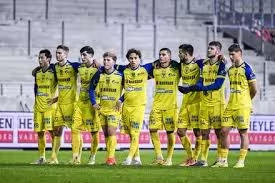
Following a historic campaign that saw Union Saint-Gilloise claim a second Belgian Pro League title in four years and reach the Europa League knockout stages, the Brussels club enters 2026/27 with a squad rebuilt around high-potential young talent, a new head coach in Sébastien Pocognoli, and the challenge of defending their crown while competing in the Champions League for the first time in the club’s modern history. This is the definitive guide to the current Union squad.
Technical Leadership & Coaching Profile
Manager: Sébastien Pocognoli
Pocognoli was appointed in June 2026, succeeding David Hubert who departed after delivering the league title. The 38-year-old Belgian coach arrives from KRC Genk, where he impressed with his tactical acumen and ability to develop young players. A former defender who represented Belgium at international level, Pocognoli brings a modern, analytical approach that aligns with Union’s established model of data-driven recruitment and player development. His mandate is clear: maintain the club’s competitive trajectory while navigating the demands of Champions League football for the first time.
Tactical Philosophy
Pocognoli has retained the 3-5-2 system that became Union’s trademark under successive managers, prioritising defensive solidity, wing-back overloads, and quick vertical transitions. The system relies on a disciplined back three, energetic wing-backs who provide width in both phases, and a midfield trio that combines technical quality with physical intensity. The attacking partnership of Franjo Ivanović and Promise David provides a focal point, with the wing-backs and midfielders encouraged to join attacks in numbers. Set-pieces remain a significant weapon, with Union consistently ranking among Belgium’s most dangerous teams from dead-ball situations.
Preferred Formations
3-5-2 / 3-4-3 in possession.
Strategic Transfer Activity
Union’s summer window was defined by the club’s established model: sell high-value assets, reinvest in younger talent with resale potential, and maintain competitive balance. The departures of Kevin Mac Allister to Besiktas and Koki Machida to Hoffenheim generated significant funds, while the arrivals focused on youth and versatility. The club also promoted several academy graduates to the first-team squad, reflecting the continued investment in internal development.
Table A: Summer Major Transfer Influx
| Player | Position | Former Club | Fee Paid |
|---|---|---|---|
| Anouar Ait El Hadj | Attacking Midfielder | Genk | €4m |
| Mohammed Fuseini | Forward | Sturm Graz | €3.5m |
| Kamiel Van de Perre | Central Midfielder | — | Undisclosed |
| Mamadou Traoré | Centre-Back | — | Undisclosed |
| Hélio Varela | Winger | — | Undisclosed |
| Ousseynou Niang | Winger | — | Undisclosed |
The First-Team Roster
Goalkeepers
Anthony Moris (#49): The veteran Luxembourg international remains Union’s undisputed number one, his shot-stopping and command of the penalty area providing a foundation of experience behind the back three. At 36, Moris’s leadership within the dressing room is invaluable, and his distribution quality suits Pocognoli’s build-from-the-back approach.
Kjell Peersman (#12): The young Belgian goalkeeper continues his development as backup, gaining valuable exposure to first-team standards. His potential suggests a long-term successor to Moris.
Vic Chambaere (#31): The 23-year-old provides additional depth in the goalkeeping department.
Defenders
Christian Burgess (#16): The English centre-back remains the anchor of Union’s defensive line, his physical presence and aerial dominance central to the back three’s effectiveness. At 34, Burgess’s experience and leadership provide essential stability within a youthful squad.
Kevin Mac Allister (#5): The Argentine defender’s departure to Besiktas removed a key figure from the defensive core, leaving a void that Pocognoli must fill through internal promotion and tactical adjustment.
Ross Sykes (#26): The English centre-back provides physical presence and front-foot defending, his partnership with Burgess forming the foundation of Union’s defensive structure.
Koki Machida (#44): The Japanese defender’s departure to Hoffenheim ended a productive spell at the club, his composure on the ball and versatility across the backline leaving a significant void.
Fedde Leysen (#3): The young Belgian defender has established himself as a first-team regular, his development accelerating under Pocognoli’s guidance. At 23, his left-footed passing and reading of the game make him a valuable asset.
Mamadou Traoré (#4): The summer arrival adds physical presence and aerial ability to the defensive rotation, his development continuing within the first-team environment.
Anan Khalaili (#27): The Israeli wing-back provides energy and attacking thrust on the right flank, his overlapping runs offering width in Pocognoli’s system.
Guilherme Smith (#2): The Portuguese wing-back offers pace and directness on the left flank, his crossing ability providing service for the attacking line.
Midfielders
Charles Vanhoutte (#24): The Belgian midfielder remains a key figure in Union’s engine room, his tactical intelligence and ball-winning ability providing the platform for the attacking talents ahead of him. At 28, Vanhoutte’s experience and leadership are invaluable within the squad.
Kamiel Van de Perre (#6): The young Belgian midfielder has established himself as a first-team regular, his energy and progressive passing making him a dynamic presence in the midfield trio. His development reflects Union’s commitment to internal pathways.
Anouar Ait El Hadj (#10): The marquee summer signing from Genk brings creativity and technical quality to the attacking midfield role. At 24, Ait El Hadj’s ability to unlock defences and deliver in decisive moments makes him a crucial addition to Pocognoli’s structure.
Mathias Rasmussen (#8): The Danish midfielder provides tactical discipline and versatility across midfield roles, his experience adding stability to the engine room.
Noah Sadiki (#7): The young Belgian midfielder continues his development within the first-team squad, his physical profile and technical quality offering long-term potential.
Lazare Amani (#17): The Ivorian midfielder provides additional depth in central areas, his energy and work rate making him a reliable rotation option.
Forwards
Franjo Ivanović (#9): The Croatian striker remains Union’s primary attacking focal point, his movement and finishing instincts making him a genuine goalscoring threat. His partnership with Promise David forms the attacking axis of Pocognoli’s system.
Promise David (#29): The Canadian-Nigerian striker provides physical presence and aerial dominance, his hold-up play creating space for Ivanović and the attacking midfielders. His goalscoring record since arriving in Belgium has been impressive.
Mohammed Fuseini (#11): The summer arrival from Sturm Graz adds pace and directness to the attacking line, his development continuing within the first-team environment.
Hélio Varela (#22): The Portuguese winger offers creativity and unpredictability from wide areas, his dribbling ability providing a different dimension to the attacking options.
Ousseynou Niang (#21): The Senegalese winger provides additional depth in the attacking line, his pace and directness offering a constant threat in transition.
Dennis Eckert (#19): The German forward provides depth and competition in the attacking positions, his experience adding a different profile to the forward line.
Leadership Group & Squad Regulations
Club Captain: Anthony Moris
The veteran goalkeeper wears the armband and embodies the standards Pocognoli demands. His experience of Union’s rise from the second division to Belgian champions provides essential perspective for a squad integrating numerous new arrivals.
The Leadership Committee
Christian Burgess and Charles Vanhoutte serve as senior voices alongside Moris, their combined experience anchoring a dressing room that blends emerging talent with established professionals.
Homegrown Quota Check
With Kamiel Van de Perre, Fedde Leysen, and several academy graduates in the first-team squad, Union maintains a strong connection to their youth pipeline. The club’s investment in internal development remains a cornerstone of its identity.
Financial & Contractual Health
Financial Balance Overview
Union’s summer business continued the club’s established model of generating significant income through player sales while reinvesting in younger talent. The departures of Mac Allister and Machida generated substantial funds, allowing the club to invest in Ait El Hadj and Fuseini while maintaining financial sustainability.
Contract Red Alerts
Securing the long-term futures of key young assets like Fedde Leysen and Kamiel Van de Perre will be a priority. The club’s ability to retain its most promising players — or command premium fees for their departure — remains central to its financial strategy.
The Academy Pipeline & Loan Tracker
Breakout Talents to Watch
Kamiel Van de Perre has established himself as a first-team regular, his development reflecting the academy’s productivity. Fedde Leysen has emerged as a key defensive figure, while several academy graduates continue to push for first-team opportunities.
Notable Out on Loan
Union’s loan strategy has seen several young players depart for regular minutes elsewhere, with the club’s focus remaining on developing internal talent for the first-team pathway.
Set-Piece Specialists & FPL Cheat Sheet
Penalties: Franjo Ivanović (First Choice) / Promise David (Second Choice).
Direct Free-Kicks: Anouar Ait El Hadj / Mathias Rasmussen.
Corners & Crosses: Anouar Ait El Hadj / Guilherme Smith.
Final Outlook: Navigating the Tactical Horizon
Union Saint-Gilloise enters 2026/27 as Belgian champions and Champions League participants for the first time in the club’s modern history, a remarkable achievement for a club that has risen from the second division to the summit of Belgian football in less than a decade.
The early-season evidence reflects the challenges of balancing domestic dominance with continental ambition. The squad possesses genuine quality in key positions: Moris’s experience in goal, Burgess’s leadership in defence, Vanhoutte’s control in midfield, and the attacking partnership of Ivanović and David. The arrival of Ait El Hadj adds a creative dimension that could prove decisive in unlocking deep defences.
The challenges ahead are substantial. The Champions League’s demands will test squad depth, and the departure of key defensive figures in Mac Allister and Machida has left gaps that Pocognoli must address. The fixture list becomes increasingly congested as autumn progresses, and the margin for error in the Belgian Pro League is thin.
But the ingredients for a successful campaign are present: a tactically astute coach in Pocognoli, a squad blending experience with emerging talent, and a club culture that has consistently defied expectations. The Union faithful, who have witnessed their club’s extraordinary rise, are now dreaming of European nights at the Stade Joseph Marien. If Union can maintain their domestic momentum and navigate the unique challenges of Champions League football, this could be the season that establishes them as a genuine force in European football. The foundation is secure, the ambition remains, and the path forward is clear.