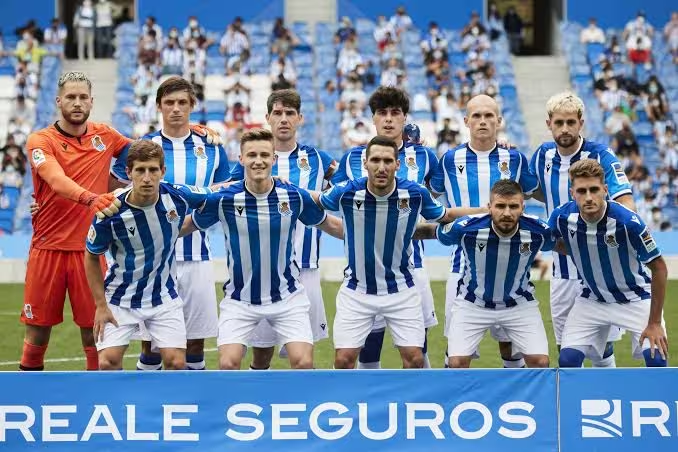
Real Sociedad enter the 2026/27 campaign as Copa del Rey champions, a remarkable achievement considering Pellegrino Matarazzo inherited a team languishing in the relegation zone when he took over in January. The Italian-American coach transformed the club’s fortunes, guiding them to a historic cup triumph over Atlético Madrid in La Cartuja. Yet the season ended with concerning league form—no wins in the final stretch—and a 10th-place finish that exposed the fragility beneath the silverware. The summer has been one of restraint rather than revolution. Only two signings arrived: defender Mamadou Sarr and versatile full-back Héctor Fort, both aimed at addressing the defensive vulnerabilities that saw La Real concede 62 goals last season, the worst record in the division. Brais Méndez departed after four years, while the futures of Álex Remiro and Take Kubo remain unresolved. This is the definitive guide to the current Real Sociedad squad.
Technical Leadership & Coaching Profile
Manager: Pellegrino Matarazzo
Tactical Philosophy: Matarazzo’s football bears the stamp of his German-school education: direct, vertical, and relentless in transition. La Real under his guidance press high to disrupt opposition build-up, then attack with speed and purpose once possession is recovered, prioritising penetration through wide areas and shots from distance. The system demands intensity in the counter-press and intelligent movement in the final third. Defensive solidity, however, remains the glaring weakness—the team’s inability to stop conceding undermined their league campaign and leaves Matarazzo’s project still “under construction.”
Preferred Formations: Matarazzo alternates between a 4-2-3-1 and a 4-4-2 hybrid, with the capacity to shift to a 5-3-2 depending on game state. Pre-season experiments included three-at-the-back systems, suggesting tactical flexibility will be a theme.
Strategic Transfer Activity
Real Sociedad were the last club in La Liga to make a signing, a patience that reflected sporting director Erik Bretos’ conviction that “the solid base of this team is already in place.” When business finally arrived, it was defensive: Mamadou Sarr and Héctor Fort, both recruited specifically to address the division’s worst defensive record. The squad was bloated with 27 contracted players, necessitating departures before registrations could be completed.
Table A: Summer Major Transfer Influx
| Player | Position | Former Club | Fee Paid |
|---|---|---|---|
| Mamadou Sarr | Centre-Back | Strasbourg | Undisclosed |
| Héctor Fort | Right-Back | Barcelona | Undisclosed |
| Kazunari Kita | Centre-Back | Kyoto Sanga | Loan made permanent |
| Jon Pacheco | Centre-Back | Alavés | Loan return |
Mamadou Sarr arrives with a profile tailor-made for Matarazzo’s demands: fast, aggressive, and capable of defending in isolation against counter-attacks. The French centre-back provides the recovery pace that Jon Martín and Igor Zubeldia lack. Héctor Fort, signed from Barcelona, offers cover across both full-back positions, though his primary role will be as a reserve for Jon Mikel Aramburu. The return of Jon Pacheco after a loan spell at Alavés provides further depth, though his status remains uncertain.
The First-Team Roster
Goalkeepers
Álex Remiro (#1): The undisputed starter, though his future hangs over the season. Remiro enters the final year of his contract, and with talks over an extension yet to reach a conclusion, speculation about a departure persists. Matarazzo has publicly reiterated his confidence in the Navarran, and Remiro started the season as first choice. His shot-stopping remains reliable, though the defensive chaos in front of him last season did him few favours.
Unai Marrero (#13): The Copa del Rey hero, whose penalty shootout saves in La Cartuja wrote his name into club folklore. Marrero provides exceptional cover and will likely start in cup and European competitions, but Remiro remains the league number one.
Aitor Fraga (#): The academy goalkeeper provides third-choice depth.
Defenders
Jon Martín (#): The 20-year-old has emerged as the defensive cornerstone, signing a contract extension until 2032—the longest deal in the squad—a statement of the club’s belief in his potential. Martín’s leadership is remarkable for his age, and he has become undroppable in the heart of defence.
Mamadou Sarr (#): The summer signing brings pace and physicality to a defence that was repeatedly exposed last season. His ability to defend in open space is precisely what Matarazzo lacked.
Jon Mikel Aramburu (#): The Venezuelan international has made the right-back position his own, his stamina and attacking overlap a key outlet. Matarazzo has expressed complete confidence in him.
Sergio Gómez (#): The former Manchester City academy player has settled at left-back, providing technical quality and delivery from wide areas.
Igor Zubeldia (#): The veteran defender has lost his starting place after a dip in form. Pre-season evidence suggested Beitia had overtaken him in the hierarchy, a significant changing of the guard.
Luken Beitia (#): The young centre-back has seized his opportunity, impressing Matarazzo throughout pre-season and starting ahead of Zubeldia in the final friendly against Chelsea. His promotion from the academy represents the pathway Matarazzo values.
Héctor Fort (#): The summer arrival from Barcelona provides cover at right-back and centre-back, his versatility valuable in a long season.
Jon Pacheco (#): Back from a loan at Alavés, Pacheco’s future remains uncertain. He has shown glimpses of quality but faces competition for minutes.
Álvaro Odriozola (#): The experienced right-back is sidelined until October with injury, limiting his contribution in the early months.
Aihen Muñoz (#): The left-back provides cover for Sergio Gómez, though he may seek a move for regular football.
Midfielders
Carlos Soler (#): The creative metronome. Soler’s performances since arriving have been “spectacular,” and he is undroppable in the attacking midfield role, dictating tempo and providing goals and assists.
Jon Gorrotxategi (#): The young pivot’s emergence was one of last season’s bright spots, but a pubis injury has disrupted his pre-season and leaves his availability uncertain.
Beñat Turrientes (#): The Basque midfielder has slipped in Matarazzo’s hierarchy, with the coach opting for Yangel Herrera in the final pre-season friendly despite Turrientes’ strong performances last campaign. A crucial season lies ahead.
Yangel Herrera (#): The Venezuelan offers physicality and box-to-box energy, but his injury record is a persistent concern. Matarazzo’s pre-season experiment with Herrera in the pivot produced mixed results.
Luka Sucic (#): The Croatian has impressed Matarazzo, who views him as a likely starter behind the striker. His creativity and shooting from distance fit the manager’s vertical philosophy.
Pablo Marín (#): The versatile midfielder provides squad depth across multiple positions.
Arsen Zakharyan (#): The Russian’s future is uncertain. The club would like to recoup part of their €12 million investment, but no suitable offer has materialised, and he could remain as a squad option.
Forwards
Mikel Oyarzabal (#10): The captain and symbol of the club. Oyarzabal returns as a World Cup winner with Spain, his goals in the tournament reinforcing his status as La Real’s emotional and attacking leader. Matarazzo must decide whether to deploy him as the central striker—his most prolific role—or drop him into the No. 10 position to accommodate Óskarsson.
Orri Óskarsson (#): The Icelandic striker has seized his opportunity, finishing pre-season as the team’s top scorer and earning the starting No. 9 role. His intelligent movement and predatory instincts in the box make him the perfect complement—and eventual successor—to Oyarzabal.
Takefusa Kubo (#): The Japanese winger remains La Real’s premier one-on-one threat, his dribbling and creativity capable of unlocking any defence. His future is not entirely secure, but his quality is undeniable.
Ander Barrenetxea (#): The academy graduate has matured into a reliable attacking outlet, his pace and directness on the left flank providing balance to Kubo’s creativity on the right.
Gonçalo Guedes (#): The Portuguese winger has struggled with injuries but offers experience and quality when fit.
Leadership Group & Squad Regulations
Club Captain: Mikel Oyarzabal
The captaincy sits naturally on Oyarzabal’s shoulders. A World Cup winner with Spain, a one-club man, and the team’s emotional compass, his leadership is unquestioned.
The Leadership Committee: Igor Zubeldia has been a long-serving vice-captain, though his diminished on-field role may alter the dynamic. Álex Remiro and Jon Martín provide leadership across the squad.
Homegrown Quota Check: Real Sociedad’s commitment to Zubieta remains central to their identity. More than a dozen academy players featured in pre-season, with Luken Beitia earning a promotion to the first-team squad. The club’s B team continues to produce competitive professionals, a pipeline that Bretos describes as “knocking on the door.”
Financial & Contractual Health
Financial Balance Overview: La Real’s financial model relies on academy production and astute sales. The €12 million invested in Zakharyan remains unrecovered, a rare misstep in an otherwise prudent transfer strategy. The two summer signings were funded by the Brais Méndez departure and the club’s existing budget, with no major sales required.
Contract Red Alerts: Álex Remiro’s situation is the priority. With his contract expiring in 2027 and Barcelona and Newcastle reportedly monitoring, the club must either extend his deal or prepare for his departure. Take Kubo’s future also requires attention, while Zakharyan’s unresolved status complicates squad planning.
The Academy Pipeline & Loan Tracker
Breakout Talents to Watch: Luken Beitia has already broken through, starting ahead of Zubeldia against Chelsea and earning Matarazzo’s trust. Job Ochieng, a right winger, has impressed in pre-season and could provide cover on the flanks. Gorka Carrera, the B team’s top scorer, is pushing for first-team opportunities.
Notable Out on Loan: Javi López is expected to depart on loan after falling behind in the rotation. Jon Karrikaburu, once a highly-rated academy prospect, is also likely to leave in search of regular football.
Set-Piece Specialists & FPL Cheat Sheet
Penalties: Mikel Oyarzabal (First Choice) / Carlos Soler (Second Choice).
Direct Free-Kicks: Take Kubo / Luka Sucic / Carlos Soler.
Corners & Crosses: Carlos Soler and Take Kubo are the primary deliverers, with Sergio Gómez offering an alternative from the left.
For Fantasy La Liga managers, Carlos Soler is the standout asset, combining set-piece duties with a proven record of goals and assists from midfield. Mikel Oyarzabal’s goalscoring pedigree and penalty duties make him a premium forward option. Orri Óskarsson, after his prolific pre-season, is a differential to monitor.
Final Outlook: Navigating the Tactical Horizon
Real Sociedad enter the 2026/27 season with a squad that appears both settled and fragile. The Copa del Rey triumph proved Matarazzo’s methods can produce silverware, but the league collapse that followed exposed the limitations of a group that remains defensively vulnerable and, in attacking areas, overly dependent on Oyarzabal’s availability and form.
The primary challenge is defensive cohesion. Sixty-two goals conceded last season was a damning statistic, and while Sarr’s arrival addresses the pace deficiency, integrating him alongside Martín and determining the best partner for the young captain will take time. Beitia’s emergence offers hope, but relying on a teenager in a campaign featuring four competitions is risky.
The attacking dynamic is a fascinating puzzle. Oyarzabal and Óskarsson are La Real’s two best finishers, but deploying them together requires Oyarzabal to drop into the No. 10 role—a position where he is effective but less lethal than as a pure striker. Matarazzo must balance the desire to field his best players with the need for rotation across a demanding calendar.
The absence of significant investment suggests the club is betting on internal development and Matarazzo’s coaching rather than market solutions. That is a noble strategy, but it leaves little margin for error. If Oyarzabal stays fit, if Sarr adapts quickly, and if Beitia’s emergence proves sustainable, La Real have the quality to challenge for the European places their Copa del Rey triumph secured. If not, the fragility that undermined last season’s league campaign could return with a vengeance. The margin between cup glory and league mediocrity is fine, and Matarazzo knows it.