Bayern Munich enter 2026/27 with the mandate of securing a third consecutive Bundesliga title under Vincent Kompany and mounting a serious challenge for the Champions League, the one trophy that eluded them last season. The summer window was executed with the club’s trademark efficiency, two €50 million arrivals completed early before sporting director Max Eberl shut the door on further business. Four matches into the campaign, Bayern sit second on 10 points, two behind Borussia Dortmund, with 14 goals scored and just 2 conceded.
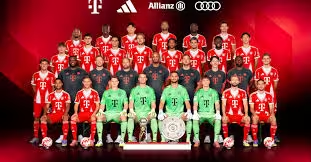
Technical Leadership & Coaching Profile
Manager: Vincent Kompany
Kompany enters his third season in charge having already delivered two Bundesliga titles and a DFB-Pokal. The Belgian’s playing career included a decade at Manchester City, where he captained the club through its most successful era, and his transition to management has been similarly assured.
His first season at Bayern delivered the league title; his second added the domestic double and a Champions League semi-final appearance. The style is now firmly embedded: possession-based football combined with aggressive pressing and rapid transitions, a high defensive line that compresses the opponent’s space, and a focus on creating optimal conditions for the attacking players to thrive.
The pressure this season is calibrated differently. Domestic dominance is now an expectation rather than an achievement, and the primary objective is European. Kompany’s contract situation has not been a distraction, with the club’s focus on squad continuity.
Tactical Philosophy
Kompany has established a 4-2-3-1 as Bayern’s base formation, a structure that maximises the output of the attacking trio while providing the defensive stability required to dominate possession.
The system is built on high pressing, positional rotation, and verticality. In possession, the two central midfielders — typically Joshua Kimmich and Aleksandar Pavlović — control the tempo while the full-backs push high to provide width. The attacking midfielders and wingers interchange positions, creating overloads and isolating defenders.
Defensively, Bayern’s high line is a defining feature. The centre-back partnership of Dayot Upamecano and Jonathan Tah is expected to defend large spaces, relying on recovery pace and tactical fouling to neutralise counter-attacks. The early-season statistics reflect the system’s effectiveness: 14 goals scored and 2 conceded in four matches, including a 7-0 demolition of Union Berlin.
The primary tactical question mark concerns the attacking midfield position. Jamal Musiala remains the first choice when fit, but his recent health issues have created opportunities for Ismael Saibari and Lennart Karl.
Preferred Formations
4-2-3-1 (primary) / 4-1-4-1 (when controlling games)
Strategic Transfer Activity
Bayern’s summer window was completed with characteristic decisiveness. Two arrivals, both at €50 million, addressed specific needs, and Eberl publicly declared the business finished before the window closed.
Nathaniel Brown arrived from Eintracht Frankfurt to strengthen the left-back position, though his versatility has already proven broader than anticipated — he was deployed as a No. 10 in the Supercup and impressed among Bayern’s star attackers. Ismael Saibari joined from PSV Eindhoven, a Morocco international capable of playing across all attacking positions, providing cover for Harry Kane and competition for Musiala.
The departures were equally significant. Leon Goretzka and Raphaël Guerreiro left on free transfers, while Nicolas Jackson returned to Chelsea following his loan. Alexander Nübel, long considered the heir to Manuel Neuer, joined Besiktas. Sacha Boey, João Palhinha, and Bryan Zaragoza were deemed surplus to requirements, with the club open to offers.
Table A: Summer Major Transfer Influx
| Player | Position | Former Club | Fee Paid |
|---|---|---|---|
| Nathaniel Brown | Left-Back/Attacking Midfielder | Eintracht Frankfurt | €50m |
| Ismael Saibari | Attacking Midfielder/Forward | PSV Eindhoven | €50m |
| Bara Sapoko Ndiaye | Midfielder | (loan made permanent) | Undisclosed |
The First-Team Roster
Goalkeepers
Manuel Neuer (#1): At 40, Neuer remains among the world’s elite goalkeepers, his shot-stopping and sweeper-keeper distribution still central to Bayern’s build-up play. His experience and authority within the dressing room are irreplaceable. The concession is his durability: 22 Bundesliga appearances last season due to niggling injuries, and a gradual transition is now inevitable.
Jonas Urbig (#40): The 23-year-old made 14 league appearances last season, impressing when called upon, and is expected to see increased minutes across three competitions. His development is the club’s long-term succession plan.
Sven Ulreich (#26): The veteran backup provides experience and professionalism within the goalkeeping group.
Defenders
Dayot Upamecano (#2): The French centre-back has formed a formidable partnership with Jonathan Tah, his recovery pace and physicality ideally suited to Kompany’s high defensive line. His concentration and positioning have improved significantly across his time at Bayern, and he is now one of the first names on the team sheet.
Jonathan Tah (#4): The summer arrival from Bayer Leverkusen delivered a superb debut season, his aerial dominance and composure complementing Upamecano’s profile. Despite possessing similar physical attributes, the two have developed an effective understanding.
Minjae Kim (#3): The South Korean international provides reliable backup in central defence, his physicality and tackling offering a different dimension when required.
Hiroki Ito (#21): The Japanese defender offers versatility across the back line and a left-footed option in central defence.
Josip Stanišić (#44): The Croatian was a regular fixture last season, making 43 appearances across all competitions. His versatility — capable of playing both full-back positions and centre-back — and physicality make him a valuable squad asset.
Konrad Laimer (#27): The Austrian international delivered a standout campaign at right-back, registering nine assists while maintaining his relentless defensive work. His energy and tactical intelligence are central to the pressing structure.
Nathaniel Brown (#25): The marquee defensive addition from Eintracht Frankfurt. Primarily a left-back, Brown’s versatility was demonstrated in the Supercup when he operated as a No. 10 and looked entirely comfortable among Bayern’s attacking stars. He also scored against Leipzig and Heidenheim in pre-season, underlining his attacking threat. He competes with Alphonso Davies at left-back.
Alphonso Davies (#19): The Canadian remains one of world football’s most explosive full-backs when fit, his recovery pace and dribbling ability offering a unique threat on the left. Injury issues have disrupted his last two seasons, and Eberl explicitly ruled out a summer departure. His return to peak form would be a significant boost.
Midfielders
Joshua Kimmich (#6): The Germany captain is the tactical brain of the team, responsible for implementing Kompany’s philosophy on the pitch. He is expected to inherit the armband when Neuer retires and remains one of the first names on the team sheet. His passing range and positional discipline provide the platform for Bayern’s control.
Aleksandar Pavlović (#45): The 22-year-old has established himself as Kimmich’s partner following Goretzka’s departure, starting all 14 of Bayern’s Champions League matches last season and becoming a regular for Germany. His composure and ball progression make him a modern midfield anchor.
Tom Bischof (#8): The 21-year-old impressed in his debut campaign, making 14 Bundesliga starts and showcasing his versatility — including at left-back. With Goretzka gone, there is a clear opportunity for him to establish himself as a more important squad member.
Leon Goretzka: Departed on a free transfer, ending a long association with the club.
Bara Sapoko Ndiaye (#39): The young midfielder signed permanently following his loan spell, representing the club’s increasing faith in the next generation.
Lennart Karl (#42): The young attacking midfielder trained with the squad after fitness issues and is viewed as one of the outstanding young talents at the club. He competes for minutes in the attacking midfield positions.
Forwards
Harry Kane (#9): The England captain delivered a remarkable 36-goal Bundesliga season, winning the European Golden Shoe for a second consecutive year. He has been the Bundesliga’s top scorer in each of his three seasons at the club and is firmly in Ballon d’Or contention. His finishing, link-up play, and leadership make him irreplaceable.
Michael Olise (#17): The French winger has become one of world football’s most productive attackers, his dribbling and vision central to Bayern’s attacking output. Real Madrid interest was dismissed by Eberl, and Olise chose to keep the No. 17 shirt rather than the No. 11 offered to him.
Luis Díaz (#14): The Colombian winger arrived last season and immediately formed a devastating partnership with Kane and Olise. His incisive tenacity and goalscoring threat from wide areas complete the finest attacking trio in club football.
Jamal Musiala (#10): The German international remains the first choice at No. 10 when fit, but his recent absence seizures have disrupted his pre-season and ruled him out of the Supercup. His return to peak form is a key variable for Bayern’s season.
Serge Gnabry (#7): The experienced winger offers a valuable outlet, contributing goals and assists while maximising the output of the front three. Another serious injury ruled him out of the run-in and the World Cup, and his return date remains unclear.
Ismael Saibari (#34): The Morocco international arrived from PSV to provide versatility across all attacking positions. He can cover for Kane up front, operate on either flank, or play centrally. Eberl described him as bringing “a different kind of football.”
Leadership Group & Squad Regulations
Club Captain: Manuel Neuer
The goalkeeper remains the squad’s captain, his authority and experience anchoring a dressing room that has undergone significant transition. His presence at 40 provides continuity through the club’s evolutionary phase.
The Leadership Committee
Joshua Kimmich is the captain-in-waiting, having skippered the side in Neuer’s absence last season. His tactical intelligence and standards-setting influence make him the natural successor. Thomas Müller’s departure from the leadership structure has elevated Kimmich’s role further, with Konrad Laimer and Dayot Upamecano serving as additional senior voices.
Homegrown Quota Check
Bayern’s squad contains a strong German core, with Neuer, Kimmich, Pavlović, Bischof, Musiala, Gnabry, and Lennart Karl all having developed within or been recruited to the German football system. The club’s academy continues to supply talent, with Bara Sapoko Ndiaye and several younger players training with the first-team squad.
Financial & Contractual Health
Financial Balance Overview
Bayern’s financial position remains the strongest in German football, underpinned by commercial revenues, matchday income, and consistent Champions League participation. The €100 million spent on Brown and Saibari represents a significant investment, but one comfortably within the club’s parameters. The wage structure has been trimmed through the departures of Goretzka and Guerreiro.
Contract Red Alerts
Manuel Neuer’s contract situation remains a season-by-season consideration at 40, with Jonas Urbig being gradually prepared for succession. Konrad Laimer is expected to sign an extension beyond 2027 in the near future. Max Eberl’s own future was clarified at the end of August, with his contract extension confirmed.
The Academy Pipeline & Loan Tracker
Breakout Talents to Watch
Tom Bischof is the most prominent academy graduate ready to take a significant step forward. With Goretzka gone, the 21-year-old has a clear pathway to increased minutes, and his versatility — including at left-back — gives Kompany additional options.
Lennart Karl is viewed as one of the outstanding young talents at the club, capable of competing for the No. 10 position alongside Musiala and Saibari. Bara Sapoko Ndiaye represents the next wave of academy talent integrated into the first-team squad.
Notable Out on Loan
Sacha Boey, João Palhinha, and Bryan Zaragoza were deemed surplus to requirements and the club was open to offers. Can Ünal, the Bayern Campus coach, departed to join Sandro Wagner’s coaching staff, with Maximilian Welzmüller promoted as his replacement.
Set-Piece Specialists & FPL Cheat Sheet
Penalties: Harry Kane (First Choice) / Michael Olise (Second Choice).
Direct Free-Kicks: Michael Olise / Joshua Kimmich / Leroy Sané.
Corners & Crosses: Joshua Kimmich / Michael Olise / Konrad Laimer.
Final Outlook: Domestic Dominance, European Obsession
Bayern’s 2026/27 campaign is defined by a simple calculus: anything less than a third consecutive Bundesliga title would be considered failure, and the Champions League represents the only meaningful addition to the trophy cabinet.
The squad is stronger than last season. The arrivals of Brown and Saibari add quality and flexibility, the departures of fringe players have streamlined the wage bill, and the core of Neuer, Kimmich, Upamecano, Tah, Kane, Olise, and Díaz remains intact. The early-season evidence is encouraging: 14 goals scored, 2 conceded, and a 7-0 demolition of Union Berlin demonstrating the attacking potency that produced 122 Bundesliga goals last season.
The variables are concentrated in three areas. Musiala’s health and return to form will determine whether Bayern can sustain the creative output required at the highest level. Davies’ fitness will define the left-back position, with Brown providing an outstanding alternative but lacking the Canadian’s explosive recovery pace. And the Champions League will test whether Kompany’s high defensive line can withstand the transition threat of Europe’s elite, a question that has lingered since last season’s semi-final exit.
The margin for error in the Bundesliga is minimal given Dortmund’s strong start, but Bayern’s squad depth and attacking quality suggest the title race will be decided by their own consistency rather than external challenge. The true measure of this season will arrive in the knockout stages of the Champions League, where Kompany’s project faces its definitive examination.