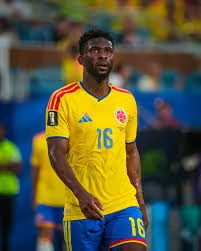
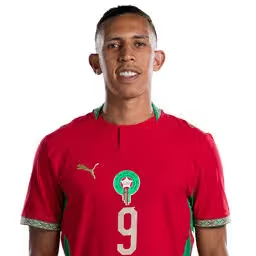
Following back-to-back La Liga titles under Hansi Flick and a summer of unprecedented financial freedom, Barcelona enters 2026/27 with the most ambitious squad rebuild of the Flick era, a Ballon d’Or-winning midfielder in Rodri, and the burning desire to end their Champions League drought. This is the definitive guide to the current Blaugrana squad.

Technical Leadership & Coaching Profile
Manager: Hansi Flick
Flick enters his third season at the helm having already cemented his legacy in Catalonia. The German has won two consecutive La Liga titles, becoming only the fourth Barcelona coach this century to claim back-to-back league crowns in his first two seasons, joining the company of Pep Guardiola, Luis Enrique, and Ernesto Valverde. His adaptation to Spanish football has been remarkably swift, blending his trademark Gegenpressing philosophy with Barcelona’s traditional possession-heavy identity. The challenge now is delivering the one trophy that has eluded the club since 2015: the Champions League.
Tactical Philosophy
Everything for Flick revolves around his team’s relentless high press, but this is not a press with failsafes. Barcelona respond to a broken press with another layer of pressing, employing an exceptionally high defensive line that allows defenders to step up and engage when the attacking and midfield lines are bypassed. The wingers — Lamine Yamal and Raphinha — are deployed as wide as possible, hugging the touchlines to isolate full-backs before cutting inside, leaving the full-backs to overlap and creating a structure that is ruthlessly effective at breaking down opponents but inherently vulnerable to counter-attacks. Flick’s willingness to play this way regardless of opposition is a defining characteristic, a full-throttle approach born of his Bundesliga roots.
Preferred Formations
4-2-3-1 in possession.
Strategic Transfer Activity
For the first time since 2022, Barcelona were able to operate freely during the transfer window after meeting La Liga’s financial fair play regulations. The result was eight permanent signings, double the amount of Flick’s first two years combined, with a net spend of approximately €82 million. The club made Atlético Madrid’s Julián Álvarez their priority target all summer, but Atleti’s total resistance forced a deadline-day pivot to Arsenal’s Gabriel Jesus.
Table A: Summer Major Transfer Influx
| Player | Position | Former Club | Fee Paid |
|---|---|---|---|
| Rodri | Central Midfielder | Manchester City | €70m + bonuses |
| Anthony Gordon | Left Winger | Newcastle United | €70m + €10m variables |
| Karim Adeyemi | Forward | Borussia Dortmund | €22m + variables |
| Gabriel Jesus | Striker | Arsenal | €10m + €4.5m add-ons |
| Jesse Bisiwu | Left Winger | Club Brugge | €8.5m |
| Dominik Livaković | Goalkeeper | Fenerbahçe | €2m |
| Hamza Abdelkarim | Striker | Al Ahly | €1.5m |
| João Cancelo | Full-Back | Al-Hilal | Free |
The First-Team Roster
Goalkeepers
Joan Garcia (#1): The Spanish international has claimed the coveted number one shirt following Marc-André ter Stegen’s departure, and his performances before a recent injury confirmed his status as Barcelona’s long-term goalkeeper. Garcia’s shot-stopping and command of his area provided a reassuring presence behind an aggressive defensive line.
Wojciech Szczęsny (#13): The veteran Polish goalkeeper provides experienced backup, sharing opportunities with Livaković in the early weeks of the season. His professionalism and composure offer reliable cover during Garcia’s absence.
Dominik Livaković (#25): The Croatian international arrived from Fenerbahçe for a modest €2 million, bringing World Cup experience and additional depth to the goalkeeping department. Flick has demonstrated his willingness to rotate between Szczęsny and Livaković, keeping both engaged.
Defenders
Jules Koundé (#23): The French international remains a cornerstone of Barcelona’s backline, though Flick has shown that even established figures are subject to rotation based on performance and workload. Koundé’s recovery pace is essential for a defensive line that operates as high as Flick demands.
Pau Cubarsí (#5): The teenage sensation continues to mature into one of Europe’s finest ball-playing center-backs. At just 19, Cubarsí’s composure and ability to defend in open space are tailor-made for Flick’s risky high-line system.
Andreas Christensen (#15): The Danish international provides experienced depth in central defense, his positional intelligence and aerial presence offering a reliable rotation option across a demanding multi-competition calendar.
Gerard Martín (#18): Flick retains huge trust in the 24-year-old as his starting left center-back, with the German viewing him as a dependable option capable of operating across the defensive line. His versatility and tactical discipline have earned him consistent minutes.
Eric Garcia (#24): The ultimate utility man, Garcia has been deployed at center-back, right-back, and defensive midfield, embodying the positional flexibility that Flick values. His intelligence and technical quality make him invaluable within a demanding system.
João Cancelo (#2): The Portuguese full-back finally secured a permanent move to Barcelona after two loan spells, terminating his contract with Al-Hilal to complete the transfer. At 32, he remains a quality option on both flanks, though Flick has demonstrated he must earn his place, with academy graduate Xavi Espart initially preferred before Cancelo responded with a two-goal performance against Racing Santander.
Alejandro Balde (#3): The explosive left-back remains Barcelona’s first-choice option on the left flank, his pace and attacking thrust providing essential width in Flick’s system. When fit, he is one of the most dangerous full-backs in La Liga.
Xavi Espart (#12): The young defender has been a revelation under Flick, demonstrating the versatility to operate on either side of defense. His emergence is a testament to Flick’s willingness to trust La Masia talent, and his performances have kept senior players honest.
Héctor Fort (#12): The academy graduate returned from a loan spell at Elche and provides additional depth across the backline, his development offering long-term security on the right side of defense.
Midfielders
Rodri (#16): The marquee signing of the summer and arguably the most transformative arrival of the Flick era. The 2024 Ballon d’Or winner arrived from Manchester City for €70 million plus bonuses, beating Real Madrid to his signature. Rodri won the Golden Ball at the 2026 World Cup, and his presence gives Barcelona a controlling midfielder of the highest caliber, a profile the squad has lacked since Sergio Busquets. If he stays fit, he can elevate this team to another level.
Pedri (#8): The midfield metronome remains central to everything Barcelona do, though Flick manages his minutes meticulously to preserve his availability across a long season. Pedri has started nearly every match but has not completed a single 90 minutes this season, a deliberate strategy to protect a player with a history of muscle injuries. His importance to the team is unquestioned; the substitutions are a calculation designed to keep him available for the business end of the campaign.
Frenkie de Jong (#21): The Dutch midfielder is currently sidelined with a meniscus injury expected to keep him out for several months, a significant blow to Barcelona’s midfield depth. When fit, his press-resistance and progressive passing remain valuable assets.
Gavi (#6): The energetic midfielder has found himself lower in Flick’s pecking order this season, playing just 29 minutes across his last four La Liga matches. His intensity and competitive edge remain assets, but he faces fierce competition for minutes in a crowded midfield.
Dani Olmo (#20): The Spanish playmaker alternates with Fermín López in the attacking midfield role, with Flick employing a clear rotation pattern between the two. Olmo’s creativity and goal threat from advanced positions make him a valuable weapon, particularly when paired with Karim Adeyemi on the left.
Fermín López (#7): The academy graduate has inherited the number seven shirt and established himself as a key rotational piece, alternating with Olmo based on tactical requirements. Flick has paired Fermín with Anthony Gordon on the left, creating a partnership that combines energy, pressing, and goal threat.
Marc Bernal (#22): The young defensive midfielder continues his development within the first-team squad, gaining exposure to Flick’s demanding tactical framework. His physical profile and positional intelligence suggest a bright future.
Marc Casadó (#17): The academy graduate provides additional midfield depth, though his minutes have been limited within a competitive rotation.
Brian Fariñas (#4): The young midfielder has been promoted to the first-team squad, earning a permanent number as he integrates into Flick’s system.
Forwards
Lamine Yamal (#10): The crown jewel of Barcelona’s attack and one of the few players exempt from Flick’s rotation policy, having featured in every match this season. Now wearing the iconic number ten, Yamal absorbs the majority of Barcelona’s progressive responsibilities, receiving the ball glued to the touchline before cutting inside to devastating effect. At 19, he is already the team’s primary attacking focal point.
Raphinha (#11): The Brazilian has emerged as one of the most important players in Flick’s system, with his move into a central attacking position becoming a defining feature of Barcelona’s season. Initially a response to the lack of a traditional striker, Raphinha’s deployment through the middle has worked perfectly, allowing him to contribute goals, pressing, and defensive work while making back-post runs to support the attack. Alongside Yamal, he is one of only two players to have featured in all eight matches.
Anthony Gordon (#17): Barcelona’s first and most expensive signing of the summer, arriving from Newcastle for €70 million plus €10 million in variables. The England international has hit the ground running, providing two assists within four minutes of his competitive debut against Elche. Gordon brings speed, direct running, and aggression — attributes perfectly suited to Flick’s style.
Karim Adeyemi (#14): The German winger arrived from Borussia Dortmund for €22 million plus variables, reuniting with Flick from their time together at Bayern Munich. Adeyemi offers raw pace and versatility across the front line, scoring on his first official start. Flick specifically requested his signing, viewing him as a player capable of stretching defenses.
Gabriel Jesus (#9): The deadline-day arrival from Arsenal provides the recognised number nine that Barcelona had been chasing all summer. The Brazilian took a significant pay cut to join, and Flick quickly approved the move upon learning of his availability, valuing his pressing, work rate, and winning experience. His injury record is a concern, but at €10 million plus add-ons, he represents a low-risk solution to Barcelona’s striker shortage.
Roony Bardghji (#19): The Swedish winger provides depth in wide areas, though he is currently sidelined with a cruciate ligament injury expected to keep him out for an extended period.
Jesse Bisiwu (#27): The 18-year-old Belgian winger arrived from Club Brugge for €8.5 million and has been integrated into the first-team squad. His pace, power, and one-v-one ability mark him as a signing for the future, though he has shown glimpses of his potential with two goals in pre-season.
Hamza Abdelkarim (#29): The Egyptian striker finished pre-season as Flick’s top scorer with four goals after joining permanently from Al Ahly for €1.5 million. At 18, he represents a long-term investment, but his performances have already earned him a competitive debut and a place in the first-team squad.
Leadership Group & Squad Regulations
Club Captain: Marc-André ter Stegen
The German goalkeeper remains the club captain, though he has departed on loan to Ajax as part of the summer’s restructuring. His leadership and experience are absent from the dressing room, leaving a void that Flick must fill through collective responsibility.
The Leadership Committee
Ronald Araújo’s loan departure to Liverpool removed another senior figure from the leadership structure. Rodri’s arrival brings Ballon d’Or-winning pedigree and natural authority, while Pedri and Frenkie de Jong serve as the bridge between the coaching staff and the emerging core.
Homegrown Quota Check
Barcelona’s squad is built on La Masia foundations, with Lamine Yamal, Pau Cubarsí, Gavi, Pedri, Fermín López, Marc Bernal, Alejandro Balde, and Gerard Martín all products of the academy. The departures of Ansu Fati and Marc Casadó reduced the homegrown contingent, but the pipeline remains robust, with Xavi Espart and Brian Fariñas earning first-team promotions.
Financial & Contractual Health
Financial Balance Overview
Barcelona’s summer spending exceeded €190 million on seven players, offset by approximately €108 million raised through departures. Ferran Torres’ €48.5 million sale to Paris Saint-Germain represented the largest outgoing, while Ansu Fati (€11m), Tommy Marques (€11m), and Héctor Fort (€8.5m) also generated significant funds. The net spend of €82 million reflects a club that has finally escaped the financial shackles that constrained it for years, operating within La Liga’s financial fair play regulations for the first time since 2022.
Contract Red Alerts
The long-term striker situation remains unresolved despite Gabriel Jesus’ arrival. There is an expectation that Barcelona will remain in the market for a new centre-forward, with Julián Álvarez still viewed as the ideal long-term solution. Managing Rodri’s fitness and ensuring Pedri’s availability across the season are equally critical priorities.
The Academy Pipeline & Loan Tracker
Breakout Talents to Watch
Xavi Espart (#12) has been the revelation of Flick’s third season, demonstrating the versatility to operate on either side of defense and briefly displacing João Cancelo from the starting lineup. His emergence embodies Flick’s willingness to reward performance over reputation. Hamza Abdelkarim (#29) finished pre-season as the squad’s top scorer and has already made his competitive debut at 18.
Notable Out on Loan
Ronald Araújo joined Liverpool on loan with an option to buy, ending his long association with the club. Marc-André ter Stegen departed for Ajax on loan, while Ansu Fati completed a permanent move away as Barcelona reshaped their attacking options.
Set-Piece Specialists & FPL Cheat Sheet
Penalties: Raphinha (First Choice) / Lamine Yamal (Second Choice).
Direct Free-Kicks: Lamine Yamal / Raphinha.
Corners & Crosses: Raphinha / Lamine Yamal.
Final Outlook: Navigating the Tactical Horizon
Barcelona enters 2026/27 as the team to beat in Spain, chasing a third consecutive La Liga title and a genuine Champions League challenge. Flick’s side has started the season in remarkable form, winning all eight of their opening La Liga and Champions League matches, with the German’s squad management creating an environment where no player’s place is guaranteed.
The evolution of Flick’s approach this season has been subtle but significant. While his high-press philosophy remains intact, he has introduced greater rotation, increased competition for places, and positional flexibility as key principles. Only Raphinha and Lamine Yamal have featured in every match, with Flick making between three and five changes per game on average. The result is a squad that feels fresh, engaged, and adaptable.
The signing of Rodri transforms Barcelona’s midfield from excellent to potentially the best in world football. His control, defensive understanding, and big-game experience provide the platform for Flick’s aggressive system to function at its highest level. The arrivals of Gordon and Adeyemi add pace, directness, and unpredictability to an attack that already boasted Yamal and Raphinha.
The challenge remains the striker position. Gabriel Jesus is a short-term solution, and there is an expectation that Barcelona will pursue a long-term heir to the number nine role. But the fluid attacking structure Flick has implemented — with Raphinha through the middle and Gordon or Adeyemi stretching defenses — has already proven effective, making Barcelona a more unpredictable team.
The defensive depth is a lingering concern, with Flick forced to rely on Gerard Martín and Eric Garcia in central roles while Araújo’s departure and Laporte’s unavailability left the position unaddressed. But if Cubarsí continues his development and the rotation keeps players fresh, Barcelona possess the talent and tactical clarity to compete on all fronts.
The Champions League remains the ultimate objective. Flick has conquered Spain twice; now he must prove he can conquer Europe with a Barcelona side that has finally been rebuilt in his image. The early signs are encouraging. The belief is growing. And with Rodri controlling the midfield and Lamine Yamal leading the attack, Barcelona enters this campaign with every tool required to end their continental drought.