Following a summer defined by continuity rather than revolution, Augsburg enters 2026/27 with Manuel Baum restored to permanent head coach, a squad strengthened by strategic loan additions, and a club determined to consolidate the remarkable second-half surge that delivered a ninth-place finish — their best Bundesliga placement in over a decade.
Technical Leadership & Coaching Profile
Manager: Manuel Baum
Baum was confirmed as Augsburg’s permanent head coach in late April, signing a contract through 2028 after an interim spell that transformed the club’s season. Appointed initially on a temporary basis following Sandro Wagner’s dismissal in December, Baum guided Augsburg from 14th place — just three points above the relegation zone — to a top-half finish, collecting 28 points from 17 matches. His decision to remain in the role was not finalised until after the season concluded; Baum ultimately concluded that returning to his administrative position and appointing another head coach would have threatened the continuity his tenure had established.
Tactical Philosophy
Baum’s approach is defined by pragmatism and defensive discipline. Out of possession, Augsburg operate in a disciplined low-to-mid block, compressing space centrally and forcing opponents into peripheral areas. In possession, Baum favours a direct system that maximises the physical profile of his forward line, with Michael Gregoritsch serving as the ideal target man. The coach has emphasised that he adapts the football to suit his players rather than forcing them into a preconceived tactical plan. Fabian Rieder will remain in central midfield after telling Baum his performances there represented the best football of his career.
Preferred Formations
3-4-2-1 / 5-4-1 out of possession.
Strategic Transfer Activity
Augsburg’s summer window was characterised by measured investment and late-window opportunism. The club committed little initially while securing potential permanent pathways for two 20-year-olds on deadline day — Juma Bah from Manchester City with a €21.5 million purchase option and Arijon Ibrahimovic from Bayern Munich for a €500,000 loan fee with an €8 million buy option. The permanent signing of Michael Gregoritsch, the club’s top scorer during the second half of last season, provided continuity in attack.
Table A: Summer Major Transfer Influx
| Player | Position | Former Club | Fee Paid |
|---|---|---|---|
| Young-Woo Seol | Wing-Back | Red Star Belgrade | €3.75M + bonuses |
| Hennes Behrens | Wing-Back | Hoffenheim | Undisclosed |
| Rodrigo Ribeiro | Striker | Sporting CP | €5.00M |
| Michael Gregoritsch | Striker | — | Free Agent |
| Juma Bah | Center-Back | Manchester City | Loan (€21.5M option) |
| Arijon Ibrahimovic | Attacker | Bayern Munich | Loan (€8M option) |
The First-Team Roster
Goalkeepers
Finn Dahmen (#1): The German goalkeeper remains Augsburg’s undisputed number one, his shot-stopping and command of the penalty area integral to the defensive solidity that defined Baum’s tenure. His distribution under pressure suits the direct approach Baum favours.
Tobias Jäger (#22): The academy graduate provides reliable backup coverage, his professionalism and familiarity with the club’s demands making him a trusted squad member.
Noah George (#32): The young goalkeeper offers additional depth and represents the club’s commitment to internal development.
Defenders
Jeffrey Gouweleeuw (#6): The Dutch captain remains Augsburg’s defensive anchor, his leadership and positioning central to the back three. His experience provides stability within a youthful defensive group.
Chrislain Matsima (#5): The French centre-back has established himself as a first-team regular, his physicality and aerial dominance providing the defensive steel Baum’s structure requires. His return to fitness was identified as a key boost for the season ahead.
Noahkai Banks (#40): The German-American academy graduate has emerged as one of Augsburg’s most promising homegrown talents, his composure and ball-playing ability offering a modern defensive profile. His development under Baum’s guidance will be closely monitored.
Calvin Brackelmann: The summer arrival became a candidate for increased minutes following Schlotterbeck’s departure, his physical profile offering depth in central defence.
Juma Bah (#—): The deadline-day loan arrival from Manchester City brings senior experience from La Liga and Ligue 1, his physical profile providing a potential long-term replacement for Schlotterbeck.
Young-Woo Seol (#—): The South Korean international signed through 2030, his flexibility on both flanks providing Baum with considerably more tactical options at wing-back.
Hennes Behrens: The 21-year-old joined from Hoffenheim and appears set to assume a major role on Baum’s left flank following Giannoulis’ departure.
Robin Fellhauer (#19): The utility player provides versatility across the back line and midfield, his professionalism making him a reliable option.
Midfielders
Fabian Rieder: The Swiss international has found his optimal position in central midfield, his technical quality and tactical intelligence central to Baum’s structure. His performances in the role convinced the coaching staff he should remain there permanently.
Elvis Rexhbeçaj (#8): The Kosovan international offers box-to-box energy and physical presence, his work rate making him a trusted option in Baum’s midfield.
Kristijan Jakić (#17): The Croatian midfielder provides defensive coverage and tactical discipline, his reliability making him a valuable squad option.
Tim Breithaupt (#18): The young German midfielder offers additional depth, though he was unavailable for the season opener through injury.
Mert Kömür (#36): The academy graduate has established himself as a first-team regular, his technical quality and creativity offering an attacking dimension from midfield. He was identified by Baum as one of the club’s most promising homegrown players.
Mahmut Kücüksahin (#42): The young midfielder represents the club’s commitment to internal development, his progression being closely monitored.
Tim Schnitzer: The 18-year-old academy prospect hopes to follow Banks and Kömür in establishing himself as a Bundesliga professional. Primarily a defensive midfielder, he can also operate at centre-back or as a No. 8.
Forwards
Michael Gregoritsch (#—): The Austrian returned permanently after a loan spell in which he scored six goals and provided three assists in 17 league appearances. His physical presence and work rate as the leader of Augsburg’s press make him the ideal target man in Baum’s direct system.
Anton Kade (#—): The 22-year-old summer 2025 signing was a revelation last term, registering six goals and an assist in 28 league outings. His raw pace and eye for goal make him one of Augsburg’s most important attacking players.
Alexis Claude-Maurice: The French forward remains a key figure, though his future was subject to transfer speculation over the summer. His creativity and versatility offer Baum valuable attacking options.
Rodrigo Ribeiro: The Portuguese striker joined permanently after a loan spell, his technical quality and movement offering a different profile to Gregoritsch. Baum has confirmed the two forwards can play together.
Arijon Ibrahimovic (#—): The deadline-day loan arrival from Bayern Munich adds another flexible attacking piece, his creativity and technical quality offering a different dimension in the final third.
Uchenna Ogundu: The young forward continues his development within the first-team squad, his progression representing part of Augsburg’s long-term attacking planning.
Leadership Group & Squad Regulations
Club Captain: Jeffrey Gouweleeuw
The Dutch defender remains the unequivocal leader of the squad, his experience and standards-setting influence anchoring a dressing room that has endured significant managerial turnover. His presence provides continuity during a season of consolidation.
The Leadership Committee
Keven Schlotterbeck served as alternate captain before his departure to Southampton, leaving a leadership void that Baum will need to address. Fabian Rieder and Elvis Rexhbeçaj are among the senior voices expected to assume greater responsibility.
Homegrown Quota Check
With Noahkai Banks, Mert Kömür, Tim Schnitzer, and several other academy graduates in the first-team squad, Augsburg maintains a strong connection to their youth pipeline. Baum recently identified Schnitzer alongside Banks and Kömür as the club’s most promising homegrown players, stressing that the club can only provide young footballers with an appropriate developmental framework.
Financial & Contractual Health
Financial Balance Overview
Augsburg’s transfer activity was characterised by fiscal prudence, with the club committing little initially while securing potential permanent pathways worth a combined €29.5 million for two 20-year-olds. The loan structure of the Bah and Ibrahimovic deals allows the club to assess both players before committing significant funds.
Contract Red Alerts
Baum’s contract through 2028 provides stability in the dugout. Securing the futures of key young assets like Anton Kade and Mert Kömür remains a priority, with Kade’s progression having become significant enough for Baum to mention him as a possible Germany international.
The Academy Pipeline & Loan Tracker
Breakout Talents to Watch
Tim Schnitzer has been identified as the next academy prospect hoping to follow Noahkai Banks and Mert Kömür into the first team. The 18-year-old made his senior debut last March and hopes that experience serves as the beginning of a considerably larger role under Baum. His versatility — he can operate as a defensive midfielder, centre-back, or No. 8 — could provide a route into the starting XI.
Notable Out on Loan
Augsburg’s loan departures include Marcel Łubik to Wisła Krakau, Aiman Dardari to Rot-Weiss Essen, and Kyliane Dong to Bolton Wanderers, all designed to provide regular minutes for emerging talents.
Set-Piece Specialists & FPL Cheat Sheet
Penalties: Michael Gregoritsch (First Choice) / Anton Kade (Second Choice).
Direct Free-Kicks: Fabian Rieder / Elvis Rexhbeçaj.
Corners & Crosses: Fabian Rieder / Hennes Behrens.
Final Outlook: Consolidation or Regression?
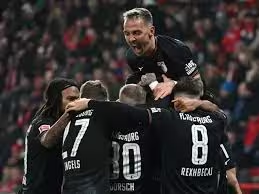
Augsburg enters 2026/27 in a state of cautious ambition. The club’s remarkable second-half surge under Baum — collecting more points than every team except the top four — demonstrated that the squad possesses genuine quality when properly organised. The early-season evidence has been striking: a 3-0 opening day victory over Schalke and an explosive 4-1 away win at Eintracht Frankfurt propelled Augsburg to the top of the Bundesliga table for the first time in the club’s history.
The challenge ahead is sustaining that trajectory. Sceptics have argued that the ninth-place finish was an outlier and that the summer’s transfers were “predominantly prospective” rather than substantially strengthening the team. The departures of Schlotterbeck, Giannoulis, and Zesiger from the defensive department have left Baum reliant on younger, less proven options.
The deadline-day arrivals of Bah and Ibrahimovic addressed the most glaring gaps, securing potential permanent pathways for two highly-rated young players while committing minimal immediate funds. Gregoritsch’s permanent signing provides a focal point in attack, and Kade’s continued development offers genuine attacking quality.
If Baum can maintain the defensive discipline and collective spirit that defined his interim tenure, Augsburg possesses the foundation to achieve another top-half finish. The academy pipeline, with Schnitzer, Banks, and Kömür leading a promising generation, provides genuine cause for optimism. But the margin between consolidation and regression is narrow, and a squad lacking in established depth could struggle if injuries bite or if the new arrivals fail to adapt. For a club that has spent 16 consecutive seasons in the Bundesliga, stability is the minimum expectation — and Baum appears well-equipped to deliver it.